- The three plays that undid WSU in San Diego
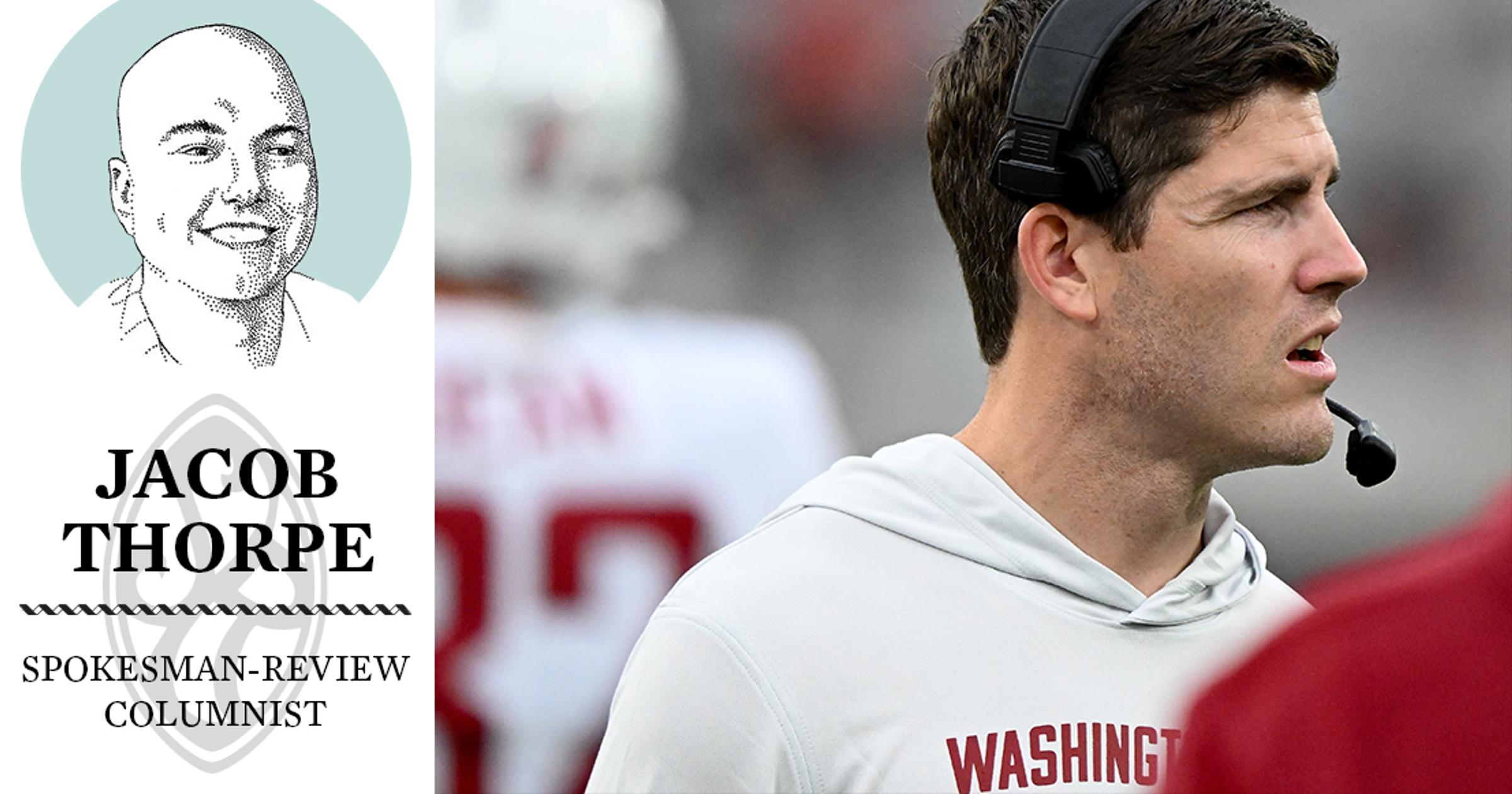
SAN DIEGO – One day this winter, when this Washington State football season has come to a merciful end and coach Kirby Moore reflects on his first season with the program, he might sit in his office and ponder how it all went so disastrously wrong. And he might think about how at times, his Cougars were close to getting things right.
That was the case in WSU’s final game before the bye week, a 26-20 road loss to San Diego State on Saturday evening. In a game coming down to the final drive, Moore might wish he could have a few things back: the timeout he called on the Cougars’ final drive, the one he called before the Aztecs’ last touchdown, the decision to send out kicker Jack Stevens for a 53-yard field goal in spitting rain that fell hopelessly short.
When Moore contemplates it all, the reasons why the Cougars have spent the entire season to this point without an FBS win, he might wish for a do-over in several spots.
“We gotta learn how to finish – plays, drives, games,” Moore said after Saturday’s game.
The Cougars, 1-8 overall and 0-5 in Pac-12 play, did well to put themselves in a position to take the lead on their final drive of this game, a reality that reflects well on quarterback Owen Eshelman, who completed 30 of 42 passes for 299 yards and one interception that didn’t come back to bite him. The visitors’ defense also forced one turnover and forced a quick three-and-out to pave the way for that opportunity.
The Cougars reached midfield before a sack, a 5-yard penalty and two incompletions ended their hopes.
The majority of the rest of this loss, however, falls at the feet of Moore and his coaching staff. The list of costly decisions includes calling a timeout before SDSU’s final touchdown, which he said was at the recommendation of defensive coordinator Trent Bray, who didn’t like the look he saw. He called his team’s final timeout on its final drive, after a false-start penalty, to avoid a 10-second runoff. Earlier in the game, after Eshelman took a 10-yard sack, he sent out Stevens for a 53-yard field goal that never really stood any chance, thanks to the rain and wind.
Then, toward the end of the first half, WSU got the ball back with two timeouts and 50 seconds to go. The Cougars didn’t show much aggression at all, choosing to run the ball and kill the rest of the clock. Conditions weren’t exactly in their favor – Eshelman had just thrown his interception, and the rain made taking a shot risky business – but Moore and coaches have shown the same kind of dull approach in several other spots earlier in the season.
Besides, what does a 1-7 team have to lose? Too often, Moore has made conservative decisions instead of aggressively going for a win.
And on the timeout Moore called before SDSU’s trick-play touchdown: On fourth-and-goal from the 2, the Aztecs only needed a field goal to go up two scores. By going for it, they ran the risk of getting stopped short, leaving the door open for the Cougars to take the lead. They came out ready to go for it, which is when Moore called a timeout. What if SDSU had used that opportunity to think better of it and kick an easy field goal? That’s not what happened, of course, but that timeout gave SDSU a chance to make a better decision.
Here’s what Moore said about having zero timeouts for the final 74 seconds of the Cougars’ final drive, which ended on a turnover on downs when an Eshelman pass fell incomplete: “I think you’re still trying to just gain chunks. There’s pass opportunities there. Obviously, we gotta learn from, if no one’s open, we gotta be comfortable throwing the ball out of bounds and not taking a sack, and that’s one we definitely gotta learn from the next two-minute drive.”
Moore and his coaching staff bear even more of the brunt than that. The Cougs went 0-for-3 on fourth down in this one. Remember in the third quarter, when WSU decided to go for it on fourth-and-4 from the SDSU 30? Eshelman dropped back and couldn’t complete a pass to running back Kirby Vorhees. Give Moore credit for deciding to go for it in that spot, but that’s not the problem with that play.
Eshelman had to look for Vorhees in the flat because he got pressure pretty quickly, which happened because San Diego State utilized the same approach that Boise State did last week: a simple stunt. An interior Aztec lineman went inside and an edge rusher looped around to surge untouched into the backfield, hurrying Eshelman.
For WSU’s offensive line and coach Jack Abercrombie, it’s one thing to get beaten by that against Boise State, the class of the conference. It’s another to fall victim to the same approach a week later – to an SDSU defense that ranks among the nation’s worst.
Think about the defense WSU was facing in this one. Headed into Saturday’s game, San Diego State ranked No. 135 of 138 FBS teams in total defense (462 yards per game), No. 133 in scoring defense (36 ppg), No. 109 in rush defense (178 ypg) and No. 134 in pass defense (284 ypg). The Aztecs’ defense has given up 41 points to Toledo, 29 to Texas State, 66 to Oregon State and 56 to Colorado State.
So what prevented the Cougars from enjoying the same kind of success?
“The situational football piece,” Moore said. “We didn’t do a good enough job there in the red zone. We didn’t do a good enough job there on fourth down. Everyone’s got a piece of that, and obviously that starts with me.”
To their credit, the Cougs sustained several long drives on offense in this game, including series of 4:28, 4:59, 6:15, 6:25 and 4:05. They converted 9 of 14 third downs, a remarkable feat for a group that entered Saturday’s game ranked five spots up from dead last in the country in that department.
But this season, this group hasn’t been able to make the winning plays when they count most. These Cougars have been subject to the same kinds of problems all season long, like the fact that in Saturday’s game, their running backs combined for 34 yards on 14 carries. The same problems have vexed them all season, and while their offensive line should get some of that blame, the rest should go to their coaching staff, which has not been able to put their team in the best positions to succeed.
In fairness, Moore is a first-time head coach, and most people watching games on TV – or in person – are never privy to the hectic nature of games in which coaches make these decisions. It isn’t easy. But Moore is paid to learn these lessons, and in Week 9, it doesn’t appear that is happening.
- Eshelman looks sharp but Cougs still chasing the Pac-12 pack
Perhaps there was a time when Washington State’s season could have been salvaged, but it wasn’t Saturday against No. 21 Boise State.
It wasn’t last week against a surging Oregon State team that is averaging 51 points during its current five-game winning streak.
But in those two games – the first two starts for Owen Eshelman after coach Kirby Moore made a switch at quarterback – the Cougars showed some … spirit? Vitality, maybe?
It would strain credulity to say the offense played well in Saturday’s 31-10 loss to the Broncos. Scoring points, after all, is the only goal for an offense that really matters.
Yet in a 1-7 season that has long gone stale, the Cougars at least threatened success with Eshelman at the helm, even if they couldn’t quite get there.
Consider, Boise State entered the game ranked No. 1 nationally in time of possession, bludgeoning opponents with long, methodical drives. WSU, however, actually managed to hold the ball for a minute longer than the disciplined Broncos.
How did they do it? Because Eshelman showed some capacity for playmaking, both with his arm and his feet. Within that 10-point offensive output were third-and-long passes thrown moments before a defender took his head off with a well-timed safety blitz. We also saw a 10-yard scramble on third-and-nine, and WSU’s offense converted four of five fourth-down attempts.
Was it perfect? No. It was chaotic. Eshelman threw no touchdowns, one interception, and somehow gave back 37 yards on four sacks. Yeesh. But the chaos created the possibility of big plays.
Ultimately, the Broncos were too good, and WSU once again failed to take advantage of a superb performance by the defense. The game was tied at 10 entering the fourth quarter. Then Eshelman threw a costly interception following a Broncos touchdown drive, and Boise State needed just two plays to get back into the end zone.
And that was it. The Cougars weren’t coming back from two scores down because their issues on offense run far deeper than quarterback, even if Eshelman provides a breath of fresh air.
The longer a person watches football, the more they come to understand that highlight catches and long runs are little more than window dressing. A football game is won and lost on the line of scrimmage, and a viewer can get a pretty good sense of which team is winning by watching the linemen–and no one else.
Well, the WSU offensive linemen are getting their butts whooped – to the degree that I’m not sure it matters how good the quarterback, running backs, or wide receivers may be. Despite Eshelman’s patience in the pocket and ability to look downfield at second and third reads, he completed only 21 of 40 pass attempts while under constant duress.
Despite having a mobile quarterback who ran the ball 19 times, no Cougar had a run longer than Eshelman’s 10-yard third-down scamper. Leo Pulalasi, whose speed was evidenced by a 54-yard run against Utah State earlier this season, managed just 12 yards on five rushes.
Kirby Vorhees got five attempts as well, netting eight yards for his troubles.
With four games left, WSU is in a precarious position. Most fans are staying home these days, and with no chance of qualifying for a bowl game, the Cougars will need to win them back by showing improvement and momentum heading into next season.
Eshelman’s first two starts came against the Pac-12’s best. Maybe he can do more against the rest.
Moore began his postgame press conference by telling reporters, “Nobody’s quitting. We’re pissed off and disappointed. We need to play better. We can be a better football team.”
- Moore's offense showed some pulse, but the Cougs still left plays on the field
PULLMAN – The beginning of this Washington State season, the gauntlet the Cougars would see to open the Kirby Moore era, was always going to be difficult to parse. They faced three Power 4 teams in their first four games. Two were on the road. One came on a short week.
The Cougars were expected to come away from that stretch with one win and three losses. Thanks to a 34-24 setback to Arizona here on Saturday evening, WSU has fulfilled that much, which is not an indictment on these Cougars. But it does bring up the question that may define the rest of this season.
How many of the problems WSU’s offense is facing are a product of the stiff competition, and how many are the product of self-inflicted wounds that the Cougars would commit against the Pac-12 foes coming up?
We won’t know that much until conference play arrives when WSU hosts Fresno State next weekend, but the early returns on the Cougars’ offense are far from encouraging. Think about this stat, which is now official after Saturday’s game: In three games against FBS competition, WSU has produced three offensive touchdowns and committed six turnovers. The Cougars have lost seven total.
Moore’s team was expected to lose the games it has. It’s the way the Cougs’ offense is costing the team, though, that raises cause for concern.
“We gotta make sure we have a plan that everyone’s on the same page,” Moore said, “going from the half to the third quarter, especially in a tight game like that where our defense is battling, and we gotta find more ways to create explosive plays. We had them in the first quarter, in the first half, and had opportunities there to score even more. And then in the second half, we didn’t. So we gotta look at the film and see where we went wrong.”
In this one, WSU quarterback Caden Pinnick completed 24 of 41 passes for 241 yards, one touchdown and one interception, which came in the first quarter. If an Arizona defender hadn’t bobbled the ball later in the first half, Pinnick would have thrown two. Those were two costly decisions. Consider the other turnover Pinnick lost, a fumble that happened because he tried to throw the ball while being dragged down, and you start to see some of the poor decision-making that has led to Pinnick’s total turnover number this fall: four.
The reason that trend looms large for WSU: Pinnick is committing turnovers because of listless decisions, not because Power 4 athletes are making spectacular plays. Remember his interception last week against FCS Duquesne, when he threw into what became triple coverage downfield? Those are the kinds of poor decisions that have created such a gaping hole in the Cougars’ offense.
It would be one thing if Pinnick was playing a solid brand of football and a freak Power 4 defender, the kind that Arizona and Kansas State can afford, used his strength to jar the ball loose. That would be forgivable. But that’s not what’s happening. It may be Pinnick’s first season of FBS ball, but he has been too slow to differentiate a good decision from a bad one, especially when he’s looking to stretch the field vertically.
That raises a fair question: How can WSU coaches help Pinnick avoid those kinds of turnovers? How can they help Pinnick make better decisions, like in the third quarter, when he slid and gave himself up one yard short of a first down?
“We’re all in this together,” Moore said. “So it starts with me, obviously the offensive staff. Just having that dialogue with him, whether it’s in practice on the headset, reminders, making sure he knows exactly the stipulations, or even there on the third down. We ran the quarterback, he slides. That’s an unfortunate one. It’s a QB-designed run, and so we got to make sure he’s on the same page with that.”
The other problem the Cougars are facing is consistency. Their first drive in Saturday’s game, an 11-play, 71-yard scoring series, was nearly flawless. It ended when Pinnick took a QB keeper 11 yards into the end zone, following a string of perfect blocks, capping a perfect series. If that’s the way the Cougs were going to play in this one, well, the Wildcats should have been on their heels.
But WSU’s offense hardly looked the same after that. In the third quarter, the Cougs put up these numbers: 3 points, 149 total yards, 44 rushing yards, two three-and-outs, four punts and three sacks taken, giving Pinnick 10 sacks taken on the season. That opened the door for Arizona to turn a three-point deficit into a four-point lead, adding two more scoring drives in the fourth frame.
The Cougs can rebound from this. They showed what their offense can look like on that first series, and by showing an increased willingness to take shorter throws, Pinnick looks more than capable of making adjustments. But the biggest one he’ll have to make to avoid meeting the same fate against Pac-12 teams is more about trimming things out of his game.
He’ll have to make better decisions, better calls on when to try to stretch the ball down the field and when to be OK with checking it down. Fresno State’s defense figures to give him more opportunities to show that kind of acumen. But it’s on Pinnick, Moore and offensive coordinator Matt Miller to put themselves in a position where those changes don’t become just possible, they become probable.
“Give Arizona credit; they have a unique scheme,” Moore said. “So there was different variations of zone, whether it was inside, outside. Obviously, the quarterback pin-pull there we scored on in the first quarter. So there were some ID things there. Give them a ton of credit with how fast and hard those guys played. But we gotta have an answer as well with protecting the quarterback and having some more opportunities in the pass game.”