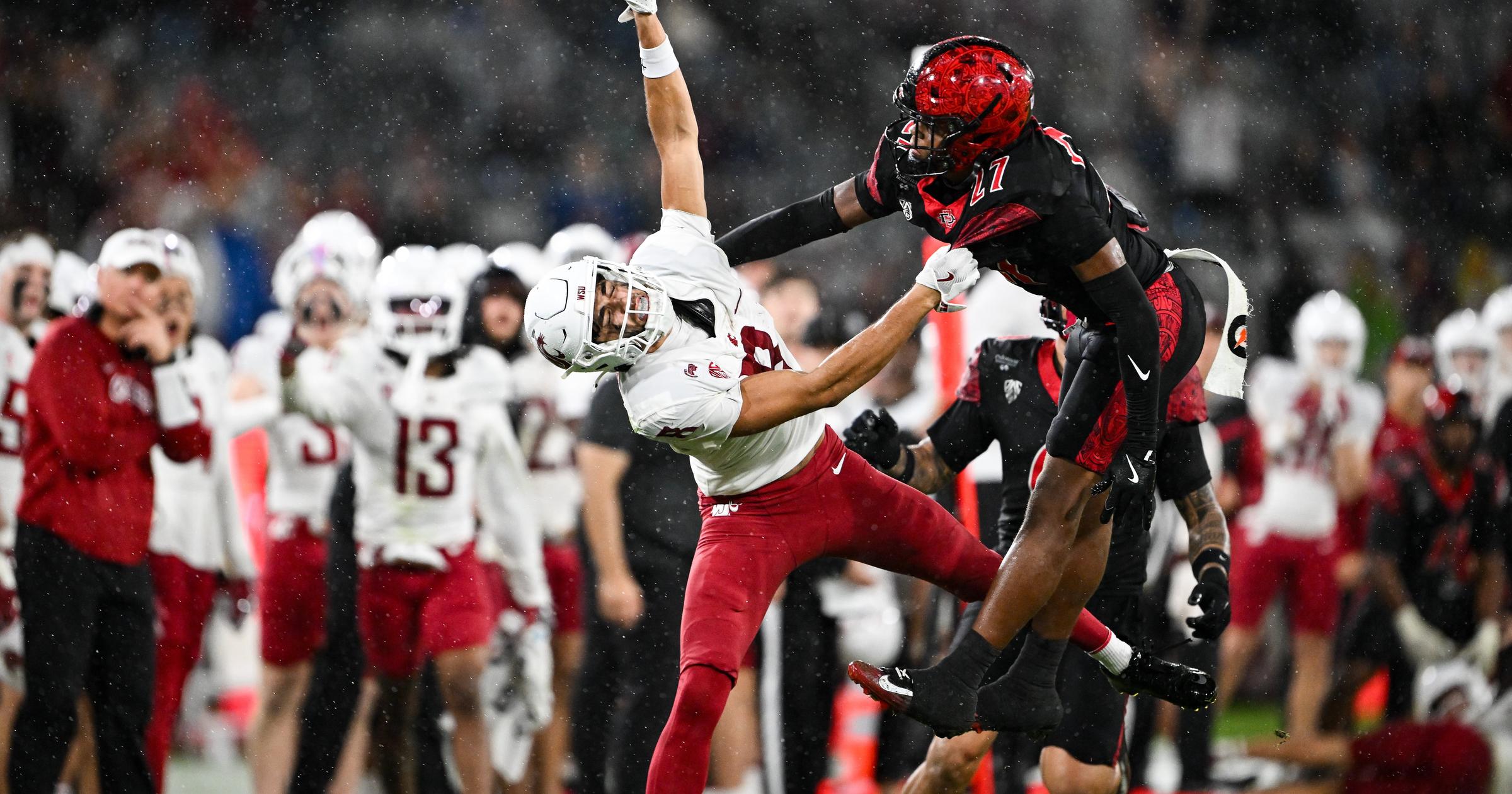
- Moore's sideline bench talks get real after WSU's bowl hopes vanish
PULLMAN – Only seconds after Owen Eshelman threw a back-breaking interception, the exact kind of turnover that Washington State needed to avoid to upset No. 21 Boise State on Saturday night, his head coach sat him down on a nearby bench.
On the sideline, Eshelman talked with coach Kirby Moore, going over the play and what went wrong. Eshelman was looking for running back Kirby Vorhees, who ran to the right. Eshelman threw it left. It turned into a turnover, which sank WSU’s chances in this 31-10 loss to Boise State, the class of the rebuilt Pac-12.
Turns out, that was a play that the Cougars had installed early in the year, sometime in spring ball or fall camp. After the game, it seemed to frustrate Moore, who has placed his trust in a redshirt freshman making only his second career start.
“We weren’t on the same page there,” Moore said. “Obviously, it starts with me, and we gotta do a better job from that standpoint.”
The Cougars only have five more opportunities to do a better job, and at 1-7, their bowl hopes are gone. It’s their first time being eliminated from bowl eligibility before November since 2010. They have nothing left to play for except pride and for the 14 seniors who are playing their final year of college football.
Moore has missed chances to avoid letting things get to this point, and many of them center on his reluctance to bench quarterback Caden Pinnick for Eshelman, a decision that took so long it likely cost the Cougars multiple wins. But things are where they are, and with four games left to play, Moore can no longer rely on motivating his players with a bowl game, with the kind of national relevance they likely envisioned for themselves back in August.
Instead, Moore will have to find other ways to motivate these Cougars. He will have to find a way to get something out of a lost season: a win at San Diego State next week or a home win over Colorado State after the bye week.
The Cougars’ chances at a successful season may be gone, but they can still eke out something resembling success with the four games they have left, which is why Moore’s motivational skills will be put under the microscope across these last five weeks of his debut season.
Moore needs to get more from his offensive line, whose lack of physicality is creating exponentially more problems for the Cougars’ offense. He needs to corral his defense, which is yielding long scoring plays , and he needs to use his offensive acumen to point Eshelman in the right direction and make sure that in his last four starts, he learns the lessons he needs to so that if/when he returns for the 2027 season, he’s ready to lead an explosive offense.
“I think our players are pretty motivated on a daily basis,” Moore said. “Naturally, there’s different parts that go into every game, and things that we’ve drawn from from the offseason, things throughout fall camp, week-to-week with the opportunities we have. But I think our leadership group does a really good job as well, and I’ve got no reservations about our guys showing up with the right mindset tomorrow.”
It’s a tricky spot for Moore, who is naturally an even-keeled guy, at least publicly. In his last two postgame news conferences, after losses to Oregon State and Boise State, he has seemed more fired up – but the bar is low because he’s usually quieter.
The topic is still a bit difficult to wrangle because of some of the physical limitations that seem to be behind losses like these. The top ones belong to Washington State’s offensive line, which gave up four sacks against Boise State’s defense. That group – left tackle Ashton Tripp, left guard Jonny Lester, center Noah Dunham, right guard Nick Bakken and right tackle Jaylin Caldwell – also couldn’t clear space for their running backs, who finished with 20 yards on 10 carries.
For WSU, that has been a problem all season. Check out how the Cougars’ tailback trio of Kirby Vorhees, Maxwell Woods and Leo Pulalasi has fared in their seven FBS games:
• vs. Washington: 16 carries, 38 yards
• vs. Kansas State: 17 carries, 72 yards
• vs. Arizona: 17 carries, 59 yards
• vs. Fresno State: 12 carries, 45 yards
• vs. Utah State: 19 carries, 77 yards
• vs. Oregon State: 13 carries, 26 yards
• vs. Boise State: 10 carries, 20 yards
That comes out to an average of 15 carries for 48 yards.
Could those three be doing more to break free? Maybe, but the bigger problem involves their offensive line, which has struggled in short-yardage situations.
Against Boise State, the group couldn’t clear enough space on a third-and-1 and Pulalasi was stuffed. To their credit, they helped convert a fourth-and-1 QB keeper, which led to the Cougars’ one touchdown.
Still, WSU’s offensive line has been a glaring issue all season, even when Caden Pinnick was playing QB and running himself into all manner of unforced sacks. It’s worth keeping in mind that three of the Cougs’ five linemen – Tripp, Lester and Dunham – were recruited to play in an Air Raid-adjacent system, which doesn’t lend itself to gritty physicality on third-and-1. But that’s what they’re being asked to do now, and it isn’t working out so well.
Beyond that, Moore will have to draw on his offensive mind and mentor Eshelman, find a way to steer him away from the kind of interception that dashed the Cougs’ chances here on Saturday evening. Moore has always fashioned himself an offensive guy. He was Missouri’s offensive coordinator for three years. Previously, he worked the same job at Fresno State, including as QBs coach.
With that type of experience, Moore hasn’t just gotten adept at the X’s and O’s. He’s had a chance to work with all kinds of quarterbacks with all types of skillsets. To get something out of the rest of this season, he’ll have to draw on that with Eshelman, who has a compelling skillset.
Can he play well enough to get a couple more wins out of this season? Neither Eshelman nor any of his teammates will be motivated by a bowl game, so now it falls to Moore and his coaching. For WSU, this season may be lost, but not every game has to feel that way.
“I think it comes down to who you are, and there’s a lot more that’s revealed about who you are when things aren’t going your way,” Eshelman said. “That’s what I’ve loved to see with guys in our locker room the last few weeks – they respond and they go back to work, and so that’s something that I’m really proud of with our guys.
“Just trying to continue to push the envelope, continue to press and see where we can get better, continue to press and grow. As a believer, that’s where I want to be in my life, whether it’s me as a husband, whether it’s me as a father, whether it’s me in whatever future career I’m in. There has to be a standard for my life and the way I do things, and I want to continue to push that standard.”
- Kirby Moore finally had something to say, and it wasn't about a tie
CORVALLIS, Ore. – After each of his Washington State team’s first five games of the season, Kirby Moore strode up to the postgame microphone and sounded neutral. He sounded the same after his group’s loss to Utah State and after its win over FCS Duquesne. He talked like a coach whose team had just played to a tie.
After WSU’s 48-30 loss to Oregon State here on Saturday night, the Cougars’ fourth straight loss, he talked like a coach who was furious. He was far more animated, much more visibly frustrated with the way things had unfolded. He had never shown so much emotion, low as the bar is for the usually vanilla Moore.
Here’s a sampling.
What did you think of Owen Eshelman’s play in his first start?
“We had a much better rhythm,” Moore said. “I thought the first couple drives we had some chances there didn’t execute, and then finding completions, obviously extending plays. Thought there was some tempo elements to the offense, and we gotta keep building on that.”
Do you wish you would have pivoted to him sooner in the season?
“We’re not looking in the rearview mirror,” Moore said. “We gotta keep building on where we’re at right now.”
Regardless of what you think of those answers , understand this: Moore had never looked so fired up after a game. He looked comfortable expressing both his likes and dislikes, looked confident in explaining his decisions, questionable as some were. He looked more like a head coach.
Pair that with his decision to bench Pinnick and roll with Eshelman and you wind up with this conclusion from Saturday’s game: WSU grew up. The Cougars entered their next chapter with this game. They started the right quarterback. Their coach is beginning to look and sound more like a guy who believes in his system.
It’s a significant development for WSU, even if it’s true that these things took too long to happen. Did coaches wait too long to start Eshelman? Probably. Did Moore take too long to sound so convicted? Also likely. But Moore is a first-time head coach, and these are lessons he had to learn at some point. Give him credit for being open enough to apply them midseason.
Moore almost certainly knows that he stuck with Pinnick for too long, same as he knows that it was a mistake to punt it away on two fourth-and-short situations around midfield, both of which immediately led to long Oregon State touchdowns. He didn’t acknowledge either after the game – it’s not fair to expect him to, given the way that would affect cohesion in the locker room – but you can see him learning the right lessons. That matters for the Cougs, even in what is turning into a lost season, now at 1-6 overall and 0-3 in Pac-12 play.
Here is his response to whether he regretted punting it on fourth-and-1 from the OSU 48, then punting again on fourth-and-3, both of which turned into OSU touchdowns on the very next play: “No, I’ve got a ton of confidence in our defense. Obviously, when you punt the ball and they have the ball inside their 15-yard line, you get a stop, you’ve got great field position. That didn’t happen. Give them credit. They’ve got good players. They executed and made plays.”
Two things can be true. One: Moore understands he should not have punted in those spots, and if a similar situation arises next weekend against Boise State, expect him to go for it. Two: He expressed confidence in his defense, which is key to keeping this season from going completely off the rails. Sometimes you just have to back your guys, even if it sounds silly to the rest of the world.
Now let’s get to Eshelman, who looked electric in his first career start, completing 32 of 49 passes for 289 yards, two touchdowns and one meaningless interception in the final seconds with the game out of reach. He also carried 15 times for 136 yards and one more score, earning the second-most rushing yards by a WSU QB in program history. If you didn’t know this was Eshelman’s first start, and your friend told you mid-game, you’d call them a liar.
As he made play after play, as he connected with Branden Ganashamoorthy for a 40-yard touchdown pass and as he glided 20 yards into the end zone in the second half, you might have had this thought: Why didn’t they go with Eshelman sooner? Why did they stick with Pinnick so long?
All of those thoughts are normal to feel, and heck, there’s probably some level of truth in them. Eshelman looked tremendous in this game. He aired it out for a long touchdown. He made a great read to score with his legs. He oozes talent and potential. The Cougars probably have one or two more wins with Eshelman at the controls.
Still, keep this in mind: Eshelman was not clearly WSU’s best quarterback coming out of fall camp. At that time, he looked less like a guy who could have pulled this off and more like a second-year freshman still learning the ropes of playing QB at the FBS level. Which was totally fine. Tons of quarterbacks aren’t ready to play at this stage of their careers.
During fall camp, Pinnick was pretty obviously the team’s best quarterback. He had some turnover problems, but because Eshelman didn’t look ready and because Julian Dugger didn’t pose enough threat with his arm, Pinnick felt like the right choice. That’s why it was no surprise when he was announced as such.
You can also squint and see the logic in rolling with him as long as Moore did. Pinnick looked static and turnover-prone in all six games he played, but as the struggles became clear and Moore took over playcalling duties ahead of the Utah State game, maybe coaches wanted to see how he looked with Moore calling plays. If he didn’t look any better, the thinking might have gone, pivot away from him then. That’s what coaches did.
Now, about that logic. Against FBS competition, Pinnick never really looked sharp. After he lost two turnovers in a 26-6 loss to Fresno State, it was probably time to bench him. At that point, it was clear that the opponent wasn’t the one causing Pinnick to play so poorly. It was his decision-making, his inability to stretch the field, his lack of willingness to even look at passes downfield, and all of that had a downstream effect on the Cougs’ offense. It hearkened back to the Paul Wulff days, which is not a conversation Moore wants to be in.
Besides, Moore isn’t paid to learn lessons. He’s paid to win games. He made a mistake riding with Pinnick for so long. Based on the results, Moore probably made a mistake pursuing Pinnick in the first place.
But these are things Moore was always going to have to take time to learn. As a first-time head coach, he was going to need to learn how to identify the right quarterback. He was going to need to learn when to pivot away from that guy. He was going to need to learn that, when you’re 1-5 and 18.5-point underdogs, you don’t punt it from midfield and take opportunities away from your new – and very capable – quarterback.
In hiring a first-time head coach, WSU brass implicitly acknowledged all of that, too.
With Eshelman at the controls, the complexion of the rest of this season changes a bit for the Cougars. They don’t look like a team that can beat Boise State next weekend, but they do look like one that can beat San Diego State, Colorado State, even Texas State on the road. Maybe they would be gunning for bowl eligibility in those games if they had gone to Eshelman sooner. But Eshelman is here now, and that’s the right call from Moore.
- Moore's offense showed some pulse, but the Cougs still left plays on the field
PULLMAN – The beginning of this Washington State season, the gauntlet the Cougars would see to open the Kirby Moore era, was always going to be difficult to parse. They faced three Power 4 teams in their first four games. Two were on the road. One came on a short week.
The Cougars were expected to come away from that stretch with one win and three losses. Thanks to a 34-24 setback to Arizona here on Saturday evening, WSU has fulfilled that much, which is not an indictment on these Cougars. But it does bring up the question that may define the rest of this season.
How many of the problems WSU’s offense is facing are a product of the stiff competition, and how many are the product of self-inflicted wounds that the Cougars would commit against the Pac-12 foes coming up?
We won’t know that much until conference play arrives when WSU hosts Fresno State next weekend, but the early returns on the Cougars’ offense are far from encouraging. Think about this stat, which is now official after Saturday’s game: In three games against FBS competition, WSU has produced three offensive touchdowns and committed six turnovers. The Cougars have lost seven total.
Moore’s team was expected to lose the games it has. It’s the way the Cougs’ offense is costing the team, though, that raises cause for concern.
“We gotta make sure we have a plan that everyone’s on the same page,” Moore said, “going from the half to the third quarter, especially in a tight game like that where our defense is battling, and we gotta find more ways to create explosive plays. We had them in the first quarter, in the first half, and had opportunities there to score even more. And then in the second half, we didn’t. So we gotta look at the film and see where we went wrong.”
In this one, WSU quarterback Caden Pinnick completed 24 of 41 passes for 241 yards, one touchdown and one interception, which came in the first quarter. If an Arizona defender hadn’t bobbled the ball later in the first half, Pinnick would have thrown two. Those were two costly decisions. Consider the other turnover Pinnick lost, a fumble that happened because he tried to throw the ball while being dragged down, and you start to see some of the poor decision-making that has led to Pinnick’s total turnover number this fall: four.
The reason that trend looms large for WSU: Pinnick is committing turnovers because of listless decisions, not because Power 4 athletes are making spectacular plays. Remember his interception last week against FCS Duquesne, when he threw into what became triple coverage downfield? Those are the kinds of poor decisions that have created such a gaping hole in the Cougars’ offense.
It would be one thing if Pinnick was playing a solid brand of football and a freak Power 4 defender, the kind that Arizona and Kansas State can afford, used his strength to jar the ball loose. That would be forgivable. But that’s not what’s happening. It may be Pinnick’s first season of FBS ball, but he has been too slow to differentiate a good decision from a bad one, especially when he’s looking to stretch the field vertically.
That raises a fair question: How can WSU coaches help Pinnick avoid those kinds of turnovers? How can they help Pinnick make better decisions, like in the third quarter, when he slid and gave himself up one yard short of a first down?
“We’re all in this together,” Moore said. “So it starts with me, obviously the offensive staff. Just having that dialogue with him, whether it’s in practice on the headset, reminders, making sure he knows exactly the stipulations, or even there on the third down. We ran the quarterback, he slides. That’s an unfortunate one. It’s a QB-designed run, and so we got to make sure he’s on the same page with that.”
The other problem the Cougars are facing is consistency. Their first drive in Saturday’s game, an 11-play, 71-yard scoring series, was nearly flawless. It ended when Pinnick took a QB keeper 11 yards into the end zone, following a string of perfect blocks, capping a perfect series. If that’s the way the Cougs were going to play in this one, well, the Wildcats should have been on their heels.
But WSU’s offense hardly looked the same after that. In the third quarter, the Cougs put up these numbers: 3 points, 149 total yards, 44 rushing yards, two three-and-outs, four punts and three sacks taken, giving Pinnick 10 sacks taken on the season. That opened the door for Arizona to turn a three-point deficit into a four-point lead, adding two more scoring drives in the fourth frame.
The Cougs can rebound from this. They showed what their offense can look like on that first series, and by showing an increased willingness to take shorter throws, Pinnick looks more than capable of making adjustments. But the biggest one he’ll have to make to avoid meeting the same fate against Pac-12 teams is more about trimming things out of his game.
He’ll have to make better decisions, better calls on when to try to stretch the ball down the field and when to be OK with checking it down. Fresno State’s defense figures to give him more opportunities to show that kind of acumen. But it’s on Pinnick, Moore and offensive coordinator Matt Miller to put themselves in a position where those changes don’t become just possible, they become probable.
“Give Arizona credit; they have a unique scheme,” Moore said. “So there was different variations of zone, whether it was inside, outside. Obviously, the quarterback pin-pull there we scored on in the first quarter. So there were some ID things there. Give them a ton of credit with how fast and hard those guys played. But we gotta have an answer as well with protecting the quarterback and having some more opportunities in the pass game.”