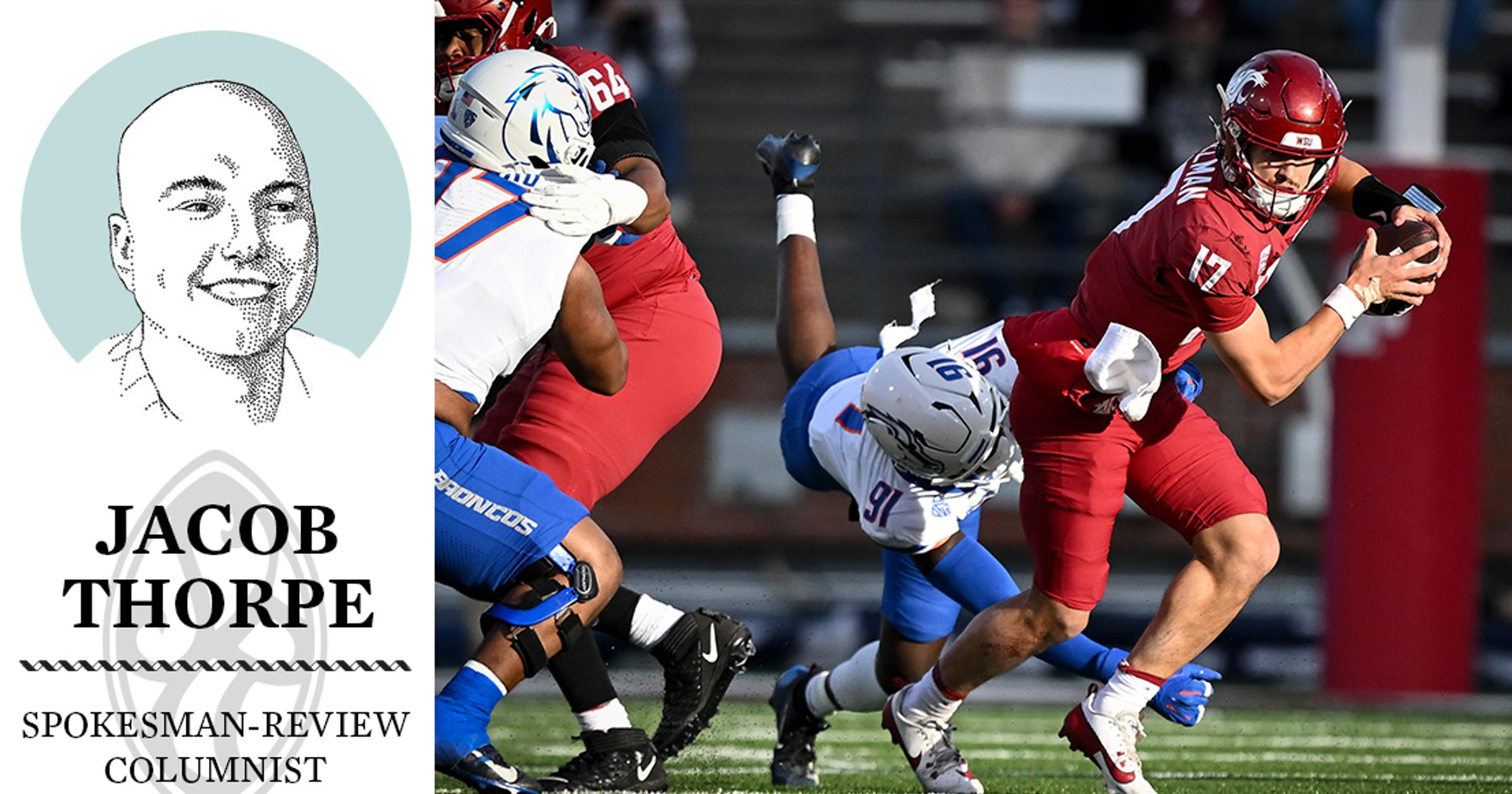
- One bad snap cost the Cougs a chance at an upset in Boise
A fourth-quarter turnover turned a close game into a lopsided loss for Washington State, which kept pace with a heavily favored opponent for three quarters before crumbling.
The Cougars defense played admirably for much of the game. WSU’s offense was stuck in the mud for most of the day, and a communication error between the Cougs quarterback and running back resulted in a costly interception that spelled another defeat for WSU.
In the end, No. 21 Boise State pulled away for a 31-10 Pac-12 win on Saturday at Gesa Field.
WSU fell to 1-7 overall and 0-4 in conference play under first-year coach Kirby Moore. The Broncos (6-1, 3-0) captured their first-ever win in Pullman and remained the front-runners in the Pac-12 with their sixth straight win.
Game spirals on crucial mistake
The Cougars were very much alive until a game-changing blunder early in the fourth quarter.
Quarterback Owen Eshelman, making his second start for WSU, wasn’t playing great, but he had mostly avoided big mistakes and was playing just well enough to keep it close. But the redshirt freshman made his first truly costly mistake of his young career with 12 minutes, 23 seconds left in the game and his team down by a touchdown.
Eshelman looked to pass over the middle on a second-and-10, expecting running back Kirby Vorhees to cut left on his route. But Vorhees went right, and Eshelman had already released the throw. His pass went right to Boise State linebacker Boen Phelps, a Freeman High grad, who returned the pick to the WSU 33 to set up a touchdown that suppressed the Cougs’ hopes of earning a signature win.
That turnover was the turning point. WSU’s offense had labored all game to move downfield, and a 14-point deficit in the fourth quarter was pretty much insurmountable. WSU reached midfield on its next drive, but a third-down sack stalled the possession – WSU’s offensive line had a game to forget, surrendering four sacks and eight QB hits.
Eshelman finished 21 of 40 for 191 yards with no TDs. He had a handful of nice moments, improvising to convert third downs (WSU went 6 of 17 on third downs) and using his legs effectively – excluding yards lost from sacks, Eshelman gained 70 yards on 19 carries. But the downfield passing game left much to be desired, and the Cougars tailbacks were a nonfactor yet again against a stout Boise State front. Vorhees and Leo Pulalasi gained 20 yards on 10 carries.
Offense remains this team’s weak spot. The unit showed some promise during a long TD drive late in the first half and a possession that ended with a field goal midway through the third quarter. But there’s just not any sustained fluidity and a glaring lack of big plays – WSU only had one play of 20-plus yards.
Despite stats, WSU defense earned props
The Cougars defensive front had a respectable outing against one of the nation’s best rushing teams – until the fourth quarter.
Boise State finished with 258 rushing yards and three TDs on the ground, averaging 7 yards per carry. Broncos running back Dylan Riley, who entered the game ranked No. 6 nationally in rushing yards, produced 128 yards and two touchdowns.
But 133 of the Broncos’ rushing yards came during the fourth quarter, and two Riley runs accounted for 105 of those. Before the superstar junior tailback broke off scoring runs of 33 and 72 yards in the fourth quarter against a deflated WSU defense, the Boise State ground game hadn’t overpowered the Cougars like it had so many other teams this year.
BSU running backs only had one carry of 20 yards before the fourth. WSU’s linebackers and defensive line did well to swarm to the ball and meet the Broncos ball-carriers near the line of scrimmage.
And the Cougars secondary deserves some credit for limiting Boise State’s downfield passing attack. WSU’s pass defense slipped on the Broncos’ first scoring drive, allowing a chunk gain on fourth down and a 33-yarder, and the Cougs defensive backs gave up four straight completions during a BSU drive that ended in a field goal at the end of the first half. Aside from those slips, it was a commendable effort for the WSU DBs. Boise State’s veteran quarterback, Maddux Madsen, was held to 14 of 23 for a season-low 149 passing yards, with two completions of 15 yards or more.
Could’ve been worse
The Cougars are officially eliminated from postseason contention. It’s a lost season that began with so much hope, a thoroughly disappointing debut for Moore in the new Pac-12. Having said that, the Cougars aren’t as bad as they were a few weeks ago.
To be sure, a 1-7 team doesn’t deserve optimism, but WSU has at least been more fun to watch over the past two weeks, showing some competitiveness against the Pac-12’s top two teams. On Saturday, the Cougars had the score tied against a ranked team heading into the fourth quarter. A month ago, that would’ve seemed impossible.
The Cougars should have a chance to win back a smidge of faith in the coming weeks. They have what appear to be three very winnable games on the horizon against fellow Pac-12 underachievers in San Diego State, Colorado State and Texas State. That first FBS win has to be in there somewhere.
- Eshelman's arm was fine, but the O-line left a hole WSU couldn't fill
PULLMAN — Not five seconds had passed after Owen Eshelman’s pick fell into the hands of Boise State defender Boen Phelps when the reality began to set in for Washington State.
This one is probably a loss.
All things considered, Eshelman played a solid game on Saturday night, completing 21 of 40 passes for 191 yards and the one pick. He led one touchdown drive, a long series that tied the game shortly before halftime, and he laced a couple passes that reminded everyone of his long-term potential.
In a vacuum, Eshelman’s one interception shouldn’t be a back-breaker for WSU. He’s a redshirt freshman, and mistakes are going to happen. But the Cougars’ margin for victory has been razor-thin all season that the one bad mistake Eshelman made all but sealed things for the Broncos, who followed with three straight touchdowns in a 31-10 win at Gesa Field, handing WSU its fifth straight setback.
There are a lots of ways to dissect the reasons why WSU’s margin for victory has been so thin this season, but the main ones center around the team’s offensive line: Left tackle Ashton Tripp, left guard Jonny Lester, center Noah Dunham, right guard Nick Bakken and right tackle Jaylin Caldwell. That group had a big hand in many of the reasons the Cougs’ offense couldn’t get off the ground in Saturday’s game: Eshelman took four sacks, he had little time to make decisions even when he wasn’t brought down, and in perhaps an even more costly development, the hosts’ rushing attack had zero legs.
In recent weeks, WSU has made two key changes to its offense — head coach Kirby Moore is now calling plays, and Eshelman has replaced Caden Pinnick at quarterback — and things haven’t looked consistently better for that group. The Cougars’ running back trio hasn’t generated anything meaningful. And their quarterback is still running for his life, no matter who it is.
That brings into focus WSU’s offensive line, which has been the common denominator for their offense’s woes, from a season-opening loss at rival Washington to a road setback to Utah State to a home defeat to No. 21 Boise State. The Cougs’ front five hasn’t protected their quarterbacks enough to give them time to make good decisions, and they haven’t been able to generate much consistent push up front, leading to running backs getting stuffed in short-yardage situations.
That much has been going on for most of this season, but it zoomed into focus after the Cougars’ loss on Saturday night. In that game, Eshelman was pressured 16 times, according to Pro Football Focus. Here’s the breakdown on where those came from: Five from Caldwell, four from Bakken (one sack), three from Dunham and two apiece from Lester (one sack) and Tripp, who returned to action after missing one-plus games with an ankle injury he suffered early on against Utah State.
As a result, Eshelman took 22 dropbacks under pressure, per PFF. That’s only marginally fewer than the 29 dropbacks on which he was kept clean. He was under heavy pressure just about all night, which limited the passes he was able to make, which in turn hampered the Cougars’ entire offensive operation.
Let’s take a look at a few plays in particular to paint this picture. The first came late in the first quarter, on the first play of WSU’s second drive of the game. Eshelman goes to hand the ball off to running back Kirby Vorhees, but he’s met immediately by BSU edge rusher Jayden Virgin-Morgan, who used a simple stunt to surge into the backfield and make the tackle.
About 12 minutes of game time later, Boise State pulls out the same trick to get pressure on Eshelman. This time it’s defender Bol Bol who comes on the same type of stunt, getting into the backfield and flushing Eshelman from the pocket. The Cougs’ QB does a nice job to escape and get a chunk of yards, but he only needed to because of the pressure that Bakken can’t pick up.
Then, about midway through the fourth quarter, the Broncos get the Cougars again with the same stunt. This time, Dunham and Bakken don’t identify it, allowing Bol to make his way into the backfield again, this time getting to Eshelman for a sack.
But other times, the Cougars’ offensive linemen just couldn’t block their matchups on running plays, a key reason why tailbacks Vorhees and Leo Pulalasi combined for only 20 yards on 10 carries. In seven games against FBS competition this season, the Cougars are averaging 15 carries for 48 yards from their running backs — Vorhees, Pulalasi and Maxwell Woods, who did not get any carries in Saturday’s game — whose retention was regarded as one of Moore’s top offseason accomplishments.
But those three haven’t generated anything resembling credible offense, and it’s in large part due to their offensive line’s inability to create space up front. To the Cougs’ credit, they did so on two key occasions on Saturday: Once when Vorhees plunged a yard into the end zone and once when Eshelman used a QB keeper to convert a fourth-and-short play.
But those plays were exceptions to the rule. More often, WSU’s front five have not found ways to move their matchups and find space for their tailbacks. On Saturday, the biggest culprit was Caldwell, who was routinely beaten off the line. On one play, he doesn’t block anyone, and on another, he’s just beaten.
For the season, WSU has earned a PFF run-blocking grade of just 50.3, which ranks No. 129 of 138 FBS teams. That shines a light on the larger dynamic at play: Three of the Cougars’ five offensive linemen — Tripp, Dunham and Lester — were recruited to play in an Air Raid-adjacent system, which prioritizes pass-blocking over gritty run-blocking in the trenches. These three aren’t at WSU to do the latter, which is one reason why the team’s running backs haven’t gotten anything consistent going all season.
Plus, between Pinnick and Eshelman, neither have had much time to pass. Pinnick was more guilty of running himself into sacks — even with only six games to his name, Pinnick is still tied for the nationwide lead with 11 QB-fault sacks, per PFF — but both have been pressured far too much. In six of their seven FBS games, the Cougars have permitted double-digit QB pressures, underscoring how consistent the problem has been.
“Well, there’s five guys, so there’s a lot of different factors,” Moore said, “and all five being on the same page, and they could all have one-on-one matchups. Boise’s got good players. Give them credit. I think there’s a couple different factors there. Obviously, had a short yardage one where (it was) third-and-1 we didn’t get it. And then there was pressure on the quarterback with some of the dropback opportunities, and so we gotta do a better job.”
- Eshelman gives Cougs hope, but D can't stop Oregon State
Washington State’s new quarterback showed some encouraging signs, but the Cougars couldn’t keep pace with Oregon State’s explosive offense. The Beavers built a big lead in the second quarter and rolled to a 48-30 Pac-12 Conference win on Saturday at Reser Stadium in Corvallis, Oregon, keeping WSU winless against FBS opponents.
Owen Eshelman distinguished himself as WSU’s best option at QB. The Cougars defense, facing one of the nation’s most productive outfits, had their worst game yet.
The Cougars (1-6, 0-3 Pac-12) get no reprieve next week when No. 23 Boise State comes to Pullman.
Cougs can’t contain Beavs potent offense
WSU surrendered season highs in points and yards (555). Defensive coordinator Trent Bray, the former coach at Oregon State, didn’t have answers in the first half against the Beavers offense, which scored on five of its first six possessions and went ahead 27-3 late in the second quarter.
Beavs breakout star QB Braden Atkinson was exceptional, as expected. He avoided mistakes and tested WSU’s deep coverage consistently, hitting on a tone-setting, 90-yard TD strike to star true freshman Jesse Legree, who finished with 108 yards and two TDs.
It was about as bad as most would have guessed for WSU’s defense, which had been mostly respectable against lesser offenses before meeting OSU’s, which ranks among the most productive in the nation. Atkinson entered the game leading the FBS in passing yards and TDs, and Legree was tops in the country in receiving yards. The Cougs can live with the fact that they only let Legree get loose for one big play downfield, but they’ll be kicking themselves for giving up so many chunk plays and such a high yardage total.
Tackling seemed to be an issue for WSU defenders. OSU averaged 6.3 yards per carry. Beavs running back AJ Newberry had three explosive runs, plus an 88-yard TD on a screen pass. No one was there to cover the play, and Newberry made the final WSU defender look silly with a juke and a hurdle.
WSU QB situation receives answer
Eshelman was called into action this week to replace struggling starter Caden Pinnick, and the redshirt freshman performed well considering the circumstances. He should be the Cougs’ signal-caller going forward.
Eshelman finished 32 of 49 for 289 yards – a season high in passing yards for WSU QBs – with two passing TDs and an interception (at the very end of the game). He showed savvy on run-pass options, rushing for 136 yards and a TD on 15 carries for the most productive rushing day by a WSU QB since John Mateer.
Eshelman’s performance was a positive for WSU’s offense.
Junior receiver Branden Ganashamoorthy was also a bright spot. He got open more than any WSU wideout has throughout the season, catching 11 passes for 147 yards and a 40-yard TD just before the half. Give some credit to coach/playcaller Kirby Moore for looking to stretch the field a bit more, though WSU connected on just three passes of 15-plus yards. The Cougars finished with 459 yards, their most in a game this season against an FBS opponent.
But there still were too many negatives. WSU tailbacks combined for 25 yards on 13 carries. Eshelman accounted for all six of WSU’s runs that gained 10-plus yards.
The Cougars went 7-for-17 on third downs – they were 0-for-9 on third-down tries before the fourth quarter, when they made the score look more respectable with a couple of TDs after going down 41-16.
WSU punted on its first four possessions, going three-and-out on three of those, allowing Oregon State to get off to a fast start and jump out to a 17-0 lead in the first quarter.
Another unfortunate note: WSU lost receiver Darrius Clemons to injury in the first half. He was on crutches after halftime. The Cougs are already down standout wideout Tony Freeman, who sustained a season-ending ACL injury in Week 1.
Beavs emerge as great story, Cougs still searching for identity
Seeing what the Beavers have become in Year 1 of the rebuilt Pac-12 is no doubt painful for WSU fans as their team has become irrelevant in 2026.
The teams had near-parallel paths to this point – left for dead after the Pac-12 imploded, playing through a couple of seasons without a conference home, going through coaching uncertainty, etc. Now, Oregon State is one of the best stories in the Group of Six, one of the best teams in the conference. The Cougars wish they were in their rivals’ shoes.
Sure, it would have been nice if both programs rose from the ashes as contenders in the new Pac-12. Unfortunately, only one has made the most of the situation thus far. The Beavers seemed to have picked a perfect fit as their new coach. They recruited the right transfer QB, a solid transfer running back and found a freshman gem at receiver. They created an identity and play with a style that’s entertaining and attracts attention.
Of course, it’s much too early to know if Moore was the right choice for WSU. He’ll get a grace period to build the program and to craft an identity. Pinnick seems to have been a miss, though. In any case, the Pac-12 legacy programs that have gone through the same struggles are facing opposite directions as of now. That can change. Hopefully, the Cougs/Beavs rivalry soon becomes one of the most competitive, anticipated G6 games of the year.