- Clemons and Bernard day-to-day after Boise loss, SDSU ahead
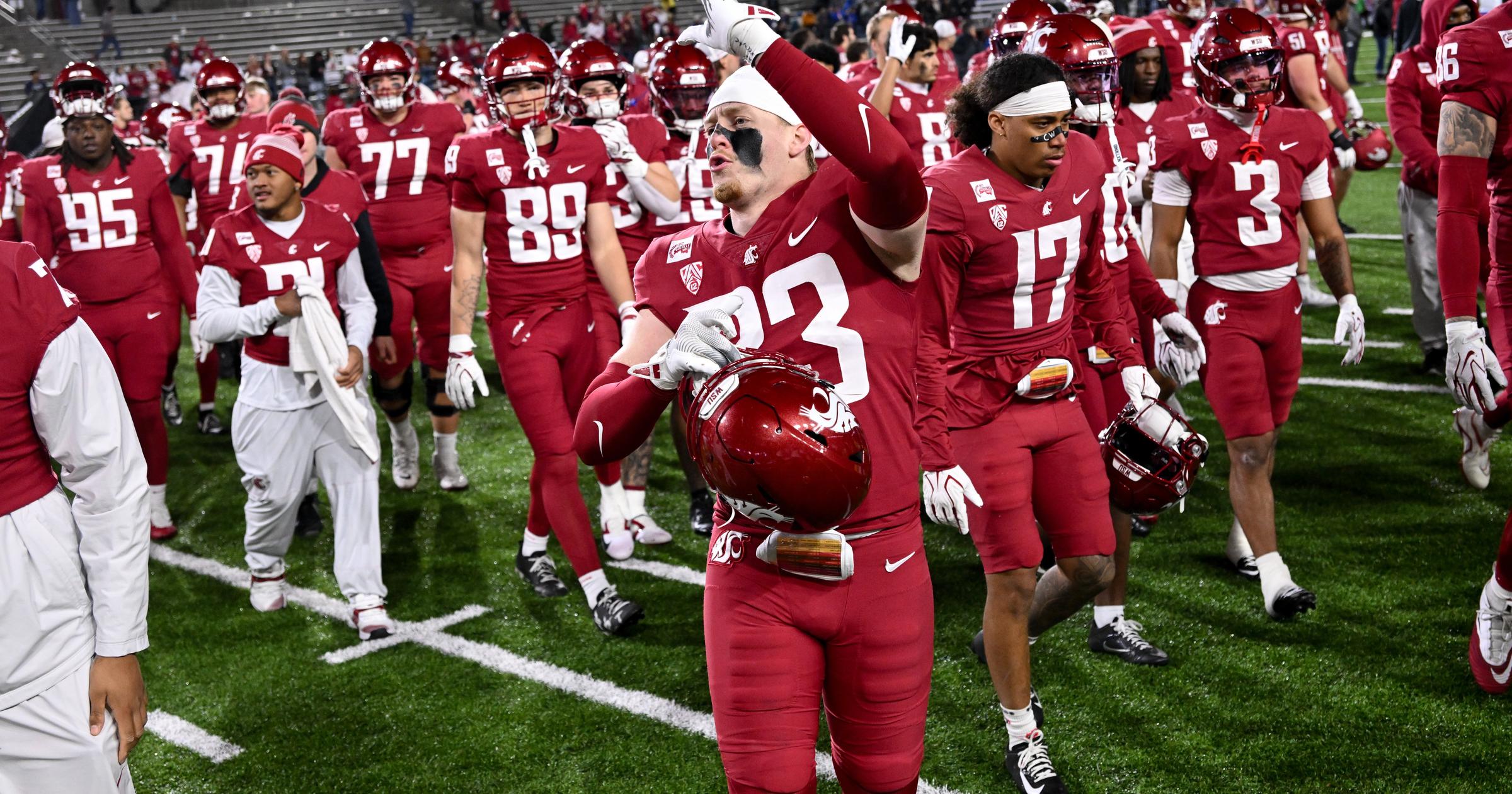
PULLMAN – Washington State may have to go another week without two starters on each side of the ball.
That’s according to head coach Kirby Moore, who said Monday that wide receiver Darrius Clemons (ankle) and safety Jeremiah Bernard (shoulder) are considered day-to-day ahead of a road matchup with San Diego State this Saturday. Both missed the Cougars’ home loss to Boise State last weekend, but both are set to return to practice this week, Moore added.
Their absences are wearing on a WSU team still looking for its first FBS win of the season, falling to 1-7 overall and 0-4 in Pac-12 play after a 31-10 home loss to BSU. Without Clemons, who suffered an ankle injury against Oregon State on Oct. 17, the Cougars didn’t expand their receiver rotation to include West Georgia transfer Jordan Dees or walk-on Caleb Northcroft, as Moore indicated could take place ahead of the game.
Instead, they played their top three receivers all heavy snaps: Branden Ganashamoorthy and Daniel Blood each played all 76 snaps of offense, while Tank Hawkins played 65 snaps. Those are the only three wideouts who played for Washington State in that game.
This season, Ganashamoorthy has played 503 snaps, the most among Pac-12 wide receivers. Four Cougars have played at least 500 snaps, making them one of only two Pac-12 teams to play four players that many snaps.
“We talk about deliberate practice,” Moore said. “That really starts with bringing great energy, having verbal combat, doing your assignment, making sure you’re not thinking out there, that you’re just reacting. I think we’ve had too many errors from a practice standpoint, with guys knowing their assignments, whether it’s motions, details within the position. We’ve got lot of trust in the guys who are out there on the field. If other guys improve and they’re to the standard, they’ll be out there.”
Bernard suffered his shoulder injury during WSU’s loss at Oregon State earlier this month, Moore said, describing it as “a little bit of a stinger.” In his absence, WSU coaches trusted Arizona State transfer Jackquintin Bal with 56 snaps, his second-most of the season and his most in four games. Against Boise State, Bal wasn’t targeted in the secondary, but he missed four tackles, most on the team.
That contributed to the Cougars’ inability to prevent big plays on defense, like BSU star running back Dylan Riley’s touchdown rushes of 33 yards and 72 yards, both of which came during the Broncos’ 21-0 fourth quarter that they used to seal the win. As a team, WSU missed 16 tackles, bringing its season total to 93 – second-most in the Pac-12, behind only Colorado State, which ranks last in the country in total defense.
Changes to O-line?
Moore said the team is “going to explore” shuffling personnel on its offensive line, which permitted 16 pressures and two sacks on QB Owen Eshelman against Boise State. The Cougars’ front five often allowed the Broncos to get home using stunts. Other times, that group was pushed back at the line of scrimmage, a big reason why running backs Kirby Vorhees and Leo Pulalasi managed only 20 yards on 10 carries.
As currently constructed, WSU’s starting offensive line includes right tackle Jaylin Caldwell, right guard Nick Bakken, center Noah Dunham, left guard Jonny Lester and left tackle Ashton Tripp, the last of whom returned to action last weekend after missing the Oregon State game with an ankle injury he sustained against Utah State on Oct. 9. All are returners, including Tripp and Lester, who started last season. Caldwell started two games before suffering an injury.
The possibilities seem numerous for the Cougars, who won’t be able to reach the six wins required for bowl eligibility, which the program has earned in 9 of the last 10 full seasons. Theoretically, WSU could still reach a bowl game by finishing the regular season 5-7, which would open up the possibility of being selected for a bowl if there aren’t enough 6-6 teams.
But the Cougs wouldn’t just end their five-game losing streak and win out. They would also need to achieve at least a 930 multiyear Academic Progress Rate.
“We’re gonna explore that this week with, obviously, practice,” Moore said of making changes on the offensive line. “We wanna give guys opportunities. At the same time, right now in the season, we gotta understand where we’re at, the communication with who’s been on the right side, with who’s been on the left side. Naturally, we wanna give some reps to some other guys as well, and then we gotta make a call there by the time we get to Thursday.”
- Keith Brown deleted social media to lock in on WSU's defense
PULLMAN — In his long college football journey, Keith Brown has learned the importance of tuning out the noise. During Washington State’s fall camp, he deleted all social media off his phone, understanding that if he wants he and his unit to reach their potential, they can’t get sucked into the distractions.
Heck, he doesn’t always look at the scoreboard. Last month, in his WSU team’s home setback against Arizona, he went into halftime not knowing the score. He had to ask a teammate to find out, he said.
Turns out, that’s part of the reason how Brown and the Cougars have done their part on defense, using herculean efforts to keep their team in games when their floundering offense has left a lot out there. At least for Brown’s part, he’s done his best to ignore the problems his team’s offense is having, even if it means jogging out there for extra series thanks to turnovers.
“Just continue to compete,” Brown likes to tell his teammates.
As WSU defensive coordinator Trent Bray makes his return to Corvallis, where he worked as Oregon State’s head coach for the 2024 season and part of the 2025 campaign, the Cougars will have to do a lot of competing to pull an upset. The Beavers, who opened as 17.5-point favorites, own one of the country’s most prolific offenses, engineered in large part by quarterback Brayden Atkinson and true freshman wideout Jesse Legree.
Which leads to this question: How does WSU’s competitiveness on defense factor into a matchup with such a productive OSU offense?
“I don’t think it affects it at all. It’s just another opportunity to go out there and compete,” Brown said. “I’m sure our entire back end is just excited for the challenge, ready to do what they’re supposed to do. No matter who we’re playing, no matter what the rankings are and stuff like that, we always wanna go and play our best.”
As WSU’s offense earns all the headlines, turning things over to redshirt freshman quarterback Owen Eshelman over the struggling Caden Pinnick, perhaps a look at the Cougars’ defense is in order. Bray’s group has consistently held its own in the face of daunting circumstances, many of which have been caused by WSU’s offense, which has lost nine turnovers — seven from Pinnick.
First, consider this statistic, which paints the picture of what the Cougars’ defense is going through: In BCF Toys’ field position value rankings, WSU ranks dead last in the country, No. 138 of 138 FBS teams. In simplest terms, this means the Cougars are averaging the worst starting field position in the country, when averaging the drives their offense starts at the drives their defense starts at.
Whittle that down to just the starting field position WSU’s defense has averaged, though, and the problem becomes even clearer. The Cougars rank second-to-last nationally in that category, checking in with a mark of 65.2 — which means on average, opponents are starting drives at about their own 35-yard line. Only one other team, Rice, gives opponents better starting field position.
To be sure, though, this is not an indictment on WSU’s defense. It’s the opposite, an explanation behind some of the scores the Cougars have given up. In Washington State’s 17-16 loss to Utah State over the weekend, the visitors lost the lead in the fourth quarter, when a fumble from tight end Jack Pedersen set the Aggies up at the Cougar 19. Three plays later, they jogged into the end zone to take the lead for good.
That reality is best illustrated by BCF Toys’ defensive short field rankings, which measure how often a defense has to jog out with the opponent starting at its own 40 yard line or further. The Cougars’ defense has been handed those situations 25% of the time. Only 15 other defenses have met that fate more often.
All of that, though, only serves to make this WSU defense’s accomplishments even more impressive. In Friday’s game, defensive end Linus Zunk and defensive tackle Jirah Leaupepetele each earned sacks. The Cougs forced seven punts. On the season, they’ve forced five turnovers, about middle of the pack nationwide.
In six games, WSU is allowing 23.7 points per game, which is fifth in the Pac-12. Maybe that doesn’t sound very impressive — but then you consider what this group has been up against. That’s when their outings click, the genius behind Bray’s operation zooms into focus.
“We’re a very connected team,” Brown said. “We have our captains group chats, leadership meetings and stuff like that, and we just continue to reiterate that we’re a team at the end of the day. The last thing you wanna do is divide the team. There is no division. We’re one team. I think honestly, we’re just as close as we were going into week one. So I’m still excited for rest of the season.”
- Moore's sideline bench talks get real after WSU's bowl hopes vanish
PULLMAN – Only seconds after Owen Eshelman threw a back-breaking interception, the exact kind of turnover that Washington State needed to avoid to upset No. 21 Boise State on Saturday night, his head coach sat him down on a nearby bench.
On the sideline, Eshelman talked with coach Kirby Moore, going over the play and what went wrong. Eshelman was looking for running back Kirby Vorhees, who ran to the right. Eshelman threw it left. It turned into a turnover, which sank WSU’s chances in this 31-10 loss to Boise State, the class of the rebuilt Pac-12.
Turns out, that was a play that the Cougars had installed early in the year, sometime in spring ball or fall camp. After the game, it seemed to frustrate Moore, who has placed his trust in a redshirt freshman making only his second career start.
“We weren’t on the same page there,” Moore said. “Obviously, it starts with me, and we gotta do a better job from that standpoint.”
The Cougars only have five more opportunities to do a better job, and at 1-7, their bowl hopes are gone. It’s their first time being eliminated from bowl eligibility before November since 2010. They have nothing left to play for except pride and for the 14 seniors who are playing their final year of college football.
Moore has missed chances to avoid letting things get to this point, and many of them center on his reluctance to bench quarterback Caden Pinnick for Eshelman, a decision that took so long it likely cost the Cougars multiple wins. But things are where they are, and with four games left to play, Moore can no longer rely on motivating his players with a bowl game, with the kind of national relevance they likely envisioned for themselves back in August.
Instead, Moore will have to find other ways to motivate these Cougars. He will have to find a way to get something out of a lost season: a win at San Diego State next week or a home win over Colorado State after the bye week.
The Cougars’ chances at a successful season may be gone, but they can still eke out something resembling success with the four games they have left, which is why Moore’s motivational skills will be put under the microscope across these last five weeks of his debut season.
Moore needs to get more from his offensive line, whose lack of physicality is creating exponentially more problems for the Cougars’ offense. He needs to corral his defense, which is yielding long scoring plays , and he needs to use his offensive acumen to point Eshelman in the right direction and make sure that in his last four starts, he learns the lessons he needs to so that if/when he returns for the 2027 season, he’s ready to lead an explosive offense.
“I think our players are pretty motivated on a daily basis,” Moore said. “Naturally, there’s different parts that go into every game, and things that we’ve drawn from from the offseason, things throughout fall camp, week-to-week with the opportunities we have. But I think our leadership group does a really good job as well, and I’ve got no reservations about our guys showing up with the right mindset tomorrow.”
It’s a tricky spot for Moore, who is naturally an even-keeled guy, at least publicly. In his last two postgame news conferences, after losses to Oregon State and Boise State, he has seemed more fired up – but the bar is low because he’s usually quieter.
The topic is still a bit difficult to wrangle because of some of the physical limitations that seem to be behind losses like these. The top ones belong to Washington State’s offensive line, which gave up four sacks against Boise State’s defense. That group – left tackle Ashton Tripp, left guard Jonny Lester, center Noah Dunham, right guard Nick Bakken and right tackle Jaylin Caldwell – also couldn’t clear space for their running backs, who finished with 20 yards on 10 carries.
For WSU, that has been a problem all season. Check out how the Cougars’ tailback trio of Kirby Vorhees, Maxwell Woods and Leo Pulalasi has fared in their seven FBS games:
• vs. Washington: 16 carries, 38 yards
• vs. Kansas State: 17 carries, 72 yards
• vs. Arizona: 17 carries, 59 yards
• vs. Fresno State: 12 carries, 45 yards
• vs. Utah State: 19 carries, 77 yards
• vs. Oregon State: 13 carries, 26 yards
• vs. Boise State: 10 carries, 20 yards
That comes out to an average of 15 carries for 48 yards.
Could those three be doing more to break free? Maybe, but the bigger problem involves their offensive line, which has struggled in short-yardage situations.
Against Boise State, the group couldn’t clear enough space on a third-and-1 and Pulalasi was stuffed. To their credit, they helped convert a fourth-and-1 QB keeper, which led to the Cougars’ one touchdown.
Still, WSU’s offensive line has been a glaring issue all season, even when Caden Pinnick was playing QB and running himself into all manner of unforced sacks. It’s worth keeping in mind that three of the Cougs’ five linemen – Tripp, Lester and Dunham – were recruited to play in an Air Raid-adjacent system, which doesn’t lend itself to gritty physicality on third-and-1. But that’s what they’re being asked to do now, and it isn’t working out so well.
Beyond that, Moore will have to draw on his offensive mind and mentor Eshelman, find a way to steer him away from the kind of interception that dashed the Cougs’ chances here on Saturday evening. Moore has always fashioned himself an offensive guy. He was Missouri’s offensive coordinator for three years. Previously, he worked the same job at Fresno State, including as QBs coach.
With that type of experience, Moore hasn’t just gotten adept at the X’s and O’s. He’s had a chance to work with all kinds of quarterbacks with all types of skillsets. To get something out of the rest of this season, he’ll have to draw on that with Eshelman, who has a compelling skillset.
Can he play well enough to get a couple more wins out of this season? Neither Eshelman nor any of his teammates will be motivated by a bowl game, so now it falls to Moore and his coaching. For WSU, this season may be lost, but not every game has to feel that way.
“I think it comes down to who you are, and there’s a lot more that’s revealed about who you are when things aren’t going your way,” Eshelman said. “That’s what I’ve loved to see with guys in our locker room the last few weeks – they respond and they go back to work, and so that’s something that I’m really proud of with our guys.
“Just trying to continue to push the envelope, continue to press and see where we can get better, continue to press and grow. As a believer, that’s where I want to be in my life, whether it’s me as a husband, whether it’s me as a father, whether it’s me in whatever future career I’m in. There has to be a standard for my life and the way I do things, and I want to continue to push that standard.”