- Second-half snaps tell the story of WSU's defensive breakdowns
PULLMAN – A few minutes after halftime began and Washington State players filed into their locker room, the sparkly new crimson and black lair that was remodeled over the summer, linebacker Keith Brown turned to a teammate with a question.
“What’s the score?” asked the sixth-year linebacker.
It was Saturday evening, and WSU had just taken a three-point lead on visiting Arizona into halftime, but Brown was none the wiser, according to his retelling. Brown and the Cougars’ defense had yielded a pair of scoring drives, and because quarterback Caden Pinnick had thrown an interception, that unit had to be on the field for one extra drive.
As the rest of the game unfolded, the Cougs lost one more turnover, a fumble from Pinnick on a play where he was trying to throw the ball away as he was getting tackled. That was the seventh turnover WSU’s offense has committed this season, which has spawned all kinds of other problems, perhaps this above all: The Cougars’ defense has been tasked with playing tons more snaps, lots more drives, putting them at risk of tiring themselves out when they shouldn’t have to.
For his part, Brown says it isn’t much of a problem.
“I don’t even think about it, man,” Brown said. “As a defender, you’re so excited to go out there and play, no matter what. … We just go out there every single series, and that series right there is the only thing I’m worried about. I don’t care if I just came off the field or the offense has been out there for a while. I’m excited to go out there and play.”
That may be the case, but it also means WSU defenders are playing heavy amounts of snaps. Check out some of the total snap counts from the Cougars’ loss to the Wildcats last weekend. Cornerback Khamari Terrell led all defenders with 72 snaps. Then came Brown, who logged 69, followed by defensive backs Jackquintin Bal with 67 and Jamarey Smith with 61.
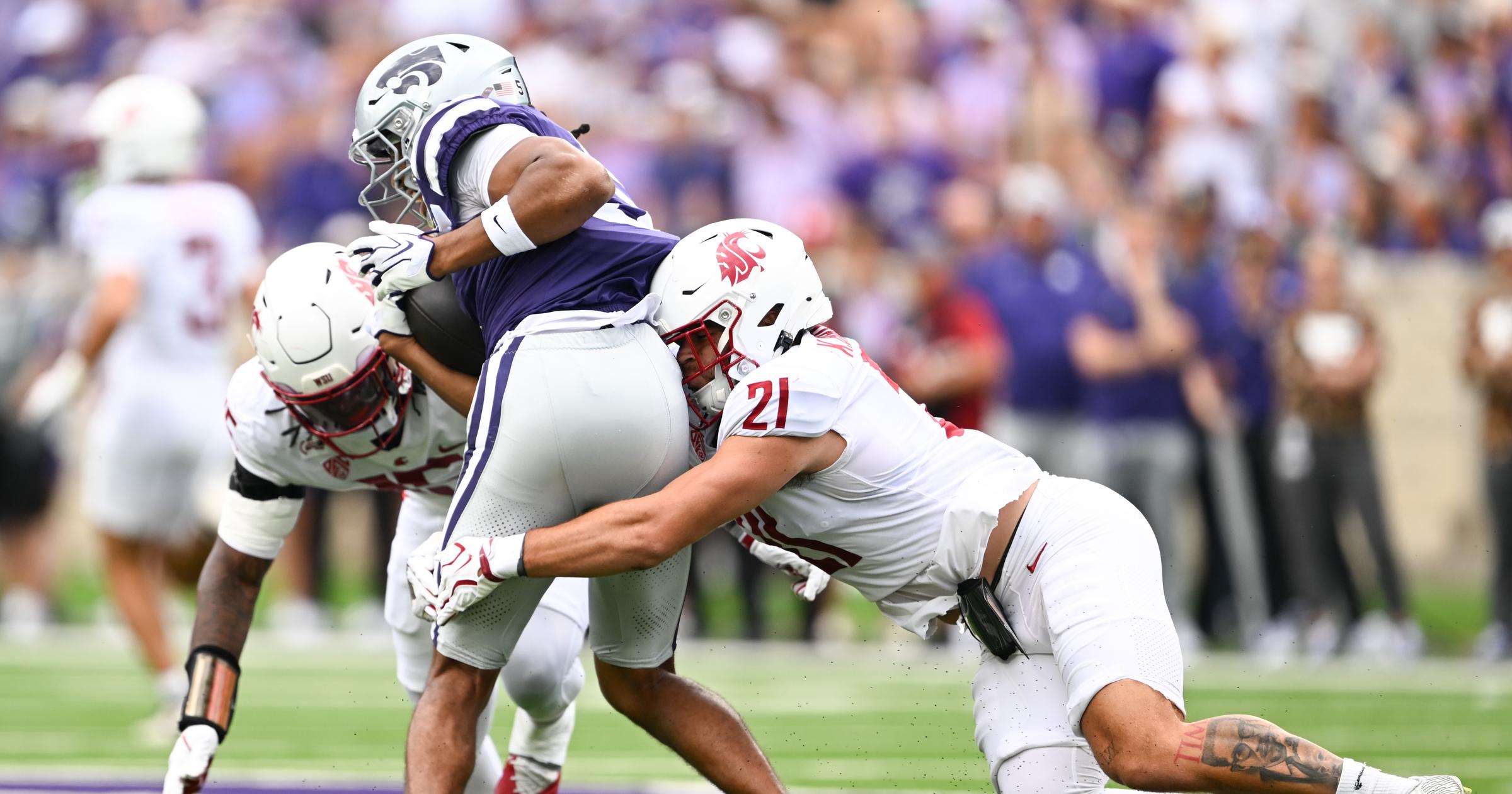
That was the second time at least three WSU defenders played at least 60 snaps each, joining the team’s earlier loss to Kansas State: defensive backs Kai Rapolla, Jaylen Thomas and Smith all cleared the 60-snap mark.
Headed into WSU’s next game, a home matchup with Fresno State to kick off Pac-12 play, two defenders have hit the 200-snap threshold: Thomas leads the team with 225 snaps while Brown is on his heels with 222. Several others are in the area, including Smith at 199, linebacker DJ Warner at 196 and safety Jeremiah Bernard at 192.
Does that add up over time? Or does it all come out in the wash for a bunch of 19- to 22-year-olds?
“It adds up in fact that you’re going against a really good quarterback,” WSU coach Kirby Moore said, referring to Arizona’s Noah Fifita, “and we were very aggressive on defense, and you saw that in the first half. Over time, he’s gonna make some plays. He’s gonna create some passes downfield, and they had the quick drive right there, and just keeping our guys fresh because the coverage and the front, it’s all gotta work together. If the front is tired and we’re not getting the rush that we want to, well, that’s affecting the back end. That’s what we gotta get solved there in the third quarter, and it really starts playing complementary football.”
Perhaps no single stat illustrates the point better than this: WSU’s defense ranks in the top half of the country in points allowed in the first quarter, permitting just 4.3, which ranks No. 57 nationally. In the fourth quarter, the Cougars are allowing an average of 11.3 points, which ranks No. 123 nationally, only about a dozen spots up from last in the country.
Think about the way WSU’s defense was operating in the first quarter against Arizona. Defensive end Linus Zunk earned a sack on the first play of the game. Bal snagged that pick-six. Then later in the first quarter, defensive tackle Jirah Leaupepele got home for another sack. “Just doing my job,” he said about that play.
The Cougs (1-3) couldn’t replicate that level of production in the second half. The Wildcats won the second half to the tune of 20-7, averaging nearly 7 yards per play, keeping Fifita clean the rest of the game.
In other words, WSU defenders wore down as the game unfolded, which is partially to be expected of a group headed out onto the field so often. The Cougars have lost seven turnovers on the season, remember? Only 18 other teams in the country have committed more. That sets up defensive coordinator Trent Bray’s unit with more and more series, and while the Cougars could certainly be doing more on defense – their inability to get much pressure on Fifita in Saturday’s second half loomed large, as did a long touchdown rush K-State broke off earlier this month – check out their high snap counts and you start to understand the root of the issue.
So what’s the solution? Play more defenders? That isn’t feasible in all of WSU’s position groups. Cornerback Jalil Tucker, a starter in Week 1, has missed the last three games with an injury. Linebacker Nylan Brown was out last week. Defensive ends Malachi Wrice and Mike Hughes were too, and they figure to be out this Saturday against Fresno State. The Cougars could get more out of young safety Kyle Peterson, for example, but after he made an early mistake that led to an Arizona touchdown, he didn’t see the field again.
What about other players on the roster? Could the Cougs give more looks to guys like defensive lineman Josh Wedel (73 snaps) or defensive end Ben Beatty, who has played just 67 snaps? The latter seems possible, but in an interesting development, WSU coaches have never separated starters Zunk and Matyus McLain. They have both played 184 snaps, indicating that coaches like them best when they’re on the field together.
With that in mind, it’s possible that the best respite for this WSU defense is an improved offense, an offense that can sustain drives. The Cougars figure to have an easier time doing that against the likes of Fresno State than they did against Power Four foes like Washington, Kansas State and Arizona. If they can hold onto the ball against the Bulldogs – whose defense ranks sixth nationally with a plus-seven turnover margin – the Cougs won’t just be doing their offense a favor.
They’ll also be doing a favor to their defense.
- We Have the Backs, Now We Need a Plan to Use Them
PULLMAN – Think back to January, when Washington State coach Kirby Moore pulled off what was seen at the time as a monumental move, putting together a three-man running back room that figured to gash opponents this fall.
Kirby Vorhees, last year’s starter, was planning on entering the transfer portal but decided to return to WSU the night before it opened. Tailback Maxwell Woods also returned to the team. And fellow running back Leo Pulalasi entered the portal, only to reverse course and also sign a new NIL revenue-sharing deal with the Cougars.
Especially under a head coach like Moore, whose best offenses at Missouri involved a productive ground attack, it seemed like the Cougs had struck gold with the return of their top three running backs.
Now let’s fast forward to this last week of September, after WSU’s 1-3 start to the season, the record the Cougars were expected to open the season with. It’s one thing that the Cougs’ offense has struggled in most of these outings. It’s another that one of the bigger culprits is their ground attack, or lack thereof, which has hampered what Moore and offensive coordinator Matt Miller had planned for quarterback Caden Pinnick’s offense.
WSU deserves credit for gashing FCS Duquesne for 316 rushing yards earlier this month, especially because Woods and Vorhees each cleared the 100-yard mark, but it’s also true that the Cougars did that against one of the FCS ranks’ worst defenses. What’s likely more informative is how they’ve fared against FBS competition, even if there’s been something of a talent gap in those games.
In a loss to Washington, WSU’s running back trio combined for 38 yards. In a setback to Kansas State, those three combined for 74. And on Saturday in a defeat to Arizona, they tallied just 59 yards between them. That adds up to 171 yards, which is 57 yards per game – not exactly eyebrow-raising in the way Moore was hoping for ahead of the season.
That forces Moore and Miller to find a way to get them more involved, to find ways to increase their production. How can they do that? Perhaps one way involves getting them more targets in the passing game, which they haven’t enjoyed much so far.
“We gotta find ways to get them matched up,” Moore said. “They make it tough, Arizona does, with how much they pressure because you are worried about the quarterback being hot at times, and you wanna make sure you’re protecting him as much as you can. And then we gotta stay on the field. That’s the best way to get the backs more touches, right? We gotta convert on third downs. The four drives there in the third quarter, we had three punts and a turnover. That’s not good enough.”
Moore had a point. In Saturday’s third quarter, the Cougars punted on three drives and lost a fumble on another, which happened when Pinnick was trying to escape pressure and attempted to throw the ball away while getting dragged down. That was Pinnick’s fifth turnover of the season and WSU’s seventh as a team.
Perhaps more to the point, WSU went 0-for-7 on third down in the second half. That didn’t just take away chances for the Cougars to score. It also removed opportunities for WSU’s tailbacks to involve themselves in the offense, which in turn could have opened up things for Pinnick and Co. Many of WSU’s problems on offense this season have run together, creating an amalgamation of issues. This is no different.
Consider this stat: This season, WSU running backs have been targeted as receivers a combined 22 times. They’ve hauled in receptions on 14. That comes out to a completion percentage of 64, a few ticks up from Pinnick’s 61% overall completion rate . That seems to suggest the Cougars could do well to incorporate more of that in their offense.
WSU gets a chance to prove it on Saturday with a home matchup against Fresno State, which figures to provide more chances to do so than the Power 4 teams that the Cougars’ offense has struggled against.
- Moore's offense showed some pulse, but the Cougs still left plays on the field
PULLMAN – The beginning of this Washington State season, the gauntlet the Cougars would see to open the Kirby Moore era, was always going to be difficult to parse. They faced three Power 4 teams in their first four games. Two were on the road. One came on a short week.
The Cougars were expected to come away from that stretch with one win and three losses. Thanks to a 34-24 setback to Arizona here on Saturday evening, WSU has fulfilled that much, which is not an indictment on these Cougars. But it does bring up the question that may define the rest of this season.
How many of the problems WSU’s offense is facing are a product of the stiff competition, and how many are the product of self-inflicted wounds that the Cougars would commit against the Pac-12 foes coming up?
We won’t know that much until conference play arrives when WSU hosts Fresno State next weekend, but the early returns on the Cougars’ offense are far from encouraging. Think about this stat, which is now official after Saturday’s game: In three games against FBS competition, WSU has produced three offensive touchdowns and committed six turnovers. The Cougars have lost seven total.
Moore’s team was expected to lose the games it has. It’s the way the Cougs’ offense is costing the team, though, that raises cause for concern.
“We gotta make sure we have a plan that everyone’s on the same page,” Moore said, “going from the half to the third quarter, especially in a tight game like that where our defense is battling, and we gotta find more ways to create explosive plays. We had them in the first quarter, in the first half, and had opportunities there to score even more. And then in the second half, we didn’t. So we gotta look at the film and see where we went wrong.”
In this one, WSU quarterback Caden Pinnick completed 24 of 41 passes for 241 yards, one touchdown and one interception, which came in the first quarter. If an Arizona defender hadn’t bobbled the ball later in the first half, Pinnick would have thrown two. Those were two costly decisions. Consider the other turnover Pinnick lost, a fumble that happened because he tried to throw the ball while being dragged down, and you start to see some of the poor decision-making that has led to Pinnick’s total turnover number this fall: four.
The reason that trend looms large for WSU: Pinnick is committing turnovers because of listless decisions, not because Power 4 athletes are making spectacular plays. Remember his interception last week against FCS Duquesne, when he threw into what became triple coverage downfield? Those are the kinds of poor decisions that have created such a gaping hole in the Cougars’ offense.
It would be one thing if Pinnick was playing a solid brand of football and a freak Power 4 defender, the kind that Arizona and Kansas State can afford, used his strength to jar the ball loose. That would be forgivable. But that’s not what’s happening. It may be Pinnick’s first season of FBS ball, but he has been too slow to differentiate a good decision from a bad one, especially when he’s looking to stretch the field vertically.
That raises a fair question: How can WSU coaches help Pinnick avoid those kinds of turnovers? How can they help Pinnick make better decisions, like in the third quarter, when he slid and gave himself up one yard short of a first down?
“We’re all in this together,” Moore said. “So it starts with me, obviously the offensive staff. Just having that dialogue with him, whether it’s in practice on the headset, reminders, making sure he knows exactly the stipulations, or even there on the third down. We ran the quarterback, he slides. That’s an unfortunate one. It’s a QB-designed run, and so we got to make sure he’s on the same page with that.”
The other problem the Cougars are facing is consistency. Their first drive in Saturday’s game, an 11-play, 71-yard scoring series, was nearly flawless. It ended when Pinnick took a QB keeper 11 yards into the end zone, following a string of perfect blocks, capping a perfect series. If that’s the way the Cougs were going to play in this one, well, the Wildcats should have been on their heels.
But WSU’s offense hardly looked the same after that. In the third quarter, the Cougs put up these numbers: 3 points, 149 total yards, 44 rushing yards, two three-and-outs, four punts and three sacks taken, giving Pinnick 10 sacks taken on the season. That opened the door for Arizona to turn a three-point deficit into a four-point lead, adding two more scoring drives in the fourth frame.
The Cougs can rebound from this. They showed what their offense can look like on that first series, and by showing an increased willingness to take shorter throws, Pinnick looks more than capable of making adjustments. But the biggest one he’ll have to make to avoid meeting the same fate against Pac-12 teams is more about trimming things out of his game.
He’ll have to make better decisions, better calls on when to try to stretch the ball down the field and when to be OK with checking it down. Fresno State’s defense figures to give him more opportunities to show that kind of acumen. But it’s on Pinnick, Moore and offensive coordinator Matt Miller to put themselves in a position where those changes don’t become just possible, they become probable.
“Give Arizona credit; they have a unique scheme,” Moore said. “So there was different variations of zone, whether it was inside, outside. Obviously, the quarterback pin-pull there we scored on in the first quarter. So there were some ID things there. Give them a ton of credit with how fast and hard those guys played. But we gotta have an answer as well with protecting the quarterback and having some more opportunities in the pass game.”