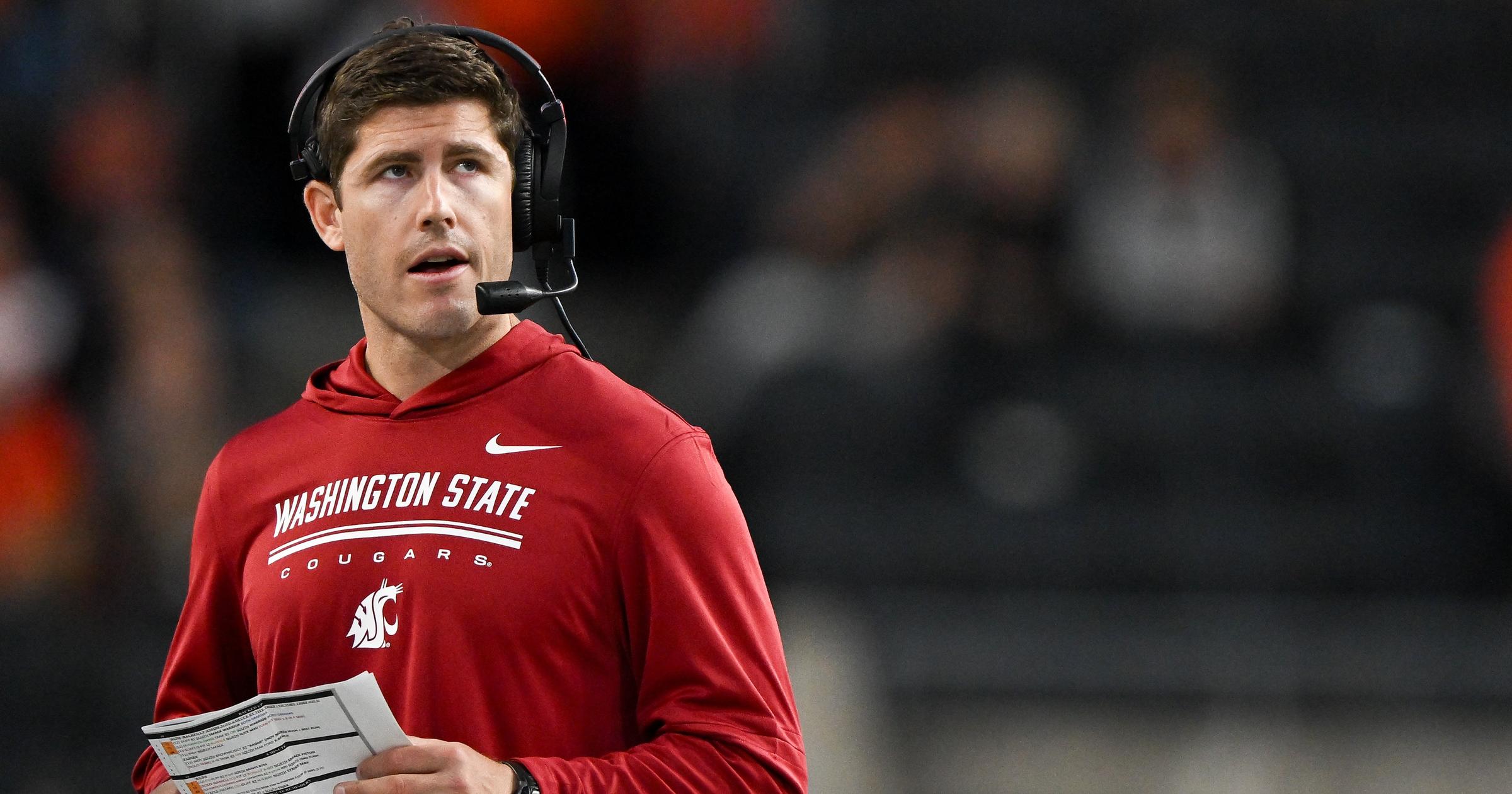
- Moore to Cougs after Fresno dud: The noise is fair, the fix is on us
PULLMAN – At some point in the Gesa Field locker room, not long after his Washington State team managed just six points in an anemic loss to Fresno State on Saturday evening, Kirby Moore got his players together and left them with a message.
“We talked about, naturally, there’s gonna be noise, and rightfully so,” Moore said. “We gotta have a better product on the field. We all agree that we’re a better football team than that. The leadership group’s gotta step up, and the only way I know how to improve is to go back to work.”
Plenty of that will be in order for the Cougars, who are now 1-4 overall and 0-1 in Pac-12 play to begin Moore’s tenure. With this 26-6 setback, WSU’s offense now ranks near the bottom in the country in several key departments. With this sampling, keep in mind that there are 138 FBS teams this season.
• 11.8 points per game, No. 130
• 27% on third down, No. 133
• 287 yards per game, No. 133
• 18 sacks allowed, No. 129
• 11 red zone attempts, No. 125
Here are two more statistics that might best capture the Cougars’ struggles on offense. They’re averaging 2.8 yards per rush, which is No. 128 nationally. They’re also averaging 5.6 yards per pass attempt, which is two spots up from dead last in the country.
The eye-test backs up those trends. Quarterback Caden Pinnick, who threw an interception to bring him to six total turnovers on the season, hasn’t shown much acumen with the deep ball. Credit WSU coaches for game-planning around that, but they also aren’t getting much out of their running game, which could play a key role in opening up the field for their quarterback.
In short, that’s how you end up with this WSU offense, which has now gone without an offensive touchdown twice in one season. For the Cougars, that’s the first time that has happened since 2008, the first season of former coach Paul Wulff’s tenure. Wulff actually did visit Moore and coaches back in August, but in terms of on-field results, that’s not company anyone with WSU’s program wants to keep.
Here are five lingering thoughts from WSU’s loss to Fresno State.
1. Caden Pinnick’s pocket presence leaves a lot to be desired: Pinnick’s list of issues is quite lengthy, but this problem ranks somewhere near the top: He doesn’t look entirely comfortable in the pocket, whether or not he’s seeing pressure. He may have taken five sacks, but Pro Football Focus only dinged the Cougars’ offensive line for one, which does a great job of crystallizing the issue.
On one play late in the first quarter, Fresno State brought a blitzer up to the line of scrimmage a few seconds before the snap, and Pinnick seemed to be aware of that. The WSU player he was lined up against, tight end Jack Pedersen, even pointed to him. But defensive back Loyall Mouzon came unblocked just the same, and even with a second to get the ball out to running back Maxwell Woods in the flat, Pinnick elected to hold on to the ball and take the sack.
At the beginning of the third quarter, Pinnick also put on display what is becoming a bigger and bigger issue: He won’t throw the ball away. On this play, he does well to fake a handoff and make one defender miss, but he’s out of the pocket so he has a chance to throw it away and avoid a loss. Instead, he takes a sack for a loss of 10 yards. The Cougars punted three plays later.
Let’s fast forward to the end of the third quarter, when WSU was facing a 13-6 deficit. Backed up deep in their own territory, the Cougars go with a shotgun dropback for Pinnick, who gets great protection from his O-line. He chose to scramble from the pocket, which looked unnecessary, and checked it down for a short gain.
On that play, it wasn’t just Pinnick’s decision to bail from a clean pocket that presented a problem. That choice spawned another: Pedersen was called for holding. That’s the kind of penalty that quarterbacks put their blockers at risk of when they scramble from the pocket, causing blockers to become more visible to officials.
2. Matyus McLain turned in his best game yet: In his fifth game at the FBS level, the defensive end McLain looked like the best version of himself. For the game, he totaled four tackles, including a half-sack and two tackles for loss, playing a key role in the Cougar defense keeping the team in the game.
Late in the first quarter, McLain shot through the line of scrimmage and dragged down running back Rayshon Luke for a loss of four. Then, late in the third frame, he made back-to-back huge plays: He brought down Fresno State QB Jayden Mandal for his half-sack, sharing it with defensive tackle Jirah Leaupepetele.
Only moments later, he dropped back in coverage and made a key third-down tackle in space, highlighting the athleticism that makes him so dangerous in the pass-rush department.
3. Jack Stevens is back in business: It wasn’t long ago when WSU kicker Jack Stevens was mired in a long streak of misses, entering last week’s game against Arizona 1-for-5 on field goals. There was a lot wrong with the Cougars’ entire field goal operation, which caused one last week to get blocked, and a lot has changed since.
The most important centers on Stevens, who connected on two field goals in Saturday’s game, including a careerlong 50-yarder to tie the game right before halftime. He looked psyched afterwards. You can tell his confidence is returning, which could aid a struggling WSU offense.
Credit WSU coaches for making changes up front. They removed usual right tackle Jaylin Caldwell, whose failure to block anyone last week resulted in a blocked field goal, as well as offensive lineman Arion Williams, who were a part of that blocked field goal. They subbed in linemen Kyle Martin and Nick Bakken, which helped facilitate a cleaner operation.
4. Why did WSU almost completely abandon the running game in the second half? For the game, Cougar running backs Kirby Vorhees, Maxwell Woods and Leo Pulalasi combined for 45 yards on 12 carries. In the second half, those numbers dropped significantly: Those three combined for just 13 yards on five carries. As a team, the Cougars posted negative-4 rushing yards in the second half.
You read that right: In the second half of Saturday’s game, WSU’s stable of running backs – whose retention was hailed as one of Moore’s top offseason accomplishments – got only five tries to run the ball. The Cougars almost entirely shelved the running game, resulting in 18 passes for 70 total yards.
What’s even weirder is that Woods, who turned in a 7-yard carry early in the game, played only 12 snaps. In the second quarter, he ran backwards to look for more space, which became a 4-yard loss. Maybe that explains his low snap count, but considering his shiftiness and speed, there has to be a bigger role in the Cougs’ offense for Woods – and Vorhees and Pulalasi.
5. Did Julian Dugger or Owen Eshelman deserve a few garbage-time snaps? Pinnick never came out of Saturday’s game, not even in the final three minutes, when the game was out of reach. He had thrown an interception on the previous series, and with only minutes left in a blowout, it seemed possible for WSU coaches to give snaps to one of their other quarterbacks, Dugger or Eshelman.
Instead, Moore rolled with Pinnick, explaining that decision this way: “With where we were at, just the rhythm. Wanted to keep him going with the first group from an offensive line standpoint. But I think everything on offense, we gotta reevaluate.”
It’s clear that Moore wants to stick with his guy, wants to ensure that Pinnick feels like QB1. But Pinnick could still have been QB1 even if coaches gave the game’s final snaps to another quarterback, if only to demonstrate to fans that, yes, they are interested in trying new things.
As WSU prepares for its next game, a road test at Utah State on Friday, it’ll be fascinating to see how Moore talks about the way he’s handling Pinnick and the team’s QB situation.
- Moore won't throw his QB under the bus after Utah State loss
PULLMAN – In his first 10 months on the job, Washington State coach Kirby Moore has made at least one thing crystal clear.
In public settings, he doesn’t want to single out his quarterback.
As the Cougars’ slow start to the season continues, reaching 1-5 after a surprising road loss to Utah State Friday night, Moore has demonstrated that he doesn’t want to talk about quarterback Caden Pinnick in specifics. When given the opportunity, he turns his answer into a referendum on his entire offense, addressing systemic issues rather than individuals.
Here’s a sample: In his postgame news conference on Friday, he was asked about his concern level with Pinnick, who has now lost seven turnovers and doesn’t look comfortable letting it fly in the pocket.
“Well, my concern level with the offense is we’re not scoring enough points,” said Moore, who called plays for the first time in Friday’s game, taking over those duties from offensive coordinator Matt Miller. “Yes, there’s a quarterback piece of that. There’s an offensive line piece of that. There’s a skill piece of that. There’s running backs. Making sure we’re seeing it how we saw it in practice. So all of that, we gotta work like heck to score more points.”
Moore was not wrong at all. The Cougars committed 13 penalties for 113 yards. Outside of running back Leo Pulalasi’s 54-yard touchdown sprint in the second quarter, they generated only 23 rushing yards on 18 carries from their running back trio. And thanks to left tackle Ashton Tripp’s ankle injury in the first quarter, things got even shakier up front in WSU’s pre-snap operations.
But as WSU prepares for its next game, a road test against surging Oregon State next weekend, the questions are only going to grow louder around Pinnick.
Here are three thoughts from WSU’s loss to Utah State.
1. Coaches may not have any choice but to move away from Pinnick
At this point, Moore and Miller may not have much choice but to pivot away from Pinnick and start a new quarterback against Oregon State, whether it’s redshirt freshman Owen Eshelman or redshirt sophomore Julian Dugger.
In Friday’s game, Pinnick completed 23 of 36 passes … for just 156 yards. He did not complete a single pass further than 9 yards downfield, according to Pro Football Focus, highlighting one of his main weaknesses: He either can’t or won’t stretch the field vertically. The only times he looked further downfield included when Utah State had jumped offsides, offering a free play, and one key miss (more on that in a moment).
That paves the way for the stat that paints this picture best: Pinnick is now one of just two quarterbacks in the country to attempt at least 150 passes and total less than 1,000 yards. The other is Middle Tennessee’s Roman Gagliano. In other words, Pinnick is having little trouble completing passes, but never further than about 9 yards, which has hampered the Cougars’ offense in huge ways.
Pinnick did look sharper in the first half, though. He played his game, completing short routes and letting his playmakers do their thing, including a nice juke and run from tight end Trey Leckner in his second game back from injury. He made shrewd reads, including when to bail from the pocket and run upfield, doing so for a couple first downs.
But in the second half, Pinnick was simply missing throws. His biggest miss came in the third frame, when he dropped back and spotted a wide open Pulalasi, who had nothing but green grass ahead of him. But Pinnick couldn’t deliver an accurate throw and it fell incomplete.
How can the Cougars solve that problem? Pinnick has provided a six-game sample of his abilities, so there may not be a way other than making a change at quarterback. On Friday, they did give one snap to Dugger, who carved out a 5-yard gain, underscoring his strengths on the ground. But to unlock a more compelling passing attack, they might consider Eshelman, whose arm talent could do just that.
“There (were) plays for Julian,” Moore said. “Obviously, Owen had more reps in practice this week. The first half, I thought Caden did a nice job of moving the ball. We just didn’t finish there in the red zone.”
Would either of those quarterbacks perform meaningfully better? It’s impossible to know, but it’s becoming clear that the Cougars’ offense might not be able to improve as currently constructed.
2. The Cougars have to be better in their pre-snap operation
To Moore’s point, WSU’s offensive issues were hardly limited to just the quarterback. Ten of the Cougars’ 13 penalties came on offense, including five holding penalties, several of which wiped out key plays.
But WSU’s pre-snap penalties were killer, too. The Cougs were whistled for three false starts and one delay of game penalty, which came in the second quarter, right after the Aggies were called for unsportsmanlike conduct. Pinnick and the WSU offense were coming off a dead ball, a penalty situation. And the Cougs couldn’t get their play off in time.
For WSU, it didn’t help that in the first quarter, left tackle Ashton Tripp went down with what Moore called a “pretty good ankle sprain.” He was out for the rest of the game, so in came Washington transfer Maximus McCree, whose lack of playing time seemed curious earlier in the season. He acquitted himself well as a blocker, but he was also dinged for two false start penalties, the first of which led to a field goal from Jack Stevens and the second of which later resulted in a punt.
Earlier in the game, after Pinnick took a late-hit penalty as he slid to the ground, the Cougars had more pre-snap chaos. With about five seconds on the play clock, Pinnick tried to change the play, leading three receivers to move around. That happened far too late in the play clock, forcing WSU to burn a timeout.
3. Jack Stevens is fully back
It’s officially safe to say: Jack Stevens is still the same guy who delivered an incredible 2025 campaign. He has now connected on six straight field goals, including three in Friday’s game, his longest a 50-yarder – the second straight game he’s connected from 50 yards, tying his career-long.
Stevens, who has put his 1-for-5 start in the past to deliver a 7-for-12 mark on the year, is back as a real weapon for this WSU offense. Things weren’t always his fault earlier in the year – he had two field goals blocked, one of which was a product of a missed block on the offensive line – but he did look shaky.
Now he looks consistent and confident, two of the best traits a kicker can possess. In a WSU offense that is still scuffling, averaging just 12.6 points per game, Stevens could play a key role if the Cougars can find a way to turn things around.
- Moore's homecoming was nice, but WSU's offense is now the problem
PULLMAN – Kirby Moore rode into this new era under a gorgeous sky, the sun glimmering down at the Pullman-Moscow Regional Airport, where a host of supporters waved crimson Washington State fans to welcome their new coach home. Moore sat shotgun in a white Jeep Wagoneer rolling through the gate, making its way to the road, before he hopped out and shared a short message with the fans gathered.
“Thank you guys. Appreciate you coming out,” Moore said, wearing a crimson crewneck and khaki pants. “Excited to be home and build this thing. I’ll see you at the press conference on Tuesday.”
That was on Dec. 14 of last year, shortly after Moore was hired as the Cougars’ 36th head coach. Fans were excited for a number of reasons, but this one ranked near the top: They were ready to see a fun, high-powered offense return to their program. Moore had just completed three seasons as Missouri’s offensive coordinator, and after a season short on impressive offense, they were ready to see something more imaginative back in place.
Some of those same people were likely in the stands Saturday evening at Gesa Field, the site of WSU’s unsightly 26-6 loss to Fresno State, showering Moore and the Cougars with boos. They hurled untold amounts of invective. This, an offensive showing devoid of touchdowns and replete with mistakes, wasn’t the product they were promised. In fact, it was the furthest thing, an outing so gruesome that it harkened back to some of this program’s darkest days.
“They deserve better,” Moore said “There’s Cougs who travel and alums and people in the Northwest who travel from all over to get here, and they deserve a better product on the field.”
Where to start with this WSU offensive outing, which played a key role in the Cougars’ loss to open Pac-12 play? Quarterback Caden Pinnick, who took five sacks, threw an interception and wasn’t ready for a snap, resulting in two more turnovers. His team has now lost nine on the year For the second time this season, WSU failed to score an offensive touchdown. The hosts converted just 3 of 14 third-down chances, dropping their season totals to 16-for-59, which is just 27%.
Think about it this way: In four games against FBS competition, the Cougars have three offensive touchdowns. They have eight turnovers.
Here on Saturday, the Cougs never got anything going on offense, not even in garbage time, after the Bulldogs had secured the final margin with a hair over three minutes to play. A sampling of the miscues: Pinnick threw a third-down pass behind tight end Jack Pedersen. Receiver Daniel Blood dropped what would have been a conversion. Center Noah Dunham might have been at fault for the aforementioned snap mishap. Wideout Branden Ganashamoorthy ran a route short of the sticks, leading to a punt, one of the eight Max Dean sent away on the night.
This was the kind of loss that forced Moore to answer some uncomfortable questions after the game. The big one: Is he sticking with Pinnick at quarterback?
“I think you wanna look at every play,” Moore said, “and see if it’s scheme, if it’s personnel, or if there’s a way that we need to look at why that play went right or it didn’t go right, and we gotta mark that on every play.”
What makes Pinnick the right QB to start WSU’s next game, a road test against Utah State next Friday?
“I think everything, we gotta reevaluate. Obviously it starts with me as the head coach,” Moore said. “On offense, we gotta find ways to score more than six points. I think that’s the most important thing. We gotta score. Tuesday in the staff meeting, we said we needed to score 27 to win this game. If we score 27, we win this game, and we didn’t do that.”
You might notice that Pinnick has not been quoted in this story yet. That’s because he was not made available to the media after Saturday’s game, despite a request from The Spokesman-Review. No WSU offensive players were made available, which is the first time that’s happened this season.
It’s a bit of a strange look from Pinnick, even if he wasn’t the one who decided he wouldn’t talk. Earlier this season, after delivering a remarkably short postgame after a loss to Kansas State, Pinnick followed up on the next Monday and admitted his mistakes. “As quarterback of this team and university, it’s my job to give this team and institution some pride and belief,” Pinnick said then. “My frustrations from the past two weeks crept up on me.”
At the time, it registered as a particularly mature moment from Pinnick, who is just 20 years old. He was commended accordingly. Now, after he hasn’t spoken after WSU’s two straight losses, it feels weird. If he wants to be regarded as the poised leader that admitted when he was at fault, he has to keep talking after the hard moments.
But that’s only the tip of the iceberg for WSU, whose entire offense is up for re-evaluation, Moore said. He wouldn’t specify whether Pinnick would be a part of that, whether coaches would look at quarterbacks Julian Dugger or Owen Eshelman, so that much is unclear. What is much more apparent is that as currently constructed, this Cougar offense is in no place to make a bowl game, much less finish in the top half of the Pac-12 standings.
We could spend this entire column going over the superlatives, the numbers that might make you wince. The Cougars totaled just 182 yards of total offense. They went 0-for-2 on fourth down. In the second half, they put up just 66 total yards, a number that reflects WSU’s offensive line’s inability to protect Pinnick just as much as it does Pinnick’s inability to make downfield throws and stretch the field vertically.
Still, perhaps the most striking thing from it all is this: WSU has not made the proper adjustments or played to Pinnick’s strengths. Way back in fall camp, the Cougars’ offense looked similarly listless. At one point, after one scrimmage, WSU’s offense looked bad enough that offensive coordinator Matt Miller sounded the way you would expect him to after this loss, not after an August scrimmage.
“Not to the standard,” Miller said. “Starting with me, I gotta be better. Gotta lead better. Gotta prepare a better plan for the guys for them to go execute it. So everybody’s gotta look themselves in the mirror.”
From that point on, WSU’s offense has languished under all the same problems, from fall camp to Week 1 to Week 5. Pinnick can’t avoid turnovers, which he now has five of, and he won’t throw the ball away when he’s in trouble, even though Moore publicly emphasized the importance of that earlier in the week. The Cougars’ offensive line can’t protect him long enough, leading him to take sacks, and now the counter is at 13. And WSU’s running backs can’t create enough separation, especially in Saturday’s game, finishing with a combined 45 rushing yards between Maxwell Woods, Kirby Vorhees and Leo Pulalasi.
So if you’re looking for reasons to criticize this WSU offense, start there: The Cougars have not improved in any material way from fall camp to Week 5 of the regular season. They’ve taken steps forward, but they’ve often followed with two steps back. Pinnick hasn’t been all to blame – WSU receivers Darrius Clemons and Blood, tasked with stepping up in the absence of injured star Tony Freeman, combined for six catches for 62 yards on Saturday – but at the heart of the operation, he bears the biggest responsibilities.
Will he have those same responsibilities next week? That much has yet to unfold, but coaches should have at least entertained the possibility by subbing in Eshelman or Dugger in garbage time, if only to get a peek at their abilities in game settings. Even if they did that, Moore could be truthful in saying Pinnick is the team’s quarterback. He could stick with him. But the least Moore and Miller could have done was give Dugger or Eshelman a chance.
“With where we were at, just the rhythm,” Moore said, explaining his decision to stick with Pinnick the whole game. “Wanted to keep him going with the first group from an offensive line standpoint. But I think everything on offense, we gotta reevaluate.”
Is there any hope for WSU, any light at the end of the tunnel? You might have to squint, but it’s there: Activate their running game and take pressure off Pinnick. Limit his menu of throws to short and intermediate routes. And ride their defense, which turned in an excellent game, keeping the team in the game until the fourth quarter, shining brightly.
Back in December, the sun shone even brighter on Moore as he smiled at fans at the airport. Now the clouds have converged over the operation, forcing him to make serious changes if he wants to pry them open and welcome the sunshine back to Washington State’s proud football program.