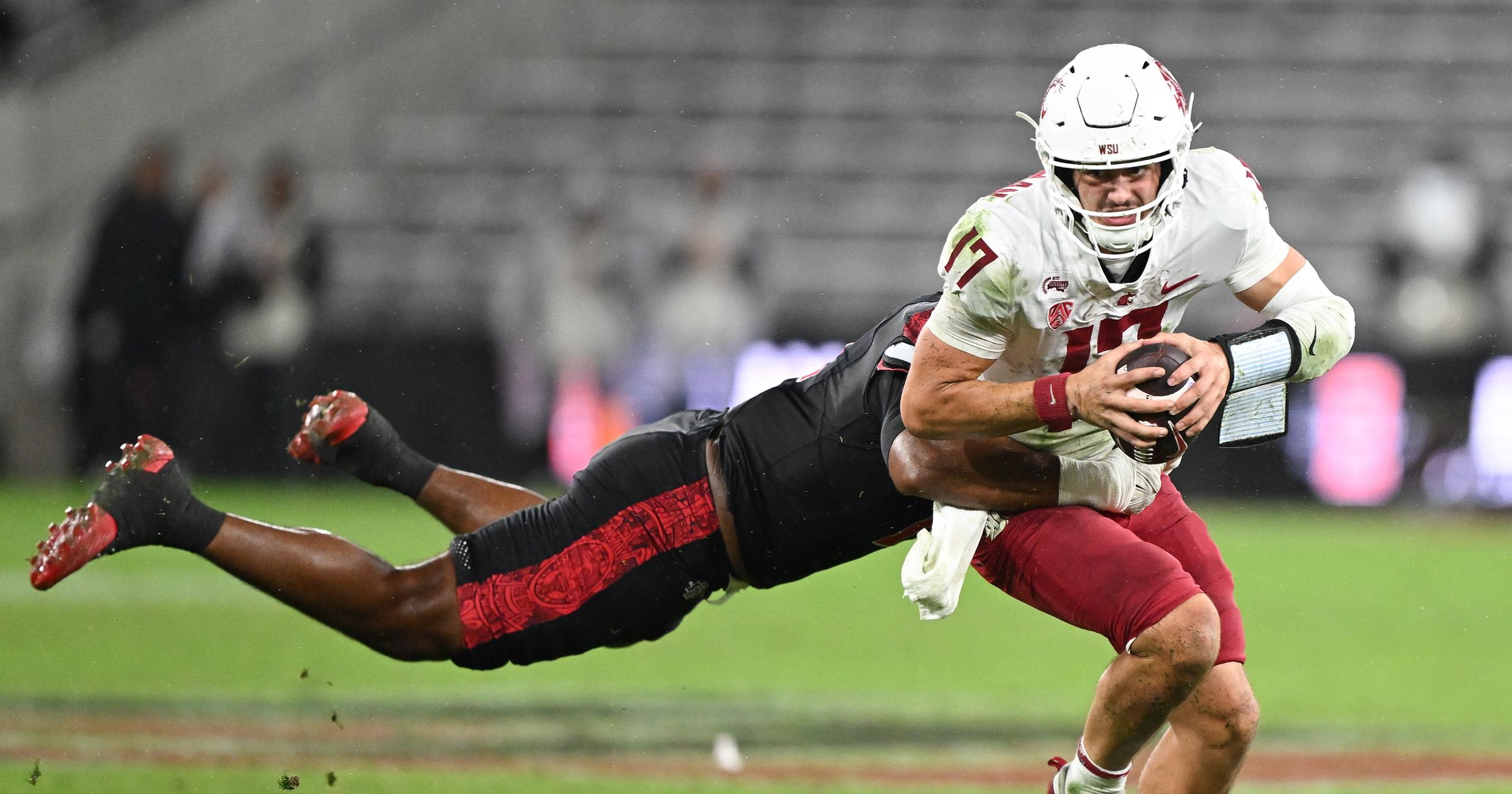
- Cougs fall in San Diego rain as another fourth-quarter push falls short
Washington State had a chance to pull off a fourth-quarter comeback on the road, but its final possession ended with a turnover on downs and the Cougars remained winless against FBS competition, falling 26-20 to San Diego State in a Pac-12 game on Saturday at a rain-soaked Snapdragon Stadium.
A nightmarish season continued for the Cougs (1-8, 0-5 Pac-12), whose offense couldn’t quite put a full game together against a woeful Aztec defense that entered the game among the worst in the FBS. WSU’s defense was effective against the pass. Against the run? Not so much.
Defensive cracks show
For the most part, WSU’s defensive front has been a strength of the team. The group made a few stops in big moments Saturday – notably, forcing a three-and-out on San Diego State’s final possession in the fourth quarter to give the offense a shot at a game-winning drive.
But overall, the Cougars’ defense was leaky against the run, surrendering 202 rushing yards on 37 carries for an average of 5.5 yards per attempt. The Aztecs had seven runs go longer than 10 yards, including a 46-yarder early in the game. Open-field tackling was a problem, as SDSU’s Lucky Sutton and Javion Kinnard churned through defenders for yards after contact.
SDSU recorded just 104 yards through the air and the Cougars tallied an interception, but WSU was fooled on a consequential pass, a WR trick pass play on a goal-line fourth down, which put the Aztecs up by 12 points midway through the fourth quarter. On that possession, SDSU leaned on the run to get into scoring position, moving the chains on Kinnard’s tackle-busting third-and-9 run to spark the important scoring drive, then picking up 16 yards on a Sutton run in the red zone that saw several WSU defenders whiff.
The Cougars’ rushing defense has been a weakness recently, allowing more than 200 yards in each of the past three games.
Offense can’t capitalize
The Aztecs entered the game ranked 133rd nationally (sixth from last) in scoring defense at 36.12 points per game and 134th in total defense (461.5 yards per game). No other defense in the nation had been on the field for more snaps (624) than SDSU’s this year.
For SDSU, it was apparently an ideal matchup against a WSU offense that ranks among the worst in the FBS.
Yet again, the Cougars made too many offensive mistakes and couldn’t run with their tailbacks (34 yards on 14 carries), spoiling what was a respectable effort from quarterback Owen Eshelman in his third start. He passed for a career-high 299 yards and rushed for two touchdowns, but threw an interception and was tagged with a third-down intentional grounding penalty in the red zone, which resulted in a missed field goal from long range.
Glaring issues emerged at the worst possible time, on WSU’s final drive with the team trailing by six points and with just under five minutes left. The Cougars couldn’t even reach midfield in 10 plays. The drive included two sacks and a false start, and ended with 38 seconds left, when Eshelman was hurried on fourth-and-10 and couldn’t complete a deep pass.
Managing only 20 points against an Aztecs defense that has proven to be more than susceptible is inexcusable for WSU and its offensive-minded head coach.
It’s gotten real gloomy
It started with so much hope – a promising new coach, a winnable new conference. But at this point, one has to wonder where this season might end up ranking among the all-time worst in WSU history.
At least the awful teams of years past were losing in a true power conference. These Cougars can’t contend against former Mountain West squads that WSU used to steamroll. It’s ugly. It’s a sad state. And it could get worse before it gets better – hopefully, it does, and this proves to be a building season. But right now, a one-win season is a real possibility. What would happen then?
- At SDSU, Cougs need Eshelman and Moore to find the gear they lost
PULLMAN – At the beginning of the week, when the frustration still hung in the hair like a bad smell and several questions lingered unanswered, Kirby Moore returned to what he knew for sure. As he thought back to his Washington State’s last game, a home loss to conference power Boise State, he was certain of one thing.
In his second start at quarterback, Owen Eshelman may have thrown one critical interception, which is when the Cougars began to lose the lead and lose the game. But he also directed one scoring drive and kept things clean otherwise.
“I thought Owen battled his tail off,” Moore said.
If the Cougars play their best in their next game, a road matchup with San Diego State set for Saturday afternoon, Eshelman shouldn’t have to. That’s because WSU will be going up against one of the country’s worst defenses in SDSU, which ranks three spots up from last in the country in total defense and five spots up from last in scoring defense.
The Aztecs (3-5, 2-2 Pac-12) are giving up about 36 points per game, allowing some 462 yards per contest, some of the worst numbers nationwide. Looking to earn its first FBS win of the season and end a five-game slide, WSU (1-7, 0-4) would do well to take advantage of those trends.
Can Eshelman and the Cougars do so? That much will likely depend on a few factors: Can their offensive line protect Eshelman and clear space for a robust rushing attack? Can Eshelman avoid turnovers? And perhaps most importantly, what can WSU get out of its three-receiver rotation of Branden Ganashamoorthy, Daniel Blood and Tank Hawkins – and will Moore’s group expand things?
Receiver Darrius Clemons, who exited early from his team’s loss to Utah State earlier this month, is listed as questionable for Saturday’s game. In his absence, the Cougs haven’t exactly expanded their receiver rotation to include other pieces like West Georgia transfer Jordan Dees or walk-on Caleb Northcroft, who would likely be next up. Instead, Moore has asked even more out of his starters, especially Ganashamoorthy, who has played 503 snaps, the third-most in the country among receivers. Blood has logged 448, which is No. 21.
WSU is one of only four teams with two receivers in the top 25, making clear what Moore seemed to indicate earlier in the week: Coaches really only trust those three starters. Is that conducive to a win, especially on the road? The temptation is to say no, but crazier things have happened.
“We talk about deliberate practice,” Moore said, explaining the usage of only three wideouts. “That really starts with bringing great energy, having verbal combat, doing your assignment, making sure you’re not thinking out there, that you’re just reacting. I think we’ve had too many errors from a practice standpoint with guys (not) knowing their assignments, whether it’s motions, details within the position. We’ve got a lot of trust in the guys who are out there on the field. If other guys improve and they’re to the standard, they’ll be out there.”
Regardless of how that trend pans out, WSU will want more out of its offensive line, and it’ll be interesting to see whether Moore shakes things up at that position group. As currently constructed, the group of left tackle Ashton Tripp, left guard Jonny Lester, center Noah Dunham, right guard Nick Bakken and right tackle Jaylin Caldwell aren’t just giving up sacks. They’re also struggling to run-block, which is making things exceedingly hard on the Cougs’ tailback trio.
Just how much has that limited the production of Kirby Vorhees, Maxwell Woods and Leo Pulalasi? In seven games against FBS competition, those running backs are averaging only 15 carries for 48 yards. They’ve enjoyed a stray long rush – against Utah State, Pulalasi broke free for a 52-yard touchdown jaunt – but more often, they haven’t seen any running lanes.
Could that change against San Diego State? Check out the patterns and the possibility seems to emerge. The Aztecs rank No. 109 nationally in rush defense, yielding an average of 178 rushing yards per game. Here’s the kicker to that, too: SDSU is allowing opponents to convert third downs at a 47% clip, which is No. 129 nationally.
That would be music to the ears of the Cougs, who are converting only 30% of their third downs, ranking six spots up from last in the country in that department. They’ve tried running up the middle to no avail. They’ve tried dropping back, which has often failed thanks to offensive linemen getting blown up. They haven’t found any easy answers.
Maybe they’ll get one this week in the form of the SDSU defense, which is a week removed from giving up a 50-spot in a 56-49 loss to Colorado State. The Aztecs have also been burned for 66 points against Oregon State, 41 against Toledo and 29 against Texas State, the last result a win. SDSU and third-year coach Sean Lewis have lost two of its last three.
Meanwhile, the Cougars will get a real challenge from the Aztec offense, which is prepared to start redshirt freshman quarterback Stone Saunders in place of Jayden Denegal, who ranks among the nation’s worst QBs in EPA per dropback. Last week against Colorado State, Saunders completed 23 of 33 passes for 369 yards, two touchdowns and two interceptions, including a pick-six shortly before halftime.
But there’s another phase of the game that WSU will have to be sharp in: special teams. SDSU redshirt freshman receiver Jaylon Hawkins leads the nation with three kickoff return touchdowns, matching the single-season school record. He took one back apiece in games against FCS Portland State, Texas State and Oregon State.
The good news for the Cougars: They rank No. 16 nationwide in kickoff return coverage, permitting an average return of only about 16 yards. That should serve them well this weekend. If things go well for them, so should their quarterback, too.
- Owen Eshelman's first start gave Wazzu its best FBS offense yet
PULLMAN – About a day out, it still feels a bit tricky to wrangle Washington State’s last game, a road loss to Oregon State on Saturday evening.
In a 48-30 victory for the Beavers, the Cougars looked better than ever on offense. In quarterback Owen Eshelman’s first start, WSU’s offense scored its season high against an FBS opponent. He unlocked the best in receiver Branden Ganashamoorthy, who finished with career highs in both receptions and receiving yards, and his running ability proved to be an understated part of his game.
That much was obvious to WSU coach Kirby Moore, who earlier in the week decided to bench Caden Pinnick, who started each of the first six games of the season.
“We just had a much better rhythm,” Moore said of Eshelman’s outing and what it provided to the team. “That takes all 11 being on the same page, whether it’s communication, whether it’s in the run game, the RPOs, obviously the pass game. It’s about landmarks and alignments there with the receivers and guys winning versus man and the quarterback trusting them. Today it was much better on first and second down. Third down, obviously did a better job in the second half than the first half.”
Still, it’s a fourth straight loss for WSU, which is now 1-6 overall and 0-3 in Pac-12 play. The Cougars are still looking for their first FBS win. Their defense may have been going up against a juggernaut in Oregon State’s offense, but good luck finding a team that can win a game allowing 48 points (OK, not counting WSU teams in the 2010s).
Where does that leave WSU for its next game, a home matchup with first-place Boise State next weekend? Here are three thoughts on that.
1. Did WSU coaches wait too long to pivot to Owen Eshelman? During Saturday’s game, as Eshelman threw for two touchdowns and rushed for another, that question hit the WSU orbit like a meteor. If Eshelman was capable of this all along, why didn’t Moore look his way earlier in the season, before things had spiraled out of control?
There is likely some level of truth in that sentiment. With Eshelman at the controls, WSU almost certainly beats Utah State. The Cougars could probably have taken down Fresno State. They could have even taken down Washington in the season-opening Apple Cup, especially now that the Huskies have shown themselves to be a shaky team.
Moore and coaches almost certainly stuck with Pinnick for too long, and in all likelihood, that decision cost their team multiple wins. For a proud program like WSU’s, which has made a bowl game in 10 of the last 11 full seasons, that isn’t good enough. Moore and his staff will get well-deserved criticism for riding too long with Pinnick, who the Cougars poured all kinds of resources into landing out of the transfer portal last winter.
But it’s also true that coming out of fall camp, Eshelman was not clearly the team’s best QB. Those honors went to Pinnick. Eshelman looked like he had the most lively arm, but several other factors tilted in Pinnick’s favor: He had a full season of experience playing college football, and with his athleticism, he profiled as a true dual-threat QB. He put all those characteristics on display across those 15 practices in August.
In that way, it’s not fair to criticize Moore for going with Pinnick for the season opener. It made sense for Pinnick to start that game, plus the next couple contests, at Kansas State and home against Duquesne.
That’s why the more salient conversation is when during the season coaches could have looked Eshelman’s way. Was there a spot in there for Eshelman to take over? It may not have made sense for coaches to bench Pinnick after a blowout win over FCS Duquesne, but even in that game, he showed a lot of the same problems that he did in Weeks 1 and 2. His one touchdown pass against Arizona, his only FBS touchdown pass, came in large part because a Wildcat defender fell down in coverage.
Pinnick showed the same symptoms in just about all his outings, in simpler terms. The logic that Moore might have been using might have involved his decision to take over playcalling duties, which he did ahead of the Utah State game: If Pinnick still looks iffy in that one, when we remove one of the variables, then we’ll find the root of the issue and pull the plug.
That logic feels a little wobbly, but if you’re a head coach who invested all kinds of time and resources into earning a commitment from Pinnick and coaching him up, that’s probably a thought that crosses your mind.
2. Eshelman should have gotten more chances to show his talents: For as fantastic as Eshelman looked, carving out 136 rushing yards and another score with his legs, he didn’t get as many opportunities to display his gifts as he could have.
On two fourth-and-short situations around midfield, Moore chose to punt it away. The first was a fourth-and-1 from the OSU 48, with the Cougs trailing 7-0. That became 14-0 one play later, when the Beavs unleashed a 90-yard touchdown pass.
The second was a fourth-and-3 from the WSU 49, with the Beavers up 20-3. One play after that, they jumped ahead 27-3, scoring on an 88-yard screen pass.
After the game, Moore defended his decision to punt in those spots, saying, “I’ve got a ton of confidence in our defense.” But also in the second quarter, he chose to take the ball out of Eshelman and the offense’s hands, opting for a Jack Stevens field goal on fourth-and-1 from the OSU 1. The Cougars got on the board for the first time with that three-pointer, and maybe there’s something to be said for giving your team some confidence by scoring any kinds of points.
But WSU was also an 18.5-point underdog, looking for its first FBS win against a juggernaut offense. The Cougars likely weren’t going to win that game with field goals. Besides, regardless of what happens after those punts, what kind of message does that send to your quarterback?
3. What kind of hope is there for WSU’s rushing game? In Saturday’s game, WSU tailbacks Maxwell Woods, Kirby Vorhees and Leo Pulalasi combined for 26 rushing yards on 13 carries. It was the latest example of their inability to get anything going, which has been augmented by their offensive line, which ranks second-to-last in the Pac-12 in Pro Football Focus’ run-blocking grades.
In fact, WSU’s run-blocking grade of 51.2 ranks No. 127 nationally. Only 11 other teams in the country have had a worse time in that department, at least in PFF’s view.
That makes it hard for WSU’s tailbacks to generate any production. The Cougars’ front five isn’t at full strength, riding with left tackle Maximus McCree in the absence of injured Ashton Tripp, but Tripp has graded below-average in run-blocking anyway.
Whatever the reason, though, the Cougs’ three running backs have left a lot to be desired this season. Here is how they’ve fared in their first six games of the season.
• Washington: 16 carries, 38 yards
• Kansas State: 17 carries, 72 yards
• Duquesne: 26 carries, 248 yards
• Arizona: 17 carries, 59 yards
• Fresno State: 12 carries, 45 yards
• Utah State: 19 carries, 77 yards
All told, the Cougars’ three running backs are averaging 80 yards per game. Trim that down to FBS opponents and the number is 52. We’ve written about this several times before, but it still rings true: Back in December, Moore’s ability to retain all three running backs felt like his top offseason accomplishment.
Now it’s fair to wonder if, with five games remaining, that group can get going in any consistent way. Eshelman’s passing ability figured to open up that possibility, but even with that going, the Cougs couldn’t generate much rushing attack from their tailbacks.
Maybe WSU can expect a big game in that department in mid-November, when it hosts a home game against Colorado State, which now ranks dead last nationally in total defense: 530 yards per game.
WSU doesn’t need to get its running backs going just for the sake of getting its running backs going. It was just one game, but Eshelman showed how skilled he is at running the ball. But the Cougs could lessen the pressure on him by getting more from their tailback trio.