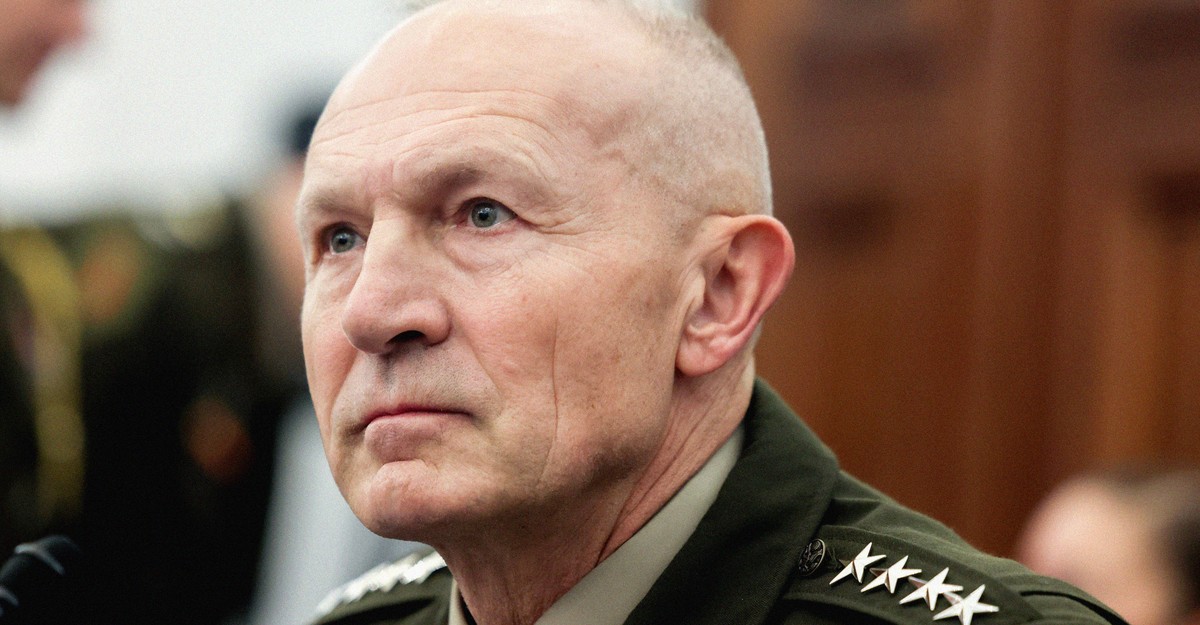
Army leadership shaken up as wartime plans hit turbulenceDefense Secretary Pete Hegseth fired the Army’s top officer, and the White House is discussing the potential departure of the Army secretary in what together would be the biggest wartime military shake-up in decades.
Hegseth asked General Randy George, who was just over halfway through his slated tenure as Army chief of staff, to step down and retire immediately, a Pentagon official told us. Officials at the White House are also discussing the future of Army Secretary Dan Driscoll, a close friend of Vice President Vance, people familiar with the matter told us. One Pentagon official said Driscoll was expected to leave the department soon.
Hegseth and President Trump have repeatedly raved about the military’s performance in the war against Iran. But George’s position has been seen as tenuous since Hegseth’s arrival at the Pentagon. The former Fox News host has fired senior officers who were associated with the previous administration or who had supported diversity initiatives he has dismissed as “woke shit.” Hegseth and Driscoll, both Army veterans with political ambitions, have been locked in a rivalry over the past year, current and former officials have said.
Still, the timing of George’s firing and the uncertainty over Driscoll’s future—on the 33rd day of hostilities against Iran—risks creating instability atop the military’s largest service. At least 50,000 troops and more than a dozen ships and submarines are now deployed in the Gulf region. Ground forces, including from the Army, could play a significant part in operations, which have so far focused on air and sea, as Trump considers forays inside Iran, including the potential seizure of enriched uranium or of Kharg Island, Iran’s oil-exporting center.
Members of the Army’s 82nd Airborne Division have been arriving in the region over the past week. Since the war began, on February 28, 13 American service members have died. Both Hegseth and George have traveled to Dover Air Force Base, in Delaware, as the fallen returned home. The United States has spent billions in Army-operated munitions to defend against Iranian drone and ballistic-missile attacks, leaving George—and now his successor—tasked with finding ways to restock that costly ordnance.
Hegseth’s pace of firings across the military is greater than that of any other Pentagon chief in the modern era, including during two decades of war in Iraq and Afghanistan. Since Hegseth’s arrival, the Pentagon has abruptly removed the chairman of the Joint Chiefs of Staff (the highest-ranking military officer), the top admiral of the U.S. Navy, and the No. 2 general at the Air Force, along with dozens of top-ranking officers and military lawyers across the services. The defense chief has not provided any detailed reasons for the departures. The Hegseth spokesperson Sean Parnell, in a statement, confirmed a CBS News report of George’s departure as “effective immediately.”
But Hegseth has repeatedly criticized the services’ top brass for, in his view, being insufficiently loyal to Trump’s agenda and overly concerned with the legalities of warfare, a position he has said stems from his experience as a member of the Army National Guard serving in Iraq. George’s firing happened a day after Hegseth took the unusual step of overruling the Army’s suspension of two Apache-helicopter crews who were being investigated for a flyover conducted near Nashville at the home of the musician Kid Rock, an avid Trump supporter. “Carry on, patriots,” Hegseth wrote on X when he announced the move.
With such an extensive purge of the senior ranks, many officers have concluded that those who speak up or question the administration risk losing their jobs. “Three years ago it would have been a big deal,” one former official told us, discussing George’s departure. “But Hegseth has already fired the chairman of the Joint Chiefs and chief of naval operations; you could argue it’s a big deal he lasted this long.”
[Read: The Pentagon’s lawyers are now under review]
George, an Iowa native who enlisted at the age of 18, graduated West Point and became an infantry officer. He commanded troops in Iraq and Afghanistan and served as a senior aide to Lloyd Austin, the secretary of defense in the Biden administration, before the Senate confirmed him to lead the Army in September 2023 for what was expected to be a four-year term. After Trump’s return in 2025, George attempted to make inroads with the new administration, highlighting the Army’s steps to modernize, its embrace of the tools of modern warfare, and its deepening ties with the tech sector. But, officials have told us, he has long been a target for Hegseth.
One person familiar with the situation said the secretary may have fired George because Driscoll, with his ties to Vance, was better protected. Driscoll attended Yale Law School at the same time as Vance, and the two men have remained close. Yet Driscoll, too, is now in jeopardy. At times over the past year, Driscoll, whom the administration tapped to play a key role in peace talks to end the Ukraine war, has threatened to overshadow Hegseth. The Pentagon, in a statement to us about Driscoll’s prospects, wrote: “All positions held by political appointees at the War Department are at will and serve at the pleasure of the President and Secretary of War.”
For much of the past year, Hegseth appeared to be on his own thin ice with White House officials, and Driscoll’s position appeared safe. But Hegseth has been a vociferous supporter of the president, who values his loyalty. And the Pentagon chief has overseen tactically successful military operations, including the June 2025 bombing of Iran’s nuclear facilities and the January 2 raid to seize the Venezuelan dictator Nicolás Maduro. He is now overseeing the much more complicated U.S.-Israeli war with Iran.
Hegseth has repeatedly said the U.S. military is performing ahead of schedule on its Iran plan, striking thousands of targets. But the war effort has been dogged by a lack of clarity over its strategic aims, the resilience of the Iranian regime, and the global economic shock of Iran’s closure of the Strait of Hormuz. Trump said yesterday that the war would continue for another two or three weeks, a timeline many analysts consider optimistic. The regime change that Trump initially said should follow the U.S. bombardment now appears unlikely.
It was not immediately clear whom Trump will nominate to replace George, though the general’s deputy, Army Vice Chief of Staff General Christopher LaNeve, is a Hegseth ally who has risen quickly through the ranks during the secretary’s tenure.
Ashley Parker contributed reporting for this story.