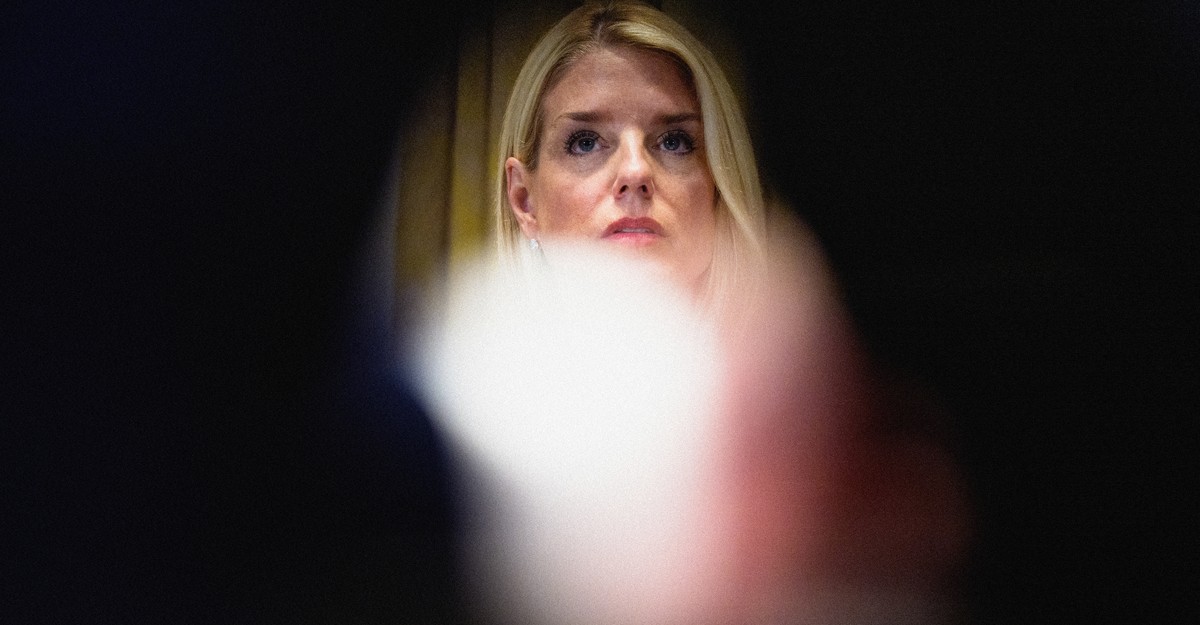
Trump's Cabinet Shuffle Returns, and Noem's Out the DoorThroughout his first term, Donald Trump serially fired and replaced members of his Cabinet as they displeased him. In his second, he seemed to be trying to break this pattern—keeping top aides even after their missteps and humiliations that would have sunk careers in any other administration. But now the president is back to his old ways. Last month, he fired Homeland Security Secretary Kristi Noem. Today, he announced the departure of Attorney General Pam Bondi.
Trump’s Truth Social post about Bondi is warm, despite his habit of insulting ex-employees: “We love Pam,” he wrote. But reportedly, the president had become frustrated with what he perceived as Bondi’s failures to use the Justice Department to go after his enemies, and with her clumsy handling of the ongoing fallout from the Jeffrey Epstein scandal. Unfortunately for Trump, these are not issues that can be fixed by appointing a new attorney general. Whoever holds the position next will be confronted with exactly the same problem: Trump is asking his attorney general to do the impossible.
Measured against Trump’s eclectic slate of early Cabinet nominees, Bondi seemed—on paper—like one of the more qualified choices. She was a vocal Trump supporter and had served on his legal team during his first impeachment trial, but she also had a legitimate track record as a lawyer and had worked for eight years as Florida’s attorney general. “Lawyers who have worked with her report that she is serious,” The Washington Post’s editorial board wrote, declaring her nomination “acceptable.” During her confirmation hearing, she reassured Senator Sheldon Whitehouse, a Democrat, that she would not “politicize” the office of attorney general or “target people simply because of their political affiliation.”
[Jonathan Chait: Pam Bondi couldn’t possibly succeed]
This commitment to apolitical justice did not last long. On February 5, Bondi’s first day in office, she signed a lengthy list of memos reversing Biden-era policies and establishing a “Weaponization Working Group” to investigate Special Counsel Jack Smith and other lawyers who brought legal cases against Trump. Many Justice Department lawyers, though, were most concerned by a memo that seemed to erode DOJ’s independence from presidential meddling. Traditionally, DOJ attorneys could decline to work on cases if they had serious moral or legal qualms. Bondi announced that this would no longer be the case. The practice, she wrote, “deprives the President of the benefit of his lawyers.”
At the time, I spoke with multiple current and former Justice Department attorneys who expressed alarm over Bondi’s phrasing. Some lawyers who later quit pointed to that memo as a turning point. DOJ lawyers have traditionally understood themselves as representing the United States—not the president.
Bondi proved dedicated to the task of turning an independent Justice Department into a machine for supporting Trump’s interests. Under her leadership, DOJ dropped the corruption case against New York Mayor Eric Adams, in what appeared to be a play to put pressure on Adams to cooperate with Trump’s immigration agenda. When asked by Sean Hannity whether she would fire prosecutors who worked on Smith’s investigation, Bondi promised, “We’re going to root them out.” During congressional hearings, she spent her time expressing her love for Trump, refusing to answer questions, and attacking Democratic members of Congress with apparently scripted insults.
Bondi shaped the Justice Department in other, stranger ways. The gift shop at DOJ’s Washington, D.C., headquarters began selling water bottles branded with Bondi’s name, current and former DOJ lawyers, who requested anonymity for fear of retaliation, told me. No one knew of any previous attorney general who had peddled their own merchandise. A well-known dog lover, Bondi also created a new category of the prestigious Attorney General’s Awards—typically given to top-performing DOJ employees—for K9s. She presented awards to the canines Lady and Diggs, employed by the Bureau of Alcohol, Tobacco, Firearms, and Explosives.
Despite Bondi’s best efforts, she was never able to provide everything Trump wanted. The Epstein scandal, in particular, proved difficult for Bondi to navigate. Her role at the head of DOJ put her in the awkward position of sating the many Trump fans eager for the release of the Epstein files, while also keeping the president’s name out of the spotlight. She made an early misstep in claiming, apparently without any basis, that Epstein’s “client list” was “on my desk right now to review,” and then releasing to MAGA influencers binders with Epstein-related material that turned out to contain little new information. After Congress passed bipartisan legislation requiring DOJ to publicly release records on Epstein, people on the left and right alike blamed Bondi for the department’s struggles to carry out this task. At a congressional hearing in February, when Representative Pramila Jayapal, a Democrat, asked Bondi to turn and address a group of Epstein’s victims, Bondi refused to look at them.
This made for bad press—a cardinal sin, in Trump’s view. Perhaps even worse, Bondi failed, in Trump’s eyes, to do enough to destroy his political enemies. With Bondi at the top, DOJ has dropped cases against Trump’s allies and brought bogus criminal cases against former FBI Director James Comey and New York Attorney General Letitia James. But those abusive prosecutions foundered. Judges threw out Comey’s and James’s cases (though DOJ is appealing), and the other cases sputtered out for a lack of evidence. According to The New York Times, Trump grew to feel that Bondi “has not moved aggressively enough to prosecute his political enemies.”
[From the March 2026 issue: What happened to Pam Bondi?]
Bondi’s inability to placate Trump was not for a lack of trying. She didn’t move aggressively enough, because she couldn’t. The politicized prosecutions that Trump wanted her to bring simply could not get through a legal system that, for all of its flaws, turns out to be capable of checking at least some of the worst abuses of a malicious executive branch.
Trump has announced that Deputy Attorney General Todd Blanche, his former personal lawyer, will take Bondi’s job while he searches for a more permanent replacement. Lee Zeldin, the administrator of the Environmental Protection Agency, is reportedly a top candidate. But neither Blanche nor Zeldin nor anyone else will be capable of escaping the trap into which Bondi fell. Bondi was boxed in by the restrictions of the legal system and the demands of online influencers, including those of the biggest influencer of all—her boss. She is just one example of how the administration now finds itself caught between the constraints of reality and the fevered promises of MAGA conspiracists.
Shortly after Trump announced Bondi’s departure, Fox News reported that she had already headed off to Florida, her home state. She leaves behind a Justice Department with a shattered reputation, weakened by the departure of thousands of attorneys who left under her watch. Bondi was not uniquely skilled at destruction, just a willing cog in Trump’s machine. Eventually, the machine ground her up, too.