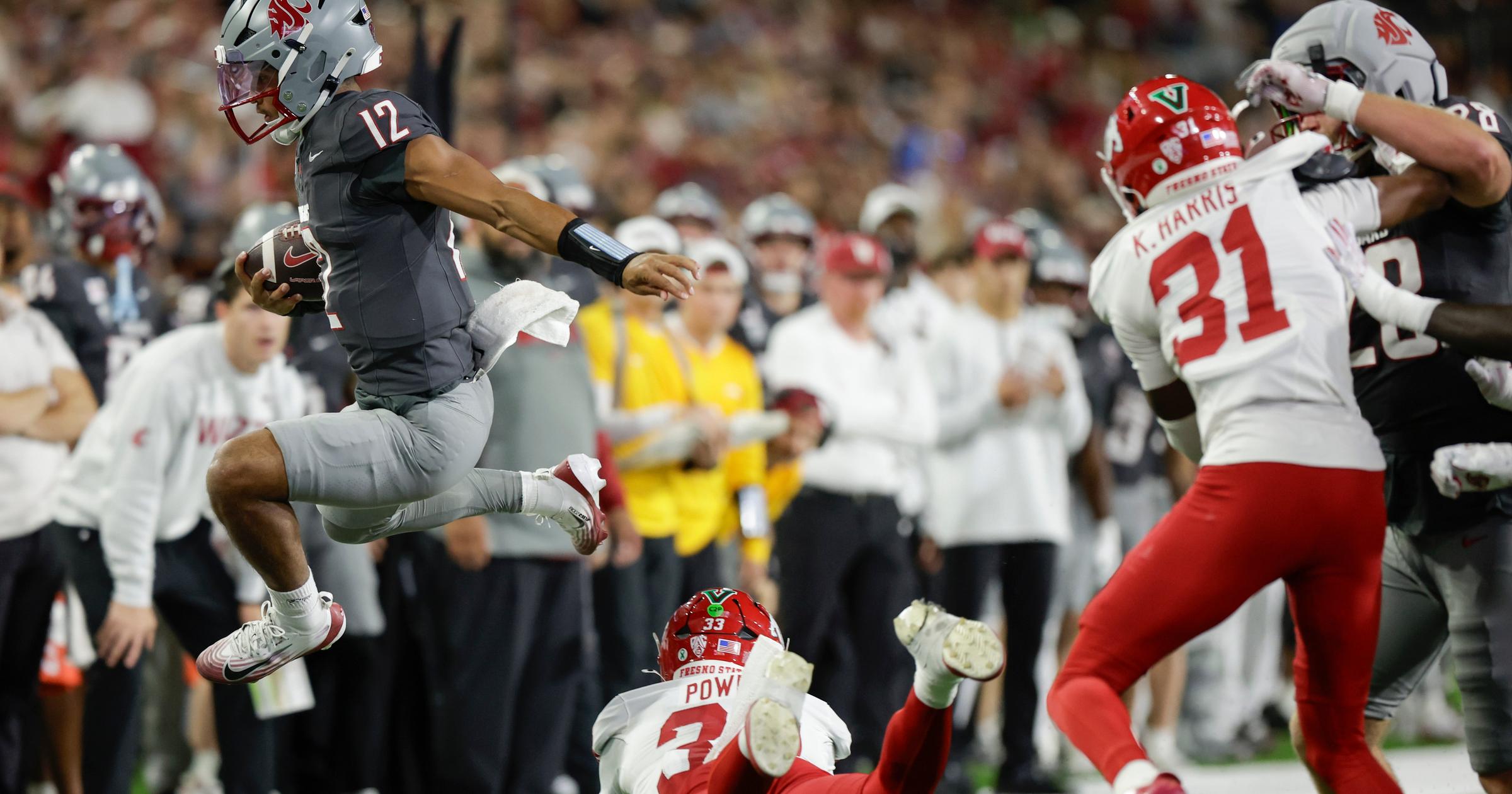
- Moore's offense showed some pulse, but the Cougs still left plays on the field
PULLMAN – The beginning of this Washington State season, the gauntlet the Cougars would see to open the Kirby Moore era, was always going to be difficult to parse. They faced three Power 4 teams in their first four games. Two were on the road. One came on a short week.
The Cougars were expected to come away from that stretch with one win and three losses. Thanks to a 34-24 setback to Arizona here on Saturday evening, WSU has fulfilled that much, which is not an indictment on these Cougars. But it does bring up the question that may define the rest of this season.
How many of the problems WSU’s offense is facing are a product of the stiff competition, and how many are the product of self-inflicted wounds that the Cougars would commit against the Pac-12 foes coming up?
We won’t know that much until conference play arrives when WSU hosts Fresno State next weekend, but the early returns on the Cougars’ offense are far from encouraging. Think about this stat, which is now official after Saturday’s game: In three games against FBS competition, WSU has produced three offensive touchdowns and committed six turnovers. The Cougars have lost seven total.
Moore’s team was expected to lose the games it has. It’s the way the Cougs’ offense is costing the team, though, that raises cause for concern.
“We gotta make sure we have a plan that everyone’s on the same page,” Moore said, “going from the half to the third quarter, especially in a tight game like that where our defense is battling, and we gotta find more ways to create explosive plays. We had them in the first quarter, in the first half, and had opportunities there to score even more. And then in the second half, we didn’t. So we gotta look at the film and see where we went wrong.”
In this one, WSU quarterback Caden Pinnick completed 24 of 41 passes for 241 yards, one touchdown and one interception, which came in the first quarter. If an Arizona defender hadn’t bobbled the ball later in the first half, Pinnick would have thrown two. Those were two costly decisions. Consider the other turnover Pinnick lost, a fumble that happened because he tried to throw the ball while being dragged down, and you start to see some of the poor decision-making that has led to Pinnick’s total turnover number this fall: four.
The reason that trend looms large for WSU: Pinnick is committing turnovers because of listless decisions, not because Power 4 athletes are making spectacular plays. Remember his interception last week against FCS Duquesne, when he threw into what became triple coverage downfield? Those are the kinds of poor decisions that have created such a gaping hole in the Cougars’ offense.
It would be one thing if Pinnick was playing a solid brand of football and a freak Power 4 defender, the kind that Arizona and Kansas State can afford, used his strength to jar the ball loose. That would be forgivable. But that’s not what’s happening. It may be Pinnick’s first season of FBS ball, but he has been too slow to differentiate a good decision from a bad one, especially when he’s looking to stretch the field vertically.
That raises a fair question: How can WSU coaches help Pinnick avoid those kinds of turnovers? How can they help Pinnick make better decisions, like in the third quarter, when he slid and gave himself up one yard short of a first down?
“We’re all in this together,” Moore said. “So it starts with me, obviously the offensive staff. Just having that dialogue with him, whether it’s in practice on the headset, reminders, making sure he knows exactly the stipulations, or even there on the third down. We ran the quarterback, he slides. That’s an unfortunate one. It’s a QB-designed run, and so we got to make sure he’s on the same page with that.”
The other problem the Cougars are facing is consistency. Their first drive in Saturday’s game, an 11-play, 71-yard scoring series, was nearly flawless. It ended when Pinnick took a QB keeper 11 yards into the end zone, following a string of perfect blocks, capping a perfect series. If that’s the way the Cougs were going to play in this one, well, the Wildcats should have been on their heels.
But WSU’s offense hardly looked the same after that. In the third quarter, the Cougs put up these numbers: 3 points, 149 total yards, 44 rushing yards, two three-and-outs, four punts and three sacks taken, giving Pinnick 10 sacks taken on the season. That opened the door for Arizona to turn a three-point deficit into a four-point lead, adding two more scoring drives in the fourth frame.
The Cougs can rebound from this. They showed what their offense can look like on that first series, and by showing an increased willingness to take shorter throws, Pinnick looks more than capable of making adjustments. But the biggest one he’ll have to make to avoid meeting the same fate against Pac-12 teams is more about trimming things out of his game.
He’ll have to make better decisions, better calls on when to try to stretch the ball down the field and when to be OK with checking it down. Fresno State’s defense figures to give him more opportunities to show that kind of acumen. But it’s on Pinnick, Moore and offensive coordinator Matt Miller to put themselves in a position where those changes don’t become just possible, they become probable.
“Give Arizona credit; they have a unique scheme,” Moore said. “So there was different variations of zone, whether it was inside, outside. Obviously, the quarterback pin-pull there we scored on in the first quarter. So there were some ID things there. Give them a ton of credit with how fast and hard those guys played. But we gotta have an answer as well with protecting the quarterback and having some more opportunities in the pass game.”
- Moore puts it plain after Cougs let early lead slip in Pullman
PULLMAN – Not 10 seconds had passed after Kirby Moore sat down at the podium, ready to discuss his Washington State team’s 34-24 loss to Arizona on Saturday evening, when he summed things up pretty succinctly.
“This should hurt,” Moore said.
That it did for the Cougars, who took an early two-score lead only for it to evaporate in the second half, when the Wildcats outpaced the hosts to the tune of 20-7. Quarterback Caden Pinnick played an OK game, but he also lost two more turnovers, giving him five on the season. And if it weren’t for an Arizona defender falling down in the fourth quarter, WSU would have netted just one offensive touchdown, which came on its opening series.
Here are five thoughts on this WSU loss, which dropped the group to 1-3 to open Moore’s debut season.
1. DE Linus Zunk turns in sharp game
It had been a quiet two games for Vanderbilt transfer Linus Zunk, one half of the pass rush duo that figured to take WSU’s defense from staunch to scary. After turning in four pressures in the season-opening Apple Cup, Zunk went on to have a muted impact in the Cougars’ next three games, posting zero pressures against Kansas State and two against FCS Duquesne.
That changed on Saturday, when Zunk registered his first sack in a WSU uniform, finishing with two pressures total, according to Pro Football Focus. That may sound like a relatively unremarkable day, but think back to WSU safety Jackquintin Bal’s pick-six in the first quarter. Part of the reason Arizona QB Noah Fifita threw such an errant pass, it seemed, was because Zunk produced enough penetration to get a hand in Fifita’s face at the last second.
For the season, Zunk now has eight QB pressures, tied with his pass-rushing partner, Matyus McLain, for the team lead. Zunk has also earned a PFF defensive grade of 70.5, which ranks second among all Cougars playing meaningful snap counts. That’s just about what WSU was looking for from Zunk when coaches recruited him out of the transfer portal.
2. WSU must improve end-of-half operations
For the second straight week, WSU coaches bungled an end-of-half opportunity, missing out on a chance to score a touchdown before halftime. In Saturday’s game, a bevy of things went the Cougars’ way: A late-hit penalty on Arizona, then a pass-interference penalty on Arizona and, three plays later, another 15-yard penalty against the Wildcats. Also sandwiched in there, Pinnick got away with a bad decision to loft the ball downfield – more on that later – because an Arizona defender bobbled an easy interception on his way out of bounds.
That set WSU up with this dream scenario: first-and-10 from the Arizona 12, the game clock at 1:18, which is tons of time. But after running their first play, a QB keeper for Pinnick, they let the clock run down, all the way from 1:15 to 33 seconds, before calling a timeout.
The reasoning remains unclear. The Cougars could have done all kinds of things with that time: run another play, called a quick timeout, you name it. Instead, they cost themselves 40 seconds doing nothing. They paid for it. One play later, Pinnick was sacked, and then on a screen play on third-and-12, Pinnick’s pass was wide of receiver Tank Hawkins Jr., forcing him to retreat and take a loss.
WSU did get points out of that drive, a field goal from struggling kicker Jack Stevens, but the Cougars certainly left something to be desired. To their credit, they did make an effort to move the ball down the field in this 2-minute situation, which they didn’t attempt last week against one of the FCS ranks’ worst defenses.
But considering the array of plays that went WSU’s way in this situation, it stands to reason the Cougars could have gotten a lot more out of that spot.
3. Cougars must clean up their special teams unit as a whole
In this game, Stevens will get dinged for a missed field goal, his fifth in four games. He has been far from perfect, but this one wasn’t his fault. On the play, offensive lineman Jaylin Caldwell failed to really block anyone, letting Arizona defender Tre Smith come through mostly unblocked and get a hand on the ball, knocking it away.
That sowed another seed of doubt in this WSU special teams unit, even with Stevens back improving, which seems to be the case after he nailed a 33-yard field goal later in the game.
In the third quarter, after another forgettable series on offense, WSU punted it back to Arizona. Wildcat receiver Caleb Smith fielded it at his own 30, darted around defenders and scampered upfield, all the way to the Cougars 31, where he was dragged down. It was a 39-yard return, setting up the Wildcats deep in Cougar territory.
It’s not the first time that’s happened to WSU’s punt coverage team. In a road game against Kansas State earlier this month, the Cougars gave up a 62-yard return, which the purple Wildcats turned into a touchdown two plays later. WSU special teams coordinator Derek Sage, who also coaches receivers, hasn’t been able to get much consistency out of that group early in the season.
The only bright spot on WSU’s special teams group has been punter Max Dean, who battled migraines in Saturday’s game to record five punts for 200 total yards, an average of 40 yards. He’s now averaging 45.2 yards per punt, which ranks No. 14 in the country.
4. Pinnick played a solid short game, but he’s shown weaknesses trying to extend plays
In Saturday’s game, Pinnick was at his best completing passes of short-to-intermediate length, tracking with patterns that have surfaced so far this fall. On passes between zero and 9 yards, Pinnick completed 18 of 21 throws, which is an elite percentage of 85%. Credit WSU coaches for putting him in those situations to make his best throws.
But Pinnick now has five turnovers, and many have come when he’s tried to extend plays and do more. Early against Arizona, Pinnick scrambled out of the pocket and flung a pass downfield, where it was easily intercepted by a Wildcat defender. He might not have seen the double coverage in the sun.
Then, in the third quarter, he was facing heavy pressure when he tried to get the ball out. He tried to do so too late, and he lost the ball as he was throwing it, resulting in another turnover for WSU, which has committed seven total this fall. Toss in another iffy decision from Pinnick, on that near-interception in the second frame, and it could have grown to eight.
“We’re all in this together,” Moore said. “So it starts with me, obviously the offensive staff. Just having that dialogue with him, whether it’s in practice on the headset, reminders, making sure he knows exactly the stipulations, or even there on the third down. We ran the quarterback, he slides. That’s an unfortunate one. It’s a QB designed run, and so we got to make sure he’s on the same page with that.”
5. WSU must get more from its running backs
Here are the numbers from Cougar running backs against FBS competition: 50 carries for 169 yards, which comes out to 3.38 yards per carry. Tailbacks Kirby Vorhees, Maxwell Woods and Leo Pulalasi were seen as a formidable trio headed into this season, but with the exception of a brilliant day against FCS Duquesne last weekend, they haven’t generated the production to match.
Things figure to get a little easier for WSU next week, when Fresno State comes to town, kicking off Pac-12 play. Those are the games in which we can begin to judge this WSU team in earnest. But against FBS teams, the Cougars’ ground game hasn’t been compelling just yet.
- We Have the Backs, Now We Need a Plan to Use Them
PULLMAN – Think back to January, when Washington State coach Kirby Moore pulled off what was seen at the time as a monumental move, putting together a three-man running back room that figured to gash opponents this fall.
Kirby Vorhees, last year’s starter, was planning on entering the transfer portal but decided to return to WSU the night before it opened. Tailback Maxwell Woods also returned to the team. And fellow running back Leo Pulalasi entered the portal, only to reverse course and also sign a new NIL revenue-sharing deal with the Cougars.
Especially under a head coach like Moore, whose best offenses at Missouri involved a productive ground attack, it seemed like the Cougs had struck gold with the return of their top three running backs.
Now let’s fast forward to this last week of September, after WSU’s 1-3 start to the season, the record the Cougars were expected to open the season with. It’s one thing that the Cougs’ offense has struggled in most of these outings. It’s another that one of the bigger culprits is their ground attack, or lack thereof, which has hampered what Moore and offensive coordinator Matt Miller had planned for quarterback Caden Pinnick’s offense.
WSU deserves credit for gashing FCS Duquesne for 316 rushing yards earlier this month, especially because Woods and Vorhees each cleared the 100-yard mark, but it’s also true that the Cougars did that against one of the FCS ranks’ worst defenses. What’s likely more informative is how they’ve fared against FBS competition, even if there’s been something of a talent gap in those games.
In a loss to Washington, WSU’s running back trio combined for 38 yards. In a setback to Kansas State, those three combined for 74. And on Saturday in a defeat to Arizona, they tallied just 59 yards between them. That adds up to 171 yards, which is 57 yards per game – not exactly eyebrow-raising in the way Moore was hoping for ahead of the season.
That forces Moore and Miller to find a way to get them more involved, to find ways to increase their production. How can they do that? Perhaps one way involves getting them more targets in the passing game, which they haven’t enjoyed much so far.
“We gotta find ways to get them matched up,” Moore said. “They make it tough, Arizona does, with how much they pressure because you are worried about the quarterback being hot at times, and you wanna make sure you’re protecting him as much as you can. And then we gotta stay on the field. That’s the best way to get the backs more touches, right? We gotta convert on third downs. The four drives there in the third quarter, we had three punts and a turnover. That’s not good enough.”
Moore had a point. In Saturday’s third quarter, the Cougars punted on three drives and lost a fumble on another, which happened when Pinnick was trying to escape pressure and attempted to throw the ball away while getting dragged down. That was Pinnick’s fifth turnover of the season and WSU’s seventh as a team.
Perhaps more to the point, WSU went 0-for-7 on third down in the second half. That didn’t just take away chances for the Cougars to score. It also removed opportunities for WSU’s tailbacks to involve themselves in the offense, which in turn could have opened up things for Pinnick and Co. Many of WSU’s problems on offense this season have run together, creating an amalgamation of issues. This is no different.
Consider this stat: This season, WSU running backs have been targeted as receivers a combined 22 times. They’ve hauled in receptions on 14. That comes out to a completion percentage of 64, a few ticks up from Pinnick’s 61% overall completion rate . That seems to suggest the Cougars could do well to incorporate more of that in their offense.
WSU gets a chance to prove it on Saturday with a home matchup against Fresno State, which figures to provide more chances to do so than the Power 4 teams that the Cougars’ offense has struggled against.