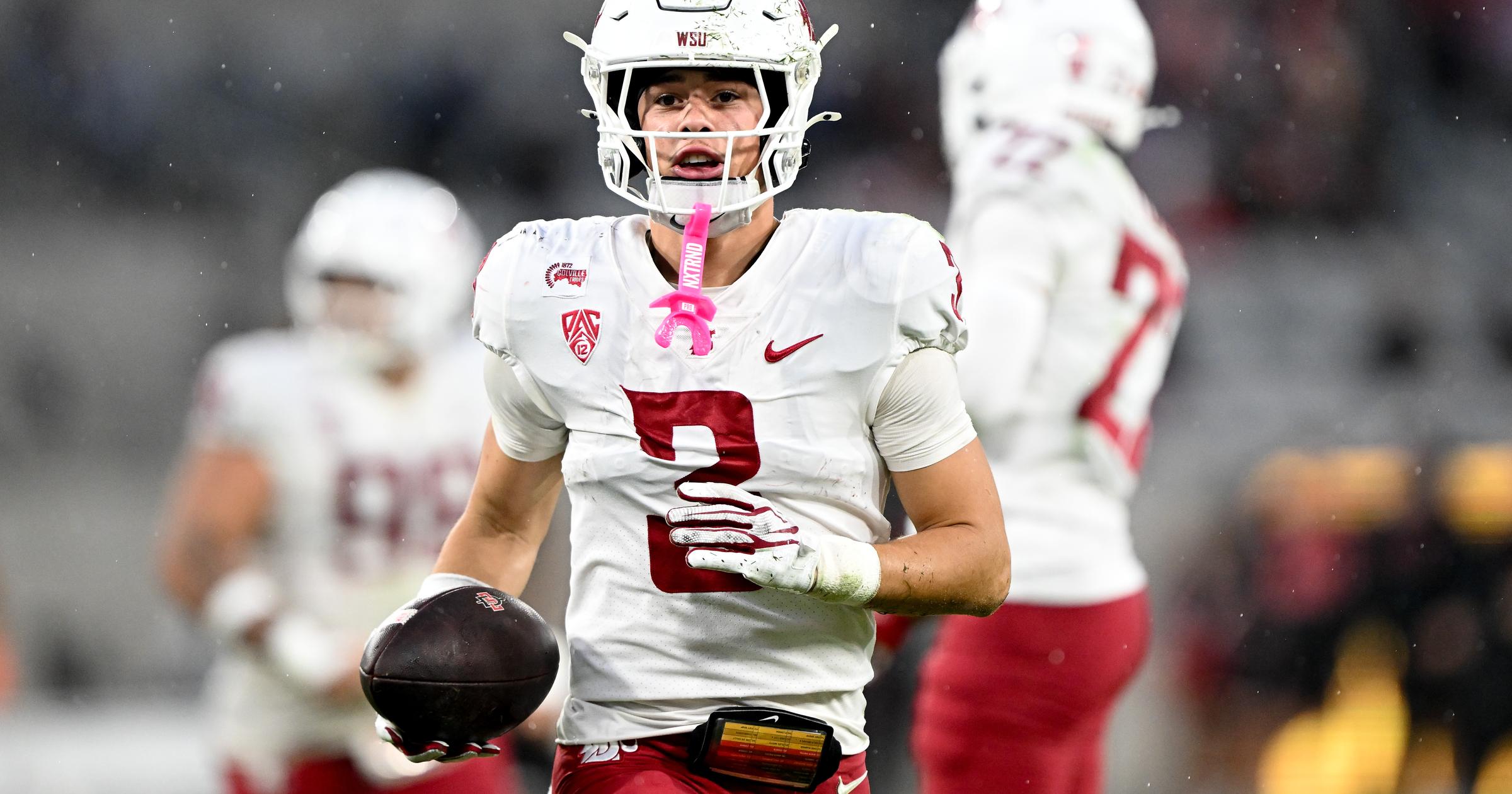
- Second-half snaps tell the story of WSU's defensive breakdowns
PULLMAN – A few minutes after halftime began and Washington State players filed into their locker room, the sparkly new crimson and black lair that was remodeled over the summer, linebacker Keith Brown turned to a teammate with a question.
“What’s the score?” asked the sixth-year linebacker.
It was Saturday evening, and WSU had just taken a three-point lead on visiting Arizona into halftime, but Brown was none the wiser, according to his retelling. Brown and the Cougars’ defense had yielded a pair of scoring drives, and because quarterback Caden Pinnick had thrown an interception, that unit had to be on the field for one extra drive.
As the rest of the game unfolded, the Cougs lost one more turnover, a fumble from Pinnick on a play where he was trying to throw the ball away as he was getting tackled. That was the seventh turnover WSU’s offense has committed this season, which has spawned all kinds of other problems, perhaps this above all: The Cougars’ defense has been tasked with playing tons more snaps, lots more drives, putting them at risk of tiring themselves out when they shouldn’t have to.
For his part, Brown says it isn’t much of a problem.
“I don’t even think about it, man,” Brown said. “As a defender, you’re so excited to go out there and play, no matter what. … We just go out there every single series, and that series right there is the only thing I’m worried about. I don’t care if I just came off the field or the offense has been out there for a while. I’m excited to go out there and play.”
That may be the case, but it also means WSU defenders are playing heavy amounts of snaps. Check out some of the total snap counts from the Cougars’ loss to the Wildcats last weekend. Cornerback Khamari Terrell led all defenders with 72 snaps. Then came Brown, who logged 69, followed by defensive backs Jackquintin Bal with 67 and Jamarey Smith with 61.
That was the second time at least three WSU defenders played at least 60 snaps each, joining the team’s earlier loss to Kansas State: defensive backs Kai Rapolla, Jaylen Thomas and Smith all cleared the 60-snap mark.
Headed into WSU’s next game, a home matchup with Fresno State to kick off Pac-12 play, two defenders have hit the 200-snap threshold: Thomas leads the team with 225 snaps while Brown is on his heels with 222. Several others are in the area, including Smith at 199, linebacker DJ Warner at 196 and safety Jeremiah Bernard at 192.
Does that add up over time? Or does it all come out in the wash for a bunch of 19- to 22-year-olds?
“It adds up in fact that you’re going against a really good quarterback,” WSU coach Kirby Moore said, referring to Arizona’s Noah Fifita, “and we were very aggressive on defense, and you saw that in the first half. Over time, he’s gonna make some plays. He’s gonna create some passes downfield, and they had the quick drive right there, and just keeping our guys fresh because the coverage and the front, it’s all gotta work together. If the front is tired and we’re not getting the rush that we want to, well, that’s affecting the back end. That’s what we gotta get solved there in the third quarter, and it really starts playing complementary football.”
Perhaps no single stat illustrates the point better than this: WSU’s defense ranks in the top half of the country in points allowed in the first quarter, permitting just 4.3, which ranks No. 57 nationally. In the fourth quarter, the Cougars are allowing an average of 11.3 points, which ranks No. 123 nationally, only about a dozen spots up from last in the country.
Think about the way WSU’s defense was operating in the first quarter against Arizona. Defensive end Linus Zunk earned a sack on the first play of the game. Bal snagged that pick-six. Then later in the first quarter, defensive tackle Jirah Leaupepele got home for another sack. “Just doing my job,” he said about that play.
The Cougs (1-3) couldn’t replicate that level of production in the second half. The Wildcats won the second half to the tune of 20-7, averaging nearly 7 yards per play, keeping Fifita clean the rest of the game.
In other words, WSU defenders wore down as the game unfolded, which is partially to be expected of a group headed out onto the field so often. The Cougars have lost seven turnovers on the season, remember? Only 18 other teams in the country have committed more. That sets up defensive coordinator Trent Bray’s unit with more and more series, and while the Cougars could certainly be doing more on defense – their inability to get much pressure on Fifita in Saturday’s second half loomed large, as did a long touchdown rush K-State broke off earlier this month – check out their high snap counts and you start to understand the root of the issue.
So what’s the solution? Play more defenders? That isn’t feasible in all of WSU’s position groups. Cornerback Jalil Tucker, a starter in Week 1, has missed the last three games with an injury. Linebacker Nylan Brown was out last week. Defensive ends Malachi Wrice and Mike Hughes were too, and they figure to be out this Saturday against Fresno State. The Cougars could get more out of young safety Kyle Peterson, for example, but after he made an early mistake that led to an Arizona touchdown, he didn’t see the field again.
What about other players on the roster? Could the Cougs give more looks to guys like defensive lineman Josh Wedel (73 snaps) or defensive end Ben Beatty, who has played just 67 snaps? The latter seems possible, but in an interesting development, WSU coaches have never separated starters Zunk and Matyus McLain. They have both played 184 snaps, indicating that coaches like them best when they’re on the field together.
With that in mind, it’s possible that the best respite for this WSU defense is an improved offense, an offense that can sustain drives. The Cougars figure to have an easier time doing that against the likes of Fresno State than they did against Power Four foes like Washington, Kansas State and Arizona. If they can hold onto the ball against the Bulldogs – whose defense ranks sixth nationally with a plus-seven turnover margin – the Cougs won’t just be doing their offense a favor.
They’ll also be doing a favor to their defense.
- San Diego exposed what keeps WSU from closing out wins
SAN DIEGO – Jaylen Thomas shook his head ever so slightly, almost imperceptibly so, as he thought about one of the problems holding back this Washington State team.
The Cougars had just turned in another loss, a 26-20 road setback to San Diego State on Saturday evening, and their secondary had just borne a fair share of the blame for this one. They are slogging through a considerable tackling issue, a key reason why the Aztecs ran wild on them.
“I just gotta find ways to get better at wrapping up,” Thomas said, “either taking the extra step to get closer to the running back. It’s just stuff I work on, just making sure I get the guy down as opposed to just making contact.”
SDSU racked up 202 yards and two touchdowns on 37 carries, including 115 from tailback Lucky Sutton, who broke free for several huge gains: a 46-yarder, two 11-yarders, a 16-yarder. His backfield mate, Javion Kinnard, scored two touchdowns on rushes of 9 and 10 yards.
The common denominator on those plays: The Cougars’ secondary, from Thomas to safety Jeremiah Bernard to nickelback Jamarey Smith, couldn’t bring down the Aztecs’ ballcarriers when they had the chance. They whiffed on several occasions, a problem that has sprung up lots of times this fall, most noticeably last week, when WSU missed 18 tackles in a loss to Boise State.
Give the Cougars credit for this: Their interior defensive linemen are making it difficult for opponents to run up the middle. Linemen like Kaden Beatty, Jirah Leaupepetele, Damarjhe Lewis and Paul Hutson have engineered that much, and they’ve done their job more often than not, using their hulking size and strength to deter Aztecs and Broncos, Bulldogs and Aggies.
So teams have wised up. San Diego State realized tailbacks had better chances going to the outside, which is true. That’s where Bernard and Thomas live, plus cornerbacks Jalil Tucker and Khamari Terrell, who are athletic and smart players. But they’ve been subject to bad tackling and some worse decision-making, choosing poor pursuit routes as they follow the ball.
“We had two goals going into the game,” WSU coach Kirby Moore said, “and the first one was to take care of the football and take the ball away. They’d won one game over three years when they lost the turnover battle. We didn’t do that. It was tied. Defensively, we wanted to keep them under 150 yards rushing. They rushed for 202. Did a better job of executing from that standpoint. There was a number of times to win the game outside of the last drive. Appreciate our players’ fight. We gotta go back to work.”
Here’s another trend that is holding back WSU’s defense: It can’t produce sacks. The Cougars didn’t bring down Aztec QB Stone Saunders for any sacks in this one, which might bely the pressure that defensive ends Matyus McLain and Linus Zunk have generated with consistency, but they haven’t been able to finish those plays.
Headed into this game, WSU ranked No. 131 of 138 FBS teams with only eight sacks on the year. After the game, that number will stay the same. What has to change is the Cougars’ tackling ability, especially on the perimeter, if they want to earn one FBS win this season.
- Why Matyus McLain is all smiles with WSU at 1-7
PULLMAN — Matyus McLain might be the happiest guy on Washington State’s team. He smiles everywhere he goes, from the practice field to game settings to press conferences, greeting everyone he sees with a warm grin and a delighted demeanor.
As the Cougars slog through this season, carrying around a 1-7 record as they continue searching for their first FBS win, it registers as remarkable. How does McLain, one of the team’s top defensive ends, stay in such a good mood?
It helps to know a bit about McLain’s background. He hails from nearby Priest River, Idaho, where in high school, McLain won a total of two games in his four years of action. The Spartans went 0-8 in 2019 and 0-7 in 2020. In 10 of those losses, Priest River didn’t score. In 2021, the Spartans lost seven games, only winning one by forfeit over Orofino. Priest River went on to win two games in McLain’s senior season, including one over the same Orofino club that had forfeited the year prior.
“I’ve lost before. It happens,” McLain said earlier this week. “The only thing you can do is keep going. I’m not gonna roll over and quit, and I don’t think anybody else in the locker room is going to do that either. You see the same thing week in, week out. We’re gonna keep trying harder and harder every single week till we get it right.”
McLain’s attitude is particularly fascinating because among these Cougars, he might have some of the most reasons to feel frustrated. Over the winter, he transferred from FCS Idaho, looking to use his speed and power to generate sacks for WSU. He looked like a candidate for a breakout year. All the signs were there.
In eight games, McLain has delivered on some of that promise. He has produced 23 quarterback pressures, according to Pro Football Focus, which is third in the Pac-12. He has also engineered a win rate — which measures how often a defender beats their blocker within 2.5 seconds of the snap — of 17.1%, which is also third in the conference. He’s faced few issues getting into opposing backfields.
But when he’s gotten there, McLain hasn’t been able to bring down quarterbacks. He has only one sack to his name. His fellow edge rusher, Vanderbilt transfer Linus Zunk, has only two sacks on 17 QB pressures. As a team, WSU has collected only eight sacks, which is tied for No. 130 of 138 FBS teams. Only four other teams in the country have supplied fewer.
If that sounds rare, it’s because it is. Think about this: In college football, 71 players have totaled at least 20 QB pressures, according to PFF, including McLain and Zunk. Only five have generated one sack or fewer.
For WSU, it’s been a disappointing string of results, but it also presents a contrast that’s difficult to square: The Cougs are producing all kinds of pressures on quarterbacks, but they aren’t completing those plays with sacks.
That folds in nicely with the bigger issue with WSU’s defense: The group is having trouble getting turnovers. The Cougs have nabbed only five, which ranks No. 126 nationally. Only seven other teams have fewer turnovers. It hasn’t been a back-breaker for WSU, whose defense is still a plus, but that group is now allowing nearly 387 yards of offense per game — No. 102 nationally, fifth in the Pac-12.
“Our coach, Andrew Browning, he always talks about it: We’re not chasing sacks,” McLain said. “We’re chasing hits, hurries. Chasing that, it’s gonna lead to sacks. I mean, you’re right. (It’s about) getting there a little faster, but you watch the tape — we’re all over the D-line. The front seven is everywhere. No question about it. We’ve got it.”
For WSU, the part that might sting most is that defenders have had chances to bring down quarterbacks, to grab interceptions. In the third quarter of a loss to Boise State last weekend, the Cougars had a chance to do two things: Bring down BSU QB Maddux Madsen for a sack, plus get off the field on third down. If they did that, they would have had a chance to take the lead.
Instead, Madsen eluded the pressure and dashed upfield for a 17-yard gain, which led to a touchdown moments later. In hindsight, it was the kind of sequence that sums up this entire WSU defense’s season: Some encouraging flashes and serious potential, but it didn’t land.
In the same game, the Cougs had a few chances to intercept Madsen, who still has not thrown one this fall. One came toward the end of the first half, not long after WSU and QB Owen Eshelman turned in a long scoring drive to tie the game, when Boise State marched into the red zone. Madsen dropped back and laced a pass over the middle, where WSU nickelback Jamarey Smith broke on the route, but BSU receiver Cam Bates got a hand in the mix to prevent Smith from catching it.
Earlier in the game, back in the first quarter, Madsen tried a pass over the middle, where WSU linebacker DJ Warner was waiting. He reached out and got two hands on the ball, but it fell incomplete. It was a missed opportunity for Warner, who in his first year playing linebacker is still learning the ropes of the coverage side of his job.
Consider this stat: The Cougars have now dropped six interceptions, which is tied for the most in the country. Smith has dropped three, which is the second-most by one player nationwide.
You can read that number a couple of ways. Sometimes, a low figure might mean that defenders are simply capitalizing on their opportunities to make interceptions. Other times, it means that defenders aren’t in position to grab interceptions in the first place. There’s plenty of context involved.
For their parts, the Cougs have collected three interceptions, so they’ve taken advantage of several chances. But they’ve also dropped six, and in a 1-7 season, that figure looms large.
“We’ve definitely been in that position numerous times, and it’s all about, like I said, just executing,” Smith said. “When you get that chance and opportunity, just take it. You work so hard for it, so why not just go for it and take your shot? I’ve been there for sure, and it’s just about us having it and executing.”