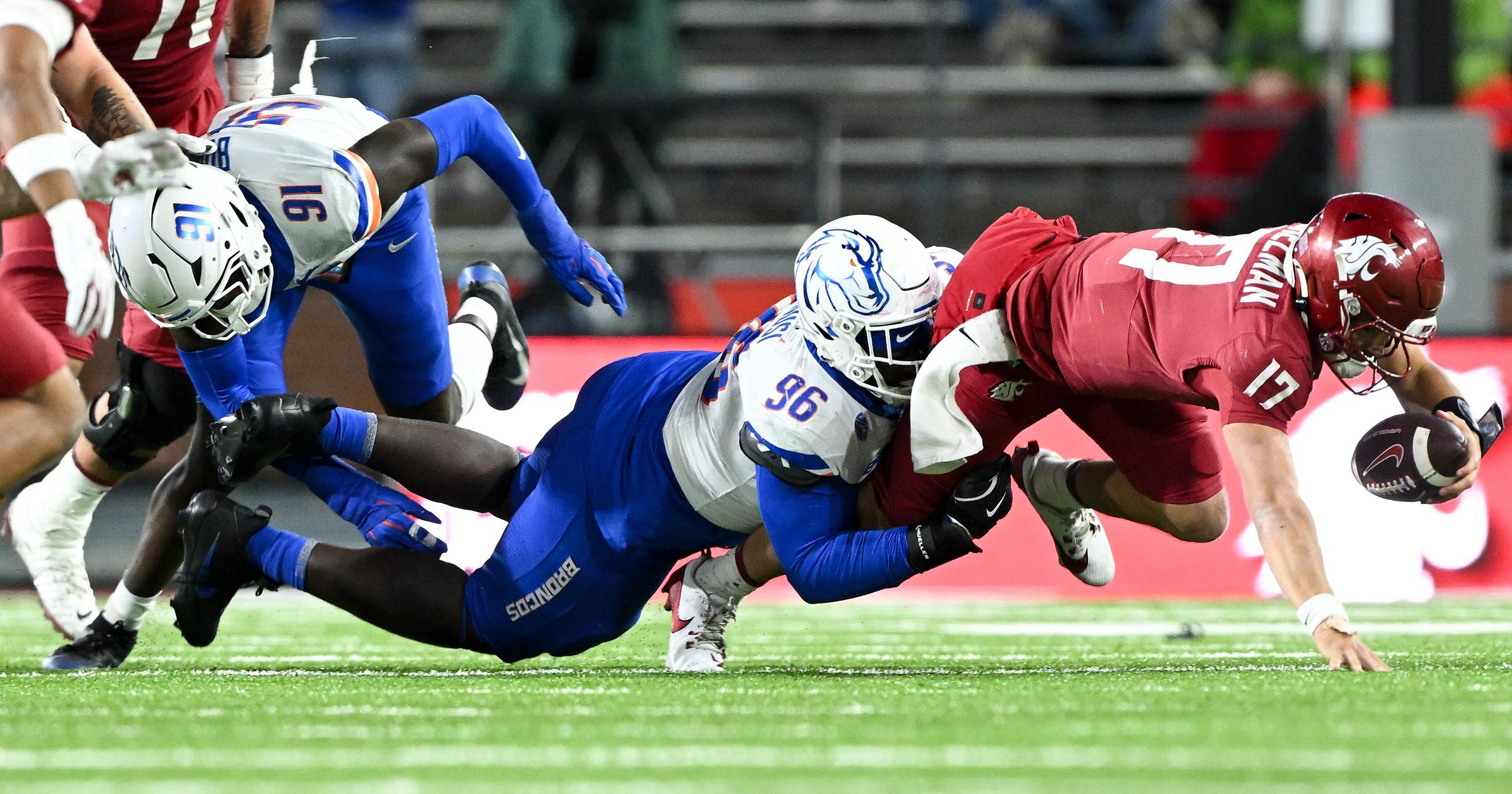
- Owen Eshelman Puts Up 30 Points in a Loss and the Cougs Finally Have a QB
PULLMAN – In the aftermath of quarterback Owen Eshelman’s first start, an electric showing in his Washington State group’s fourth straight loss over the weekend, the reactions came showering in like a typhoon.
He’s actually airing it out!
He looks poised in the pocket!
Look how sharp the Cougs’ offense looks!
Indeed, Eshelman guided WSU to 30 offensive points, the team’s most all season. That wasn’t enough to prevent the Cougs from falling short again, this time to the tune of a 48-30 final margin, but Eshelman looked accurate. He was willing to look for the deep ball. He executed a couple really well.
For the Cougars, that represented a firm step in the right direction, an indication that head coach Kirby Moore made the right call pivoting away from Caden Pinnick and swapping in Eshelman. Should coaches have made that move sooner in the season? Probably, and that conversation has been fleshed out in all kinds of ways.
“We’re not looking in the rearview mirror,” Moore said after Saturday’s game on that topic. “We gotta keep building on where we’re at right now.”
What isn’t as immediately obvious at first blush is how different the Cougs’ passing attack was with Eshelman at the controls. He aired it out, sure, but how much of a change did that represent for WSU? How did his accuracy bolster the offense? And how did he navigate the pocket?
As Washington State prepares for its homecoming game, a home showdown with first-place Boise State this weekend, those questions are worth exploring. Do the Cougs have a shot at pulling the upset? They might be 12.5-point underdogs, but Eshelman and the life he brings to his offense could be reason to believe the answer might be yes.
1. Eshelman looked to push the ball downfield
Perhaps the most striking part of Eshelman’s performance, the development that might have made you say “wow” right away, came in his readiness to stretch the field vertically. Pinnick wasn’t just shaky at this in his six starts; he wasn’t even willing to do it.
Think about this: In WSU’s loss to Utah State earlier this month, Pinnick attempted only six passes 10 yards or further downfield, according to PFF. That included zero passes 20 yards or deeper. It was clear that he wasn’t comfortable in the pocket. He didn’t trust his eyes, didn’t trust his arm.
Think about it this way: In the country, 61 QBs have dropped back at least 200 times. Among that group, Pinnick is the only one to attempt fewer than 20 passes of at least 20 yards downfield. His official numbers on those types of throws: 2-for-16 for 78 yards, one touchdown and two interceptions.
On Saturday, Eshelman tried 16 passes at least 10 yards downfield, connecting on six of them. That isn’t a great completion rate – just 38% – but his willingness to try those opened up a lot for the Cougars’ offense. On one play in the first half, Eshelman lofted one downfield for receiver Branden Ganashamoorthy, who hauled it in for a 40-yard touchdown pass.
“It was a great look,” Eshelman said after the game about the touchdown pass. “Had a couple different options there, and he ended up popping and was really excited for him on that touchdown, and just the offense was clicking well.”
Outside of Pinnick’s one FBS touchdown toss, a 46-yard completion to Ganashamoorthy on which an Arizona defender fell down in coverage, that was the Cougars’ longest passing scoring play all season. Eshelman showed great touch on that pass, as well as a layered 24-yard throw, also to Ganashamoorthy. It was obvious he felt confident letting throws like that fly.
On another play in Saturday’s game, a first-and-10 near the redzone, Eshelman showed the same willingness. He dropped back and spotted an open receiver in Daniel Blood, so Eshelman reared back and put the same kind of nice touch on this pass, finding Blood for a 23-yard gain. Four plays later, QB Julian Dugger came in for a short touchdown plunge.
2. Eshelman’s pocket presence stood out in a big way
One of the central problems facing Pinnick, especially in his last handful of starts, was his pocket presence. He often ran himself into sacks. He held onto the ball too long. He didn’t throw it away when he had the opportunity, leading to even more sacks. Sometimes he was too indecisive to avoid a rusher headed right for him.
Even with one fewer game under his belt, Pinnick is still tied for the nationwide lead in QB-fault sacks with 11, according to PFF.
Contrast that with the one game of Eshelman, who took just one sack of that variety, according to PFF. He was sacked on two other occasions, which were the fault of the Cougars’ offensive line, which played without injured left tackle Ashton Tripp.
In fact, some of Eshelman’s best plays came on the ground, when he identified pressure and bailed at the right times. He recorded three rushes of 20-plus yards: a 22-yard scramble, a 41-yard burst and a 19-yard read option, which he took 20 yards into the end zone for his first career rushing touchdown at the college level.
“Obviously there’s a lot of situational stuff with that, and knowing when it’s OK to punt, knowing when you might need to take a shot,” Eshelman said. “There were definitely some missed opportunities tonight, some times that I thought I did a good job, and we’ll keep working on that and growing in it.”
3. He didn’t let a slow start bog him down
How many times did we see this kind of situation unfold with Pinnick at the controls? He’d slog through something of a slow start, which is normal for any quarterback, and that kind of uneven beginning would follow him around the rest of the game.
At least from an outsider’s perspective, it seemed easy for Pinnick to let slow starts color the rest of his outing, never letting him find a rhythm later in the game.
Eshelman was hardly perfect in Saturday’s game. He missed on each of his first three passes, costing his team early chances, which was one of the ways Oregon State mounted an early 17-0 lead. He targeted Ganashamoorthy on each of his first three throws, all of which sailed wide of the mark, including a third-down throw that led to a punt.
But Eshelman didn’t let that throw him off for the rest of the game. He went on to complete 8 of his next 10 passes, including the aforementioned 24-yarder to Ganashamoorthy and a 14-yard toss to tight end Jack Pedersen.
Also in that stretch, he showed nice patience in the pocket, taking the shorter throws when they were there. That was another part of Eshleman’s game that stood out, to which he even alluded after the game: He seemed to understand when it’s OK to throw checkdowns and shorter passes.
That kept the Cougars’ offense moving.
- Owen Eshelman's first start gave Wazzu its best FBS offense yet
PULLMAN – About a day out, it still feels a bit tricky to wrangle Washington State’s last game, a road loss to Oregon State on Saturday evening.
In a 48-30 victory for the Beavers, the Cougars looked better than ever on offense. In quarterback Owen Eshelman’s first start, WSU’s offense scored its season high against an FBS opponent. He unlocked the best in receiver Branden Ganashamoorthy, who finished with career highs in both receptions and receiving yards, and his running ability proved to be an understated part of his game.
That much was obvious to WSU coach Kirby Moore, who earlier in the week decided to bench Caden Pinnick, who started each of the first six games of the season.
“We just had a much better rhythm,” Moore said of Eshelman’s outing and what it provided to the team. “That takes all 11 being on the same page, whether it’s communication, whether it’s in the run game, the RPOs, obviously the pass game. It’s about landmarks and alignments there with the receivers and guys winning versus man and the quarterback trusting them. Today it was much better on first and second down. Third down, obviously did a better job in the second half than the first half.”
Still, it’s a fourth straight loss for WSU, which is now 1-6 overall and 0-3 in Pac-12 play. The Cougars are still looking for their first FBS win. Their defense may have been going up against a juggernaut in Oregon State’s offense, but good luck finding a team that can win a game allowing 48 points (OK, not counting WSU teams in the 2010s).
Where does that leave WSU for its next game, a home matchup with first-place Boise State next weekend? Here are three thoughts on that.
1. Did WSU coaches wait too long to pivot to Owen Eshelman? During Saturday’s game, as Eshelman threw for two touchdowns and rushed for another, that question hit the WSU orbit like a meteor. If Eshelman was capable of this all along, why didn’t Moore look his way earlier in the season, before things had spiraled out of control?
There is likely some level of truth in that sentiment. With Eshelman at the controls, WSU almost certainly beats Utah State. The Cougars could probably have taken down Fresno State. They could have even taken down Washington in the season-opening Apple Cup, especially now that the Huskies have shown themselves to be a shaky team.
Moore and coaches almost certainly stuck with Pinnick for too long, and in all likelihood, that decision cost their team multiple wins. For a proud program like WSU’s, which has made a bowl game in 10 of the last 11 full seasons, that isn’t good enough. Moore and his staff will get well-deserved criticism for riding too long with Pinnick, who the Cougars poured all kinds of resources into landing out of the transfer portal last winter.
But it’s also true that coming out of fall camp, Eshelman was not clearly the team’s best QB. Those honors went to Pinnick. Eshelman looked like he had the most lively arm, but several other factors tilted in Pinnick’s favor: He had a full season of experience playing college football, and with his athleticism, he profiled as a true dual-threat QB. He put all those characteristics on display across those 15 practices in August.
In that way, it’s not fair to criticize Moore for going with Pinnick for the season opener. It made sense for Pinnick to start that game, plus the next couple contests, at Kansas State and home against Duquesne.
That’s why the more salient conversation is when during the season coaches could have looked Eshelman’s way. Was there a spot in there for Eshelman to take over? It may not have made sense for coaches to bench Pinnick after a blowout win over FCS Duquesne, but even in that game, he showed a lot of the same problems that he did in Weeks 1 and 2. His one touchdown pass against Arizona, his only FBS touchdown pass, came in large part because a Wildcat defender fell down in coverage.
Pinnick showed the same symptoms in just about all his outings, in simpler terms. The logic that Moore might have been using might have involved his decision to take over playcalling duties, which he did ahead of the Utah State game: If Pinnick still looks iffy in that one, when we remove one of the variables, then we’ll find the root of the issue and pull the plug.
That logic feels a little wobbly, but if you’re a head coach who invested all kinds of time and resources into earning a commitment from Pinnick and coaching him up, that’s probably a thought that crosses your mind.
2. Eshelman should have gotten more chances to show his talents: For as fantastic as Eshelman looked, carving out 136 rushing yards and another score with his legs, he didn’t get as many opportunities to display his gifts as he could have.
On two fourth-and-short situations around midfield, Moore chose to punt it away. The first was a fourth-and-1 from the OSU 48, with the Cougs trailing 7-0. That became 14-0 one play later, when the Beavs unleashed a 90-yard touchdown pass.
The second was a fourth-and-3 from the WSU 49, with the Beavers up 20-3. One play after that, they jumped ahead 27-3, scoring on an 88-yard screen pass.
After the game, Moore defended his decision to punt in those spots, saying, “I’ve got a ton of confidence in our defense.” But also in the second quarter, he chose to take the ball out of Eshelman and the offense’s hands, opting for a Jack Stevens field goal on fourth-and-1 from the OSU 1. The Cougars got on the board for the first time with that three-pointer, and maybe there’s something to be said for giving your team some confidence by scoring any kinds of points.
But WSU was also an 18.5-point underdog, looking for its first FBS win against a juggernaut offense. The Cougars likely weren’t going to win that game with field goals. Besides, regardless of what happens after those punts, what kind of message does that send to your quarterback?
3. What kind of hope is there for WSU’s rushing game? In Saturday’s game, WSU tailbacks Maxwell Woods, Kirby Vorhees and Leo Pulalasi combined for 26 rushing yards on 13 carries. It was the latest example of their inability to get anything going, which has been augmented by their offensive line, which ranks second-to-last in the Pac-12 in Pro Football Focus’ run-blocking grades.
In fact, WSU’s run-blocking grade of 51.2 ranks No. 127 nationally. Only 11 other teams in the country have had a worse time in that department, at least in PFF’s view.
That makes it hard for WSU’s tailbacks to generate any production. The Cougars’ front five isn’t at full strength, riding with left tackle Maximus McCree in the absence of injured Ashton Tripp, but Tripp has graded below-average in run-blocking anyway.
Whatever the reason, though, the Cougs’ three running backs have left a lot to be desired this season. Here is how they’ve fared in their first six games of the season.
• Washington: 16 carries, 38 yards
• Kansas State: 17 carries, 72 yards
• Duquesne: 26 carries, 248 yards
• Arizona: 17 carries, 59 yards
• Fresno State: 12 carries, 45 yards
• Utah State: 19 carries, 77 yards
All told, the Cougars’ three running backs are averaging 80 yards per game. Trim that down to FBS opponents and the number is 52. We’ve written about this several times before, but it still rings true: Back in December, Moore’s ability to retain all three running backs felt like his top offseason accomplishment.
Now it’s fair to wonder if, with five games remaining, that group can get going in any consistent way. Eshelman’s passing ability figured to open up that possibility, but even with that going, the Cougs couldn’t generate much rushing attack from their tailbacks.
Maybe WSU can expect a big game in that department in mid-November, when it hosts a home game against Colorado State, which now ranks dead last nationally in total defense: 530 yards per game.
WSU doesn’t need to get its running backs going just for the sake of getting its running backs going. It was just one game, but Eshelman showed how skilled he is at running the ball. But the Cougs could lessen the pressure on him by getting more from their tailback trio.
- Eshelman gives Cougs hope, but D can't stop Oregon State
Washington State’s new quarterback showed some encouraging signs, but the Cougars couldn’t keep pace with Oregon State’s explosive offense. The Beavers built a big lead in the second quarter and rolled to a 48-30 Pac-12 Conference win on Saturday at Reser Stadium in Corvallis, Oregon, keeping WSU winless against FBS opponents.
Owen Eshelman distinguished himself as WSU’s best option at QB. The Cougars defense, facing one of the nation’s most productive outfits, had their worst game yet.
The Cougars (1-6, 0-3 Pac-12) get no reprieve next week when No. 23 Boise State comes to Pullman.
Cougs can’t contain Beavs potent offense
WSU surrendered season highs in points and yards (555). Defensive coordinator Trent Bray, the former coach at Oregon State, didn’t have answers in the first half against the Beavers offense, which scored on five of its first six possessions and went ahead 27-3 late in the second quarter.
Beavs breakout star QB Braden Atkinson was exceptional, as expected. He avoided mistakes and tested WSU’s deep coverage consistently, hitting on a tone-setting, 90-yard TD strike to star true freshman Jesse Legree, who finished with 108 yards and two TDs.
It was about as bad as most would have guessed for WSU’s defense, which had been mostly respectable against lesser offenses before meeting OSU’s, which ranks among the most productive in the nation. Atkinson entered the game leading the FBS in passing yards and TDs, and Legree was tops in the country in receiving yards. The Cougs can live with the fact that they only let Legree get loose for one big play downfield, but they’ll be kicking themselves for giving up so many chunk plays and such a high yardage total.
Tackling seemed to be an issue for WSU defenders. OSU averaged 6.3 yards per carry. Beavs running back AJ Newberry had three explosive runs, plus an 88-yard TD on a screen pass. No one was there to cover the play, and Newberry made the final WSU defender look silly with a juke and a hurdle.
WSU QB situation receives answer
Eshelman was called into action this week to replace struggling starter Caden Pinnick, and the redshirt freshman performed well considering the circumstances. He should be the Cougs’ signal-caller going forward.
Eshelman finished 32 of 49 for 289 yards – a season high in passing yards for WSU QBs – with two passing TDs and an interception (at the very end of the game). He showed savvy on run-pass options, rushing for 136 yards and a TD on 15 carries for the most productive rushing day by a WSU QB since John Mateer.
Eshelman’s performance was a positive for WSU’s offense.
Junior receiver Branden Ganashamoorthy was also a bright spot. He got open more than any WSU wideout has throughout the season, catching 11 passes for 147 yards and a 40-yard TD just before the half. Give some credit to coach/playcaller Kirby Moore for looking to stretch the field a bit more, though WSU connected on just three passes of 15-plus yards. The Cougars finished with 459 yards, their most in a game this season against an FBS opponent.
But there still were too many negatives. WSU tailbacks combined for 25 yards on 13 carries. Eshelman accounted for all six of WSU’s runs that gained 10-plus yards.
The Cougars went 7-for-17 on third downs – they were 0-for-9 on third-down tries before the fourth quarter, when they made the score look more respectable with a couple of TDs after going down 41-16.
WSU punted on its first four possessions, going three-and-out on three of those, allowing Oregon State to get off to a fast start and jump out to a 17-0 lead in the first quarter.
Another unfortunate note: WSU lost receiver Darrius Clemons to injury in the first half. He was on crutches after halftime. The Cougs are already down standout wideout Tony Freeman, who sustained a season-ending ACL injury in Week 1.
Beavs emerge as great story, Cougs still searching for identity
Seeing what the Beavers have become in Year 1 of the rebuilt Pac-12 is no doubt painful for WSU fans as their team has become irrelevant in 2026.
The teams had near-parallel paths to this point – left for dead after the Pac-12 imploded, playing through a couple of seasons without a conference home, going through coaching uncertainty, etc. Now, Oregon State is one of the best stories in the Group of Six, one of the best teams in the conference. The Cougars wish they were in their rivals’ shoes.
Sure, it would have been nice if both programs rose from the ashes as contenders in the new Pac-12. Unfortunately, only one has made the most of the situation thus far. The Beavers seemed to have picked a perfect fit as their new coach. They recruited the right transfer QB, a solid transfer running back and found a freshman gem at receiver. They created an identity and play with a style that’s entertaining and attracts attention.
Of course, it’s much too early to know if Moore was the right choice for WSU. He’ll get a grace period to build the program and to craft an identity. Pinnick seems to have been a miss, though. In any case, the Pac-12 legacy programs that have gone through the same struggles are facing opposite directions as of now. That can change. Hopefully, the Cougs/Beavs rivalry soon becomes one of the most competitive, anticipated G6 games of the year.