Saturday night at Gesa Field wasn't a football game. It was an exorcism. Washington State's offense had spent nine weeks looking like it had never met a defense it could embarrass, and then it went out and hung 73 points and 674 total yards on Colorado State. This was not a fluke against a bad team, this was a program record against an FBS opponent, a 98-yard run from Kirby Vorhees that ties the longest in Pac-12 history, and an offense that scored on its first 11 drives. For a Coug who has spent this season watching the offense sputter, 73 points and a statement: Cougs finally show what they can do was the headline we needed. And if you want to know what it looked like when the whole thing clicked, the box score is the story: 535 rushing yards, nine rushing touchdowns, and a backup quarterback named Julian Dugger sprinting 60 yards for a score in relief. It was the kind of night that makes you text a friend with just a screenshot and the word "look." Let's be honest about what this means. For the first time all season, Kirby Moore's offense looked like the one he promised back in August, when he stood at a microphone and said "when the stage presents itself, we've gotta throw it." Owen Eshelman threw it, 13 of 14 for 135 yards, but the real story was on the ground. Vorhees ran for 197 yards and four scores, including that 98-yarder where he found a gap, juked a defender, and just kept going. Maxwell Woods broke free for 108 yards and his first touchdown since last year's Potato Bowl. The Cougars averaged 9.2 yards per carry. This is the same offense that ranked 130th out of 138 FBS teams in scoring. It is also the same offense that, the week before, scored 20 points against a San Diego State team with one of the worst defenses in the FBS. So the question is not whether they can do it. The question is whether they can do it again. Cougs WBB handles Southern Utah in non-conference tune-up was a different kind of win, but the same principle applies: one good night doesn't make a season. The Cougs travel to Texas State next week, and they need to show that this was a turning point, not a one-off. The defense deserves its own line here. Colorado State entered the game as one of the highest-scoring offenses in the country, averaging 35.8 points per game. Washington State held them to one touchdown, a short run late in the first half, and safety Jaylen Thomas grabbed his fourth interception of the season, the most by a Cougar defender since 2024. The defense has been decent all year, but it has struggled to force turnovers and get home on sacks. Saturday night, it did both. It forced a fumble on an errant pitch, it stopped CSU on fourth-and-goal from the 2-yard line, and it gave the offense short fields to work with. The takeaway here is specific: if the defense can keep playing like that, and if the offense can keep running like it did, then the Cougs have a formula that works against anyone. But the running game has to travel. Vorhees had 197 yards on 12 carries. He had 297 yards for the entire season before Saturday. That is a massive leap, and it is the kind of thing that can happen when you catch a defense that ranks dead last in the FBS in points and yards allowed. The real test is whether the holes are still there against a better defense. One detail worth watching: Leo Pulalasi ended the night in sweatpants on the sideline, and the story does not say why. That matters because the Cougars are thin at running back, and Pulalasi has been part of the rotation. If he is banged up, the depth chart gets tight. For now, though, let the numbers sit. 73 points. 535 rushing yards. A 98-yard touchdown run. The Cougs had not scored 70 against an FBS opponent ever. They did it Saturday. That is not a footnote.
Cougar sports
Enough August promise, Kirby Moore's offense delivered a record pile-up
You know that feeling when you've been grinding all season, nothing clicks, and then one night the dam just bursts?
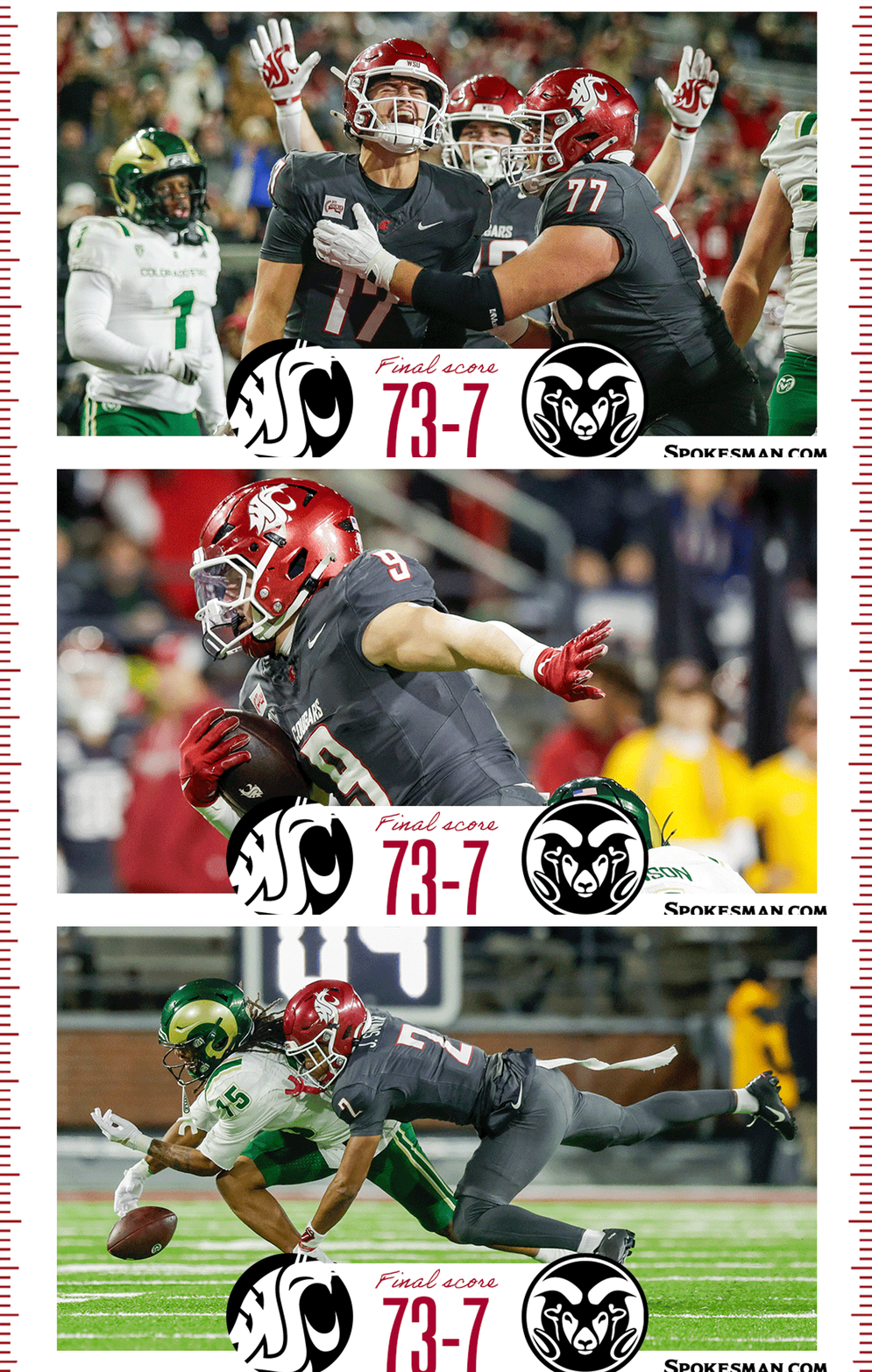
PULLMAN – Back in August, after a sweltering afternoon practice, Kirby Moore strode up to a microphone and smiled. The young man who would go on to take over quarterback duties for Washington State, redshirt freshman Owen Eshelman, had just tossed one of the prettiest balls of camp.
Moments prior, Eshelman had delivered the touchdown pass, a bomb downfield to Tony Freeman. At that point in fall camp, the Cougars’ offense was enjoying a scintillating day, especially from Eshelman, who was flashing his potential.
Read the original at Spokesman.com
Briefing
- Source
- Spokesman.com
- Published
- November 16, 2026
Related
- 73 points and a statement: Cougs finally show what they can do
PULLMAN – If you missed Washington State’s game on Saturday, you were in for quite the surprise while brushing up on how the Cougars did the night before. So let’s make this clear: Yes, WSU did record a 73-7 win over Colorado State, good for the Cougars’ first FBS win of the season. Yes, those Cougars did that. The same team that could barely run the ball all season, the same team that entered with its top three tailbacks combining to average less than 50 yards per game. The same team that hadn’t scored more than 30 against an FBS team all year did that. The same team that hadn’t come particularly close to beating an FBS opponent was scoring so easily that in the final moments of the game, they had the Gesa Field crowd chanting “Eighty!” Yes, that Washington State team did all that. “The grass is green, the holes are big,” said WSU running back Kirby Vorhees, who totaled 197 rushing yards, including a 98-yard score, the longest in program history. “I can’t thank my O-line enough for that. It was a great display of what happens when everyone’s in sync and everything’s going the way that we planned it – maybe a little better than we planned it. It was great out there. I think everyone played a humongous role in my success tonight.” We could spend this entire column going over the superlatives from this game, but here are the top ones, the ones that illustrate how thoroughly the Cougars thrashed the Rams in this one. WSU’s 535 rushing yards are the program’s most in a single game. Vorhees’ 98-yard rush is the longest in college football this season. And the Cougs’ 73 points are the program’s most against an FBS opponent – ever. On Saturday night, there wasn’t much this WSU offense couldn’t do, which is saying a lot for a group that spent nine games showing what it couldn’t do. Some of the Cougs’ top weaknesses on offense centered on their running game, which was struggling so much that after their last game, it stood to reason that maybe they should just abandon it altogether. They were showing zero signs they could turn that around. Turns out, the remedy was Colorado State’s defense, which we have to acknowledge. The Rams aren’t just bad. They are historically, cartoonishly, a-middle-of-the-pack-FCS-defense-might-be-better bad. Their tackling was iffy, their pursuit angles are worse and their effort is off-and-on at best. CSU entered allowing nearly 45 points per game, the most in the country by a wide margin. This is one of the worst defenses to ever grace college football, no matter the year. All of that is important to acknowledge, because as astonishingly impressive as this WSU effort is, CSU’s defense played a big hand in making it possible. The Rams weren’t even lining up right at the line of scrimmage. And once Cougar tailbacks reached the second level, they were good for huge chunks, averaging 9.2 yards per carry. “If you get stuffed on the first run, all right, all right. You keep going,” Vorhees said. “Obviously the more you pound the rock, the bigger the holes get, and the softer the defense gets. So I think it was great to see that Coach Moore saw that the defense was just giving us – we’re taking what we’re given right. So we just kept pounding the rock and then those holes just kept getting bigger and bigger. The defense didn’t wanna hit, so we just kept going.” “It was a really good job by the guys up front,” WSU coach Kirby Moore added, “and still, I thought our backs did the best job they had all season. There’s gonna be a corner, there’s gonna be a safety on Kirby’s long run there. The safety’s unblocked, right? Did a good job making him miss, and then you saw his athleticism show up there. But Max (Woods), some of those third-down runs – there’s gonna be a guy there. You make him miss, and we were explosive in the run game.” To drive home a couple final points on how completely, utterly and entirely WSU shredded Colorado State’s defense, check out the Cougars’ drive chart. WSU scored touchdowns on five straight drives in the first half, and five more in the second. The only times they didn’t score a touchdown were because they ran out of time, not because the Rams stopped them. This is territory that not even the late Mike Leach touched in Pullman. The truth is that no WSU team has ever treated an FBS opponent the way these Cougars treated the Rams. In a vacuum, it might just be what these Cougs and their fans needed. Yes, the season is toast. WSU will miss a bowl game for just the second time in the last 11 full seasons. At this point in the season, the Cougars aren’t playing for much more than pride and for their 14 seniors. So you take the wins when you can get them, especially when you hadn’t taken down an FBS foe all year. But beyond that, what does it mean for WSU? For part of that, let’s hand the mic back to Vorhees. “To be honest, I don’t think it does anything for the rest of the season. I think it does a tremendous amount for next season,” Vorhees said. “We came into this game knowing that one, we don’t have a bowl chance. That’s out the window. So what do we have to do in this game? “We have to dominate our opponent. We have to show the guy in front of us that he is not willing to play with us. He cannot play with us, and I think that’s exactly what we did tonight. That’s exactly what we can build on going into next year. Especially, just like he said, with the recruits here. This is a great, great opportunity for them to see that when we’ve all got our hats on the right level, that’s what Cougar football is about.” When the offseason hits and Moore sets out on retaining players, there will be a pecking order on who the coaching staff will prioritize the most. With this performance, Moore and coaches will have something to show the ones on offense: See what we can do when we get this thing rolling? See what this offense can look like now that we’ve had a year to learn from our mistakes? There’s a pitch to be made from this game, no matter how bad Colorado State’s defense is, and that’s especially important for a WSU program that now expects heavy roster turnover every winter. An offensive-minded coach, Moore now has something to show Vorhees, to show Maxwell Woods, to show Eshelman, whose retention would amount to key developments for the Cougars. What might really convince those types of guys to stay, though, is another game or two in the same ilk. When they travel to take on Texas State next weekend, the Cougs won’t be able to replicate this production. They may never in the history of the program. But they might be able to keep their offense humming in something resembling the same way, and if they can round out the year with another win, their roster might not bleed as profusely as it figured to before Saturday’s game unfolded. “It just felt good to play a complete game – offense, defense, special teams,” WSU linebacker Keith Brown said. “I think when all three phases are rolling how they did tonight, that’s the results you can get. So if we can just continue that the rest of the year, I think we’ll have a great last couple games.”
- That Eshelman Run Felt Like a Comeback but the Fourth Quarter Had Other Plans
SAN DIEGO – At some point in the fourth quarter, not long after Washington State angled toward mounting a comeback against San Diego State in Saturday’s game, things began to feel a bit eerie. Driving down the field, the Cougars were facing a 26-14 deficit. Moments later, quarterback Owen Eshelman pulled a read option and jogged untouched into the end zone, letting out a good scream as he did so. All of a sudden, as listless as this WSU effort felt only a few moments prior, the visitors were angling toward a comeback. It conjured memories of a certain game from two years ago: In 2024, in a road game against San Diego State, the Cougars were looking at a 26-14 hole in the fourth quarter. They made up the ground in the fourth quarter, sandwiching two John Mateer touchdowns around a Buddah Al-Uqdah interception, a string of winning plays to pull off a stunning rally. These Cougars had no such luck Saturday night. Their final drive petered out around midfield, where right tackle Jaylin Caldwell was called for a false start, coach Kirby Moore took his final timeout to prevent the ensuing 10-second runoff and Eshelman’s final two passes fell incomplete, handing the ball back to the Aztecs. With six straight loss es, WSU (1-8, 0-5 Pac-12) has three games left to find its first FBS win of the season. The Cougars are idle next week, giving them a chance to rest for the first time after nine games. Here are five thoughts from the game. 1. WSU has to generate more sacks After nine games, the Cougars have generated only eight sacks, which ranks No. 134 of 138 FBS teams. That’s not exactly what Moore had in mind when he landed transfers Matyus McLain and Linus Zunk out of the transfer portal last winter. WSU did not produce any sacks in Saturday’s game, the second straight sack-less game the team has played. This season, McLain and Zunk have had few issues creating havoc in backfields, but the sacks have eluded them. On Saturday, they largely struck out on both fronts. WSU engineered only six pressures on SDSU redshirt freshman quarterback Stone Saunders, according to Pro Football Focus, including two from McLain and one from Zunk. Simply put: The Cougars have to get more pressure on quarterbacks, and they have to bring them down when they have the chance. On one play in Saturday’s game, cornerback Khamari Terrell had Saunders wrapped up for what looked like an easy sack, but Saunders wiggled free. 2. It’s probably time to abandon the run game altogether WSU running backs Kirby Vorhees, Maxwell Woods and Leo Pulalasi combined for only 34 yards on 14 carries, an average rush of 2.4 yards. Here is how they have fared in eight FBS games this season. • Washington: 16 carries, 38 yards. • Kansas State: 17 carries, 72 yards. • Arizona: 17 carries, 59 yards. • Fresno State: 12 carries, 45 yards. • Utah State: 19 carries, 77 yards. • Oregon State: 13 carries, 26 yards. • Boise State: 10 carries, 20 yards. • SDSU: 14 carries, 34 yards. That comes out to an average of 15 carries for 46 yards, some of the worst numbers in the country. It’s clear the problem comes in large part from the Cougars’ offensive line, which can’t move bodies in short-yardage situations. Maybe that group can solve some things for its final three games of the season, but it’s more likely that WSU can find success by doing away with the running game for the most part. 3. Cougars’ perimeter tackling left a lot to be desired WSU’s last two opponents, Boise State and San Diego State, were wise to realize something: They couldn’t generate many yards up the middle, where Cougar defensive linemen have done well to bottle things up, but they could very easily bounce to the outside and jet upfield. That’s how SDSU running back Javion Kinnard scored both of his touchdowns, making WSU defenders like nickelback Jamarey Smith and Jeremiah Bernard miss on his way to the end zone. The Cougars missed 10 tackles in this one, according to PFF, which is better than the 16 they missed against Boise State. But when you aren’t getting sacks and aren’t generating many turnovers – even with safety Jaylen Thomas’ interception, his third of the year, the Cougs have forced only six turnovers, which is tied for No. 121 nationally – you have to tackle well. WSU has not done so recently. 4. WSU’s offense sustained drives well, but finishing remains elusive The Cougs converted 9 of 14 third downs in Saturday’s game, an encouraging development to one of the team’s biggest weaknesses all year, which allowed them to sustain several drives. They scored one touchdown on a drive that chewed up nearly five minutes and covered 75 yards, then another on a series that elapsed 6 minutes , 15 seconds and went 64 yards. WSU converted 5 of its first 6 third downs, including two on Eshelman keepers. But the Cougs couldn’t always finish their long drives. In the third frame, they used up 6:25 to march 40 yards in 13 plays, but on a third-and-10, Eshelman showed his inexperience by committing a costly intentional grounding penalty, resulting in a loss of 14 yards. That set up a fourth-and-long from the 35, which meant a 53-yard field goal try for kicker Jack Stevens. His attempt went wide left and well short, scuttled by the rainy and windy conditions. The Cougs also missed a chance to capitalize on Thomas’ interception, which landed their offense at the Aztecs 36. They ran three plays, got to fourth down and couldn’t convert. 5. The bye comes at a good time for WSU Every coach in America will say the same thing about their team’s bye week: It comes at a good time. But it’s especially true for these Cougars, who will get an extra week to prepare for a home game against Colorado State, which harbors the worst defense in college football. Theoretically, WSU shouldn’t need much help taking down such a lowly defense, but the Cougars also managed 20 points against an SDSU defense that had given up point totals of 41, 66 and 56. With a week off, look for Moore and the Cougs to make the adjustments they need to earn their first FBS win of the year.
- Owen Eshelman's first start gave Wazzu its best FBS offense yet
PULLMAN – About a day out, it still feels a bit tricky to wrangle Washington State’s last game, a road loss to Oregon State on Saturday evening. In a 48-30 victory for the Beavers, the Cougars looked better than ever on offense. In quarterback Owen Eshelman’s first start, WSU’s offense scored its season high against an FBS opponent. He unlocked the best in receiver Branden Ganashamoorthy, who finished with career highs in both receptions and receiving yards, and his running ability proved to be an understated part of his game. That much was obvious to WSU coach Kirby Moore, who earlier in the week decided to bench Caden Pinnick, who started each of the first six games of the season. “We just had a much better rhythm,” Moore said of Eshelman’s outing and what it provided to the team. “That takes all 11 being on the same page, whether it’s communication, whether it’s in the run game, the RPOs, obviously the pass game. It’s about landmarks and alignments there with the receivers and guys winning versus man and the quarterback trusting them. Today it was much better on first and second down. Third down, obviously did a better job in the second half than the first half.” Still, it’s a fourth straight loss for WSU, which is now 1-6 overall and 0-3 in Pac-12 play. The Cougars are still looking for their first FBS win. Their defense may have been going up against a juggernaut in Oregon State’s offense, but good luck finding a team that can win a game allowing 48 points (OK, not counting WSU teams in the 2010s). Where does that leave WSU for its next game, a home matchup with first-place Boise State next weekend? Here are three thoughts on that. 1. Did WSU coaches wait too long to pivot to Owen Eshelman? During Saturday’s game, as Eshelman threw for two touchdowns and rushed for another, that question hit the WSU orbit like a meteor. If Eshelman was capable of this all along, why didn’t Moore look his way earlier in the season, before things had spiraled out of control? There is likely some level of truth in that sentiment. With Eshelman at the controls, WSU almost certainly beats Utah State. The Cougars could probably have taken down Fresno State. They could have even taken down Washington in the season-opening Apple Cup, especially now that the Huskies have shown themselves to be a shaky team. Moore and coaches almost certainly stuck with Pinnick for too long, and in all likelihood, that decision cost their team multiple wins. For a proud program like WSU’s, which has made a bowl game in 10 of the last 11 full seasons, that isn’t good enough. Moore and his staff will get well-deserved criticism for riding too long with Pinnick, who the Cougars poured all kinds of resources into landing out of the transfer portal last winter. But it’s also true that coming out of fall camp, Eshelman was not clearly the team’s best QB. Those honors went to Pinnick. Eshelman looked like he had the most lively arm, but several other factors tilted in Pinnick’s favor: He had a full season of experience playing college football, and with his athleticism, he profiled as a true dual-threat QB. He put all those characteristics on display across those 15 practices in August. In that way, it’s not fair to criticize Moore for going with Pinnick for the season opener. It made sense for Pinnick to start that game, plus the next couple contests, at Kansas State and home against Duquesne. That’s why the more salient conversation is when during the season coaches could have looked Eshelman’s way. Was there a spot in there for Eshelman to take over? It may not have made sense for coaches to bench Pinnick after a blowout win over FCS Duquesne, but even in that game, he showed a lot of the same problems that he did in Weeks 1 and 2. His one touchdown pass against Arizona, his only FBS touchdown pass, came in large part because a Wildcat defender fell down in coverage. Pinnick showed the same symptoms in just about all his outings, in simpler terms. The logic that Moore might have been using might have involved his decision to take over playcalling duties, which he did ahead of the Utah State game: If Pinnick still looks iffy in that one, when we remove one of the variables, then we’ll find the root of the issue and pull the plug. That logic feels a little wobbly, but if you’re a head coach who invested all kinds of time and resources into earning a commitment from Pinnick and coaching him up, that’s probably a thought that crosses your mind. 2. Eshelman should have gotten more chances to show his talents: For as fantastic as Eshelman looked, carving out 136 rushing yards and another score with his legs, he didn’t get as many opportunities to display his gifts as he could have. On two fourth-and-short situations around midfield, Moore chose to punt it away. The first was a fourth-and-1 from the OSU 48, with the Cougs trailing 7-0. That became 14-0 one play later, when the Beavs unleashed a 90-yard touchdown pass. The second was a fourth-and-3 from the WSU 49, with the Beavers up 20-3. One play after that, they jumped ahead 27-3, scoring on an 88-yard screen pass. After the game, Moore defended his decision to punt in those spots, saying, “I’ve got a ton of confidence in our defense.” But also in the second quarter, he chose to take the ball out of Eshelman and the offense’s hands, opting for a Jack Stevens field goal on fourth-and-1 from the OSU 1. The Cougars got on the board for the first time with that three-pointer, and maybe there’s something to be said for giving your team some confidence by scoring any kinds of points. But WSU was also an 18.5-point underdog, looking for its first FBS win against a juggernaut offense. The Cougars likely weren’t going to win that game with field goals. Besides, regardless of what happens after those punts, what kind of message does that send to your quarterback? 3. What kind of hope is there for WSU’s rushing game? In Saturday’s game, WSU tailbacks Maxwell Woods, Kirby Vorhees and Leo Pulalasi combined for 26 rushing yards on 13 carries. It was the latest example of their inability to get anything going, which has been augmented by their offensive line, which ranks second-to-last in the Pac-12 in Pro Football Focus’ run-blocking grades. In fact, WSU’s run-blocking grade of 51.2 ranks No. 127 nationally. Only 11 other teams in the country have had a worse time in that department, at least in PFF’s view. That makes it hard for WSU’s tailbacks to generate any production. The Cougars’ front five isn’t at full strength, riding with left tackle Maximus McCree in the absence of injured Ashton Tripp, but Tripp has graded below-average in run-blocking anyway. Whatever the reason, though, the Cougs’ three running backs have left a lot to be desired this season. Here is how they’ve fared in their first six games of the season. • Washington: 16 carries, 38 yards • Kansas State: 17 carries, 72 yards • Duquesne: 26 carries, 248 yards • Arizona: 17 carries, 59 yards • Fresno State: 12 carries, 45 yards • Utah State: 19 carries, 77 yards All told, the Cougars’ three running backs are averaging 80 yards per game. Trim that down to FBS opponents and the number is 52. We’ve written about this several times before, but it still rings true: Back in December, Moore’s ability to retain all three running backs felt like his top offseason accomplishment. Now it’s fair to wonder if, with five games remaining, that group can get going in any consistent way. Eshelman’s passing ability figured to open up that possibility, but even with that going, the Cougs couldn’t generate much rushing attack from their tailbacks. Maybe WSU can expect a big game in that department in mid-November, when it hosts a home game against Colorado State, which now ranks dead last nationally in total defense: 530 yards per game. WSU doesn’t need to get its running backs going just for the sake of getting its running backs going. It was just one game, but Eshelman showed how skilled he is at running the ball. But the Cougs could lessen the pressure on him by getting more from their tailback trio.