The Strategic Follies of the Islamic Republic
Our take
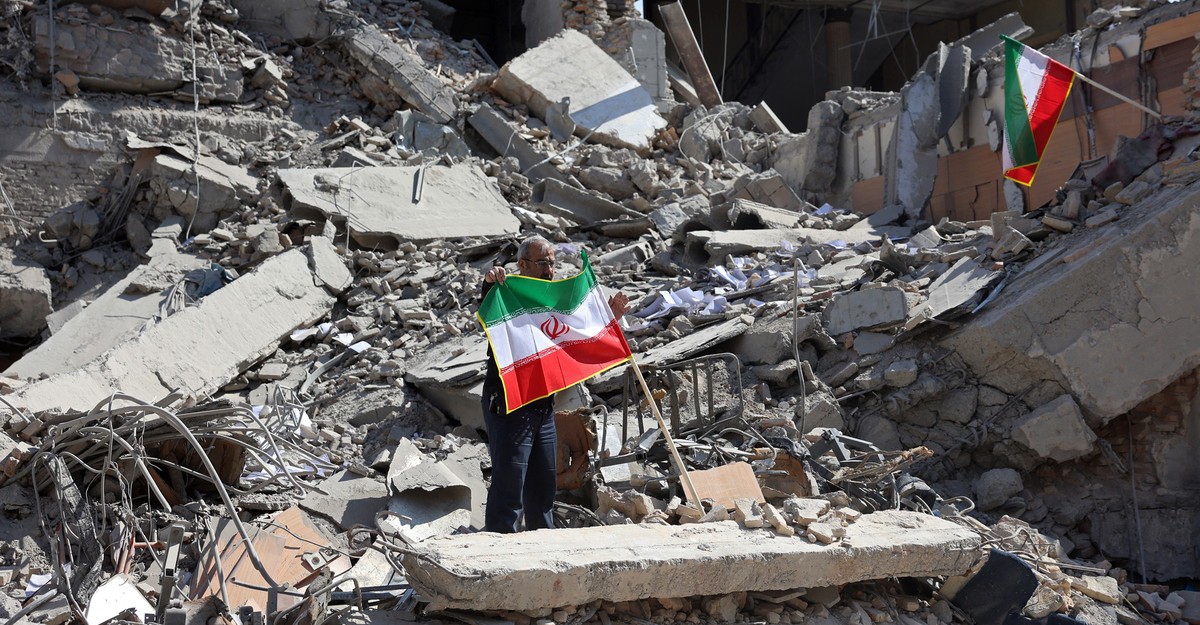
In the complex geopolitical landscape surrounding Iran, the recent article "The Strategic Follies of the Islamic Republic" sheds light on a critical misconception held by many in the West: that Iran's leadership exhibits an extraordinary strategic acumen. This notion of "strategic orientalism" often manifests during conflicts, where adversaries are attributed with qualities of cunning and foresight that may not hold true. The article argues that, in reality, the Islamic Republic's historical record is marked more by consistent miscalculations than by any strategic brilliance. This perspective is crucial, especially when considering the ongoing tensions highlighted in related pieces like The Countdown to a Ground War and The War With Iran Is Exposing Big Problems for the Military.
The article recounts the Islamic Republic's engagement in a series of conflicts that have ultimately led to self-inflicted damage rather than the intended objectives. For instance, the Iran-Iraq War saw Iran resort to devastating tactics, such as human-wave attacks, which resulted in immense loss of life and little strategic gain. Furthermore, the regime's hostile interactions with the United States—from the hostage crisis to naval confrontations in the Persian Gulf—have not only failed to bolster Iran's position but have instead led to military humiliations. A key takeaway here is that the regime’s ambitious goals, such as the destruction of Israel and driving the U.S. from the region, have come at a tremendous cost, both militarily and economically. The disconnect between the regime’s aspirations and its ability to achieve them raises critical questions about the nature of its leadership.
Moreover, the article highlights how recent military engagements have further exposed the shortcomings of Iranian strategy. Despite efforts to encircle Israel through the establishment of proxy forces like Hezbollah and Hamas, these initiatives have backfired. The casualties and geopolitical setbacks suffered by these proxies illustrate that Iran's long-term strategy is faltering. Instead of achieving regional dominance, Iran finds itself increasingly isolated, with its military infrastructure devastated and its credibility diminished. The implications of this failure are profound—not just for Iran but for the broader Middle Eastern landscape and U.S. foreign policy objectives in the region.
As we look forward, the key question remains: What will be the long-term consequences of Iran's strategic miscalculations? The regime’s current confidence, as described in the article, may be a façade masking deeper vulnerabilities. As the nation grapples with internal strife, economic turmoil, and deteriorating relations with neighbors, the possibility of a significant shift in the region's balance of power looms. Understanding these dynamics is essential for policymakers and citizens alike, particularly as tensions rise and the potential for conflict persists. The future will likely reveal whether Iran can adapt to its failures or if it will continue down a path of further isolation and instability.
When Western countries engage in conflict with other parts of the world, they often indulge in a kind of strategic orientalism. They attribute to the enemy extraordinary degrees of perseverance, fanaticism, cunning, and farsightedness. The war with Iran has proved no exception: As soon as the missiles began to fly, the familiar tropes returned. The regime possesses strategic patience, akin to the years of effort required to manufacture a Persian carpet; it is animated by indomitable religious zeal; it has mastered the art of winning by losing; and, of course, it thinks half a dozen moves ahead, as you might expect from the land that created the modern game of chess.
This gives the leaders of the Islamic Republic of Iran way too much credit. The past half century reveals a record not of strategic brilliance, but of consistent folly, as the regime has waged wars badly—failing to achieve its objectives, creating new enemies, and inflicting more damage on itself than on others.
Within a year of the revolution that brought Ayatollah Ruhollah Khomeini to power, Iran was attacked by Iraq: A bloody eight-year war ensued. The war itself was not Iran’s choice. But the regime still had its choice of tactics, and some of those were awful. It chose to launch human-wave attacks—some conducted by young teenagers—that withered under Iraqi artillery barrages and poison gas. The waste was shocking.
If that war was unavoidable, picking repeated fights with the United States, first by holding hostages from its embassy and then by attacking shipping in the Persian Gulf, was not. In a series of sharp engagements in the 1980s, American naval and Special Operations forces sank Iranian ships and speedboats and destroyed Iranian bases being used to attack tankers. U.S. forces began large-scale escort-of-convoy operations—yes, it has been done before—to get oil through the Strait of Hormuz. They succeeded, and the Islamic Republic was humiliated.
[Read: The trouble with seizing Kharg Island]
The Islamic Republic had declared from the outset that Israel was the lesser Satan and the United States the greater. The latter was to be driven from the Persian Gulf, the former to be annihilated. These objectives had absolutely nothing to do with any reasonable definition of Iranian national interest, and their pursuit brought only military devastation and economic misery to the country. Before the revolution, some 50 years ago, Israel’s GDP was a quarter that of Iran. Today, with a tenth of Iran’s population, its GDP is greater than Iran’s.
The policies pursued by the Islamic Republic in the 1990s—the death fatwa against Salman Rushdie and attempts to kill his associates, the terror bombing of a Jewish community center in Argentina—gained it nothing but opprobrium. More recently, it attempted to assassinate a former American president. It also began a serious effort to bring Israel to its knees by assembling a crushing array of proxies—Hezbollah in Lebanon, a Syrian client state with a large Iranian and Hezbollah presence, and two irregular groups with which it partnered, the Yemeni Houthis and Palestinian Hamas. At the same time, it built a covert nuclear-weapons program, and assembled an arsenal of ballistic missiles to be able to attack Israel.
The aim here—which, judging by their declarations, the Islamic Republic’s leaders believed within reach—was the destruction of Israel. In response to an Israeli strike in Damascus in April 2024 that killed the head of the Islamic Revolutionary Guard Corps’ Quds Force in Syria and Lebanon, Iran fired hundreds of drones and missiles at Israel. In October of that year, following the assassination of the Hamas leader Ismail Haniyeh in Tehran and Hezbollah leader Hassan Nasrallah in Beirut, it did the same.
What was the return on its investment? In a series of Israeli campaigns, some grueling (the war in Gaza’s tunnels), some tactically dazzling (the so-called beeper attacks on thousands of sabotaged Hezbollah pagers), the proxies and partners were defeated. Hamas was ground down, Hezbollah shattered, the Syrian regime collapsed in a renewed civil war, and the Houthis silenced, for the moment, by combined Israeli and American attacks. Israel’s punitive raids on Iran were limited. Iran’s strategy of encirclement of Israel had collapsed, and its ballistic-missile counterpunch was largely deflected by Israeli and Western defenses.
There remained the Iranian nuclear program, long delayed and stymied by sabotage, assassinations, and sanctions. The Trump administration, like its predecessors, hoped to negotiate the Iranians out of approaching nuclear capacity but failed.
And so came, with American approval, the June 2025 12-day war in which Israel demolished Iranian air defenses, killed dozens of senior commanders and scientists, and, together with a one-day American intervention, smashed Iranian nuclear sites. And after another American attempt at negotiation came the current war, the most extensive set of precision attacks on military targets the world has ever seen.
The final outcome of the present conflict is unknowable, but some of the results are clear: the destruction of Iranian air defenses and its navy, the elimination of several ranks of senior leaders, the shattering of military infrastructure and industry. The Iranian counterpunch this time consisted chiefly of attacks against its Gulf neighbors, most of whom had declined to get involved in this war. Iran’s strategic logic was the same as in the mid-1980s: attack the world’s oil supply in order to bring the war to a conclusion on favorable terms by holding Western economies hostage. The result thus far has been the intensification of American military pressure and the permanent alienation of Iran’s neighbors, some of whom will support or even join the war against it.
[Read: Trump’s eye is already on Cuba]
And now, it appears, Iran’s leaders, most of whom dare not touch electronic means of communication or appear in public, have concluded that they have the upper hand. They talk of imposing peacetime tolls on commerce through the Strait of Hormuz, insisting on massive reparations and the expulsion of American bases by their neighbors. It reflects a self-assessment reminiscent of Monty Python’s Black Knight.
Meanwhile, what of Iran itself? The capital city running so short on water that there has been serious discussion of having to move it; a drug-addiction problem that is among the worst in the world; hundreds of billions spent on a badly damaged nuclear program, or lost in foreign investment or to sanctions; and a population so seething with anger at its rulers that its risings against them every few years can be controlled only by massacring thousands of unarmed civilians.
In the early 1980s, in the full flush of revolutionary ardor and against an age-old enemy who had attacked them without provocation, the Iranian people and armed forces fought and suffered for their country. That enthusiasm was gone less than a decade later, and although some portion of the population may still retain it, it has largely dissipated in the welter of corruption, maladministration, and tyranny that is the hallmark of the regime. Their supposedly clever leaders have fallen, one after another, to American and Israeli bullets and bombs.
As for that noble Iranian game, chess. Ayatollah Khomeini initially banned the game, relenting shortly before his death, and today Iran has a few grandmasters playing the game their country brought to the world. But some of the best players, and particularly women, have defected to the West or been barred from playing at home—for the crime of wanting to compete with Israeli grandmasters, or simply for refusing to wear the hijab. It is a revealing record of folly on the part of leaders who are, from the strategic point of view, idiots.
Read on the original site
Open the publisher's page for the full experience
Related Articles
- The Countdown to a Ground WarDonald Trump announced this week that the United States and Iran had made significant progress in negotiations, and he was allowing five days to reach a deal. Tehran denied that it was talking with Washington at all. This is not, in any meaningful sense, a negotiation: It is a countdown. The timing is not coincidental. Thousands of Marines and much of the 1st Brigade of the 82nd Airborne are en route to the Middle East. Trump may intend the talks to act as cover for an escalation decision already made. Even if he doesn’t, the structural reality is the same: When the deadline expires, he will be close to having significant ground-combat capability in the region and a collapsing diplomatic process to justify using it. The gap between the two sides makes the collapse of talks likely. The American framework is, in essence, a demand for Iran’s surrender. The administration’s 15-point proposal, delivered to Iran via Pakistan, requires Tehran to dismantle its entire uranium-enrichment infrastructure, surrender its stockpiles of highly enriched uranium, sever all ties with proxy forces across the region, and accept strict limits on its conventional military. In exchange, Washington is offering sanctions relief and support for a civilian nuclear-energy program. The proposal is very similar to the deal that the United States put on the table before the bombing campaign began. Iran’s counter-framework reflects a regime that does not believe it is losing. Tehran is demanding binding guarantees that neither the United States nor Israel will strike again, reparations for the damage already inflicted, and formal recognition of its control over the Strait of Hormuz. On enrichment and proxies, Iranian negotiators have shown no willingness to move. The war has not moderated the Iranian regime. It has hardened it. The Islamic Revolutionary Guard Corps now dominates Iran’s internal deliberations to a degree unprecedented even under Ayatollah Ali Khamenei. Iran effectively controls the strait, and it knows that this control affords Tehran real leverage. Iran appears to have concluded that it is better positioned for a war of endurance than for a negotiated capitulation. Trump could still choose to declare victory, or even accept terms closer to Iran’s position, if he concludes that the alternative is a longer and more uncertain war. Last year’s trade confrontation with China ended with significant American concessions obscured by wins against U.S. allies and dressed in the language of reciprocal success. A similar reframing is conceivable here. He could point to Iran’s degraded navy, its shattered air force, the deaths of senior regime officials, and the setback to its nuclear program and argue that the threat has been sufficiently reduced to warrant a softer settlement. [Eliot A. Cohen: The war with Iran is exposing big problems for the military] But the Iran case will be harder to obscure than the China one was. Trade balances are abstract; the Strait of Hormuz is not. A deal that leaves the IRGC in effective control of the world’s most crucial shipping lane, imposes no enforceable limits on Iran’s missile or enrichment programs, and offers the regime international legitimacy cannot easily be framed as victory, especially when America’s closest regional partners will be lining up to say otherwise. Saudi Crown Prince Mohammed bin Salman reportedly told Trump that the United States should continue fighting to destroy the Iranian regime and remake the region. The United Arab Emirates’ ambassador to the United States rejected the idea of a “simple cease-fire,” calling instead for “a conclusive outcome that addresses Iran’s full range of threats.” The UAE and Saudi Arabia may not have fully welcomed the war in the first place, but now that it is under way, they will not want to see Iran emerge stronger from it. Meanwhile, Israel remains committed to regime change or, failing that, maximum degradation, and it worries about a deal that meets Tehran halfway or a cease-fire. These governments can be expected to push Trump to continue the war once the talks collapse, although they seem to have concerns about ground operations. But Trump wants to avoid a messy, long war, which could lead to sustained high oil prices and a possible recession. Ground troops would seem likely to bring this outcome about—but Trump appears to believe that their introduction will instead deliver a decisive knockout blow, which will either compel Tehran to accept his terms or make a U.S. declaration of victory credible. Trump announced yesterday that he had rescheduled a visit to China for May 14 and 15, which suggests that he expects the war to be over by then. According to media reports about internal Trump-administration deliberations, three ground operations are most likely: a raid on Iran’s nuclear facilities at Isfahan to seize its stockpile of highly enriched uranium; the seizure of Kharg Island, Iran’s principal oil-export hub; and the deployment of troops to Iran’s shoreline to suppress its attacks on shipping through the strait. Each carries risks that the administration appears to be underestimating. Austin Long, a senior nuclear fellow at MIT, told me that Iran’s highly enriched uranium is a white, crystalline solid, uranium hexafluoride, stored in thick, steel cylinders, and cannot be reliably and permanently destroyed with explosives. If the cylinders are pierced, they emit a severely hazardous gas. A successful seizure from Isfahan would require U.S. troops to secure a wide perimeter, locate and excavate up to 970 pounds of the uranium buried under an unknown depth of rubble, protect it from counterattack, load it onto aircraft, and depart under fire. The operation would be arguably the most complex raid ever carried out by U.S. forces. The 970 pounds of uranium could also be spread among Isfahan and two other sites, raising the possibility of multiple raids. [Nancy A. Youssef and Missy Ryan: The U.S. and Iran are fighting a massively asymmetrical war] Kharg Island and the coastal positions present different but equally serious problems. Forces on Kharg would immediately be within range of sustained Iranian fire; Iran could respond by attacking energy infrastructure and desalination plants across the Persian Gulf or destroying the island’s oil facilities to deny them to the Americans. Coastal positions are reportedly located near population centers, which would complicate both the military mission and the international response. In each scenario, the most plausible outcome is not a clean victory but a situation that demands more troops, more time, and more exposure to avert failure. The deeper problem is that military operations, however successful tactically, cannot substitute for what the war is trying to achieve strategically. Trump launched this conflict believing that Iran was weak, and that a short, sharp campaign would force a new leader to terms. The regime has proved more resilient and more capable of inflicting sustained damage on the region than the president expected. The question worth asking now is not whether the U.S.-Iran talks will fail, but what the United States will do on the other side of that failure. Trump has a long history of claiming victory in the face of overwhelming evidence to the contrary. This may be the rare moment when that instinct serves the country—because the alternative appears to be doubling down on a losing strategy by launching a ground war.
- The War With Iran Is Exposing Big Problems for the MilitaryIn 1986, the British historian Correlli Barnett published The Audit of War, a brutal critique of Britain’s industrial performance in World War II. One can learn from his controversial effort: The United States is going through its own audit of war right now as we close in on a month of conflict in the Persian Gulf. No other country could have projected force from its homeland on the scale that America so far has—and not just in a couple of large raids, but in a sustained campaign conducted over a vast expanse of land and sea. Though the intelligence story of this war is, as ever, in the shadows, there is no question that American intelligence-gathering and analysis, especially but not exclusively from technical sources such as satellite imagery and signal intercepts, have been extraordinary. At the high end, the performance of advanced American-military technology such as the F-35 fighter bombers flown by the United States and its ally Israel has been stunning. Not a single F-35 has been lost. These airplanes, which are flying computers and sensors as much as they are bomb droppers, have remarkable abilities to coordinate with other aircraft, identify threats, and escape detection. So, too, do B-2 bombers and many other remarkable airborne platforms. [Nancy A. Youssef and Missy Ryan: The U.S. and Iran are fighting a massively asymmetrical war] The professionalism of the American military has been on display from top to bottom. The chairman of the Joint Chiefs of Staff, General Dan Caine, and the head of Central Command, Admiral Brad Cooper, have been models of clarity, calm, and decisiveness. The young men and women flying, maintaining, and fixing the airplanes and manning defenses have displayed competence and grit. All good news. But there is plenty of bad news as well, for which the armed services and previous administrations as well as the current one are responsible. The stockpiles of advanced munitions (particularly interceptor missiles) are radically inadequate and will remain so for some time. In the Middle East conflicts of 2025, most estimates have it that nearly a quarter of the stocks of the Army’s high-altitude interceptor, the Terminal High Altitude Area Defense missile, were consumed; a comparable number may have been used up in the current conflict. Many other high-end precision-strike systems have already been consumed at greater than the yearly rate of replenishment scheduled for fiscal year 2026. The relatively modest size of the naval task force in the Persian Gulf is also notable. In the 1980s, during a previous conflict with Iran, the U.S. Navy deployed some 30 warships in the Gulf; today it has scarcely a dozen just outside it. In 1986, the Navy had 214 surface combatants (cruisers, destroyers, and frigates); in 2026 it has only half as many, at a time when the Chinese navy is arguably a greater threat than the Soviet navy ever was. One particularly significant shortage is of effective minor warships. In 1986, the fleet included 113 frigates, ships smaller than destroyers but vital for missions such as escorting convoys. Now there are none, their place having been taken by some two dozen littoral combat ships, which have proved mechanically unreliable, underequipped for high-threat environments, and unsuited for key missions. Worse: The attempt to replace them, with an Italian-designed frigate, has collapsed because of modifications that made the proposed warship wildly expensive. The Navy is now considering modifying a class of Coast Guard cutters that would lack basic armaments such as vertical tubes for launching a variety of anti-aircraft and anti-ship missiles. The dearth of mine-hunting vessels is stunning as well. The Navy had 21 mine-warfare ships in 1986. Today it has four aging mine-countermeasure vessels, due for retirement, with unproven modules for deployment on the littoral combat ships, which were not designed principally for mine warfare. And yet, the Navy first encountered Iranian mines in the Persian Gulf nearly 40 years ago. There is more bad news as well, including the apparent vulnerability of American radars (as many as 10) to precision hits from Iranian drones—a threat that should have been defeated with the kind of technologies that Ukraine deploys at scale every day. The underlying explanations for these deficiencies go well beyond the Trump administration. Some of it is the result of the illusion of peace following the Cold War, and the willful neglect of the defense industrial base, which has been well documented. But the conflict has also exposed a fundamental flaw in the modern American way of war. The United States for many years has exhibited a deep-rooted bias toward quality over quantity. The same tendency, to a lesser extent, was on display at the beginning of World War II, when the Navy preferred to build large fleet destroyers instead of the vessels it needed to defeat German submarines. As a result, even Fleet Admiral Ernest J. King, the wartime chief of naval operations, concluded that “the Navy did not obtain adequate means to deal with the U-boat until late in 1943.” The solution lay in shifting production to smaller destroyer escorts, the ancestors of contemporary frigates—smaller, slower, cheaper, and quicker to build. More than 500 were built for the Navy alone during that war. In the current case, the Navy now has so few vessels that the loss of even one ultra-valuable major warship would be a humiliation; the loss of several, a catastrophe. But history suggests that in naval wars, ships sink. The post–Cold War military assumption seems to be that the United States operates on offense, not defense. The Air Force has been reluctant to spend $5 million to $30 million on hardened shelters for aircraft that cost an order or two of magnitude more than that. When I would fly into Al Udeid, our massive air base in Qatar, in the early 2000s, I was always stunned to see airplanes of all types—fighters, bombers, refuelers—lined up wingtip to wingtip, just as they were at Clark Air Base in the Philippines on December 7, 1941. Again, changes are under way—too little, though hopefully not too late. For similar reasons, drones and, more important, defenses against them have, until very recently, been relatively low on the priority list of the armed forces. They exist, and some are very fine as pieces of technology, but the military has purchased too few, and procured too little by way of stockpiles behind them. Which leads to the third assumption: quick, low-casualty wars. The 1991 Gulf War was a stunning victory for the United States military, which has colored its assumptions about what conventional war—as opposed to counterinsurgency, a mission unwanted and disliked—should look like. In wars lasting a month or so with relatively low casualty rates, managing massive ammunition consumption, assembling and training replacements, and renewing equipment losses during a war, not after it, are simply not issues. [Karim Sadjadpour: Iran is trying to defeat America in the living room] The uniformed leaders of the armed services over the past three decades bear much responsibility for these shortcomings, because we rely on them to be our experts on warfare, but final accountability lies with civilian leadership. And the Trump administration has yet to prove that it understands just how perilous this situation is. It has talked of a $200 billion supplemental appropriation for the military, but has yet to spell out what this will buy. Rather than bluster and braggadocio, the Department of Defense needs a well-conceived and thoughtfully presented multiyear program to build a military fit for large-scale and sustained war. Congress needs to take its role just as seriously, and demonstrate its willingness to endorse deliberate inefficiency—by, for example, authorizing the building of two factories where one might do in order to maintain capacity to expand production of all kinds of munitions and platforms in a crisis. American and Israeli operations over Iran have been, on the whole, remarkably effective and efficient. Whether they will bring about the desired ends (assuming both countries have a clear idea of what those ends should be) is uncertain. But the lessons drawn even from success should be sobering. A war against a more capable opponent, particularly in the Indo-Pacific, could be far, far more painful than this one. John Paul Jones famously declared that he intended to sail into harm’s way, and then he did, winning an epic sea fight but losing his ship, the Bonhomme Richard. His successors must be robustly equipped to dare, and if necessary suffer losses, in the same way.
- Trump Is Flailing on IranDonald Trump’s way of talking about war has always swung between extremes. He threatens “fire and fury” one day and extols his dictator buddies for their kind and thoughtful gestures the next. Since the conflict with Iran began, however, the cycle between aggression and conciliation has spun more rapidly. The president issues new and more terrible threats against Tehran, then backs off with soothing praise. He has now begun to do these things simultaneously. The reason may be that world markets, especially for oil, want the war to end, so that shipping can presumably resume through the Strait of Hormuz. Trump has learned that he can encourage the markets to expect a speedy end to the war by promising that talks are proceeding toward a settlement, or at least that he intends to quit the conflict and frame it as a victory. However, the Iranians can also read these messages. Every time Trump signals that he wants the war to end, they recognize his desperation. So, to counter this effect, Trump attempts to threaten Iran with new punishments should it fail to make a satisfactory deal. But of course, the markets can also read the threats. So Trump must counteract the impression caused by his saber-rattling with promises of peace. [Read: Six days of war, 10 rationales] A little more than a week ago, Trump warned, “If Iran doesn’t FULLY OPEN, WITHOUT THREAT, the Strait of Hormuz, within 48 HOURS from this exact point in time, the United States of America will hit and obliterate their various POWER PLANTS, STARTING WITH THE BIGGEST ONE FIRST!” Then he extended the deadline twice, explaining that he was holding promising talks with the Iranians. The Iranians have responded that no such discussions have occurred. It is difficult to assess which of these notably unreliable parties is accurately conveying the state, or non-state, of negotiations. Even so, a discouraging sign emerged yesterday in the form of a morning Trump post on Truth Social. It begins by reiterating his most dovish claims that the Iranian regime has changed, thereby fulfilling his prewar objective, and is now negotiating with him: “The United States of America is in serious discussions with A NEW, AND MORE REASONABLE, REGIME to end our Military Operations in Iran.” Regime change, in fact, refers specifically to ending a country’s system of government, not merely changing the individual people running it. The revolution that deposed the shah and replaced him with an Islamic theocracy was regime change. Replacing one leader with his son does not constitute “regime change” any more than electing a Republican president to succeed a Democratic one does. At least this fiction is consistent with Trump’s apparent attempt to find a way out by spinning his adventure in Iran as a success. Praising the “new” regime as reasonable likewise advances this goal. Yesterday’s Truth Social post reiterates that the U.S.-Iran negotiations—which, again, may or may not be happening—are making progress, and will probably succeed. But Trump also vows that failure will be met with terrible violence: “Great progress has been made but, if for any reason a deal is not shortly reached, which it probably will be, and if the Hormuz Strait is not immediately ‘Open for Business,’ we will conclude our lovely ‘stay’ in Iran by blowing up and completely obliterating all of their Electric Generating Plants, Oil Wells and Kharg Island (and possibly all desalinization plants!), which we have purposefully not yet ‘touched.’” Threatening to commit war crimes—and destroying civilian infrastructure such as desalination plants would certainly qualify—is generally an uncomfortable rhetorical pivot in any presidential text. It is even more awkward when the threat immediately follows praise of the prospective target’s leadership for its reasonableness. Trump does try to supply a moral justification, of sorts, for such a crime: “This will be in retribution for our many soldiers, and others, that Iran has butchered and killed over the old Regime’s 47 year ‘Reign of Terror.’” If the president is planting a defense for a future war-crimes trial at The Hague, he has not given his prospective legal team much to work with. As a motive for committing atrocities, “retribution” is more of a confession than an alibi. What’s more, whatever moral force Trump generates by citing the regime’s “Reign of Terror” as a rationale for harming its citizens is undercut by his casually noting that those offenses were committed by the old regime, the one that Trump claims has changed. The Allies bombing Dresden in 1945 was notorious, but bombing it in 1946 would have been altogether worse. [Watch: Trump’s mixed messages about Iran] A normal politician would attempt to convey that he is being reasonable and negotiating in good faith, whereas his adversaries are violent war criminals. Trump is arguing the reverse. Perhaps he is calculating that Iran has blundered by surrendering its well-honed “unstable aggressive fanatic” identity, and now he has a chance to own that brand. Or, more likely, he is desperately flailing for a message that will reassure the stock market and scare the Iranians—rather than the other way around. To be sure, there is another group that is alarmed both by Trump’s wild threats of escalation and by his intimations of peace: the rest of the world, which is coping with an economic crisis caused by Iran’s closure of the Strait of Hormuz. Trump proposes in a new post this morning that, having changed the regime, he will leave the wee problem of the strait for our former allies to deal with. Not our problem; they should have thought of it before we started the war.
- Mutually Assured Energy DestructionA few years ago in Dhahran, the Saudi state oil company, Aramco, gave me a tour of its headquarters, a facility so sparkling and orderly that one could forget that its whole purpose was to extract from the ground one of the filthiest substances on Earth. The most impressive stop on the tour was the Aramco emergency command center, which I imagine is paying its workers a lot of overtime right now. It looked like the control room for a mission to Alpha Centauri. Men and women sat at their stations. The walls were aglow with constellations of green lights—each one, my host said, representing a functioning object in the Aramco galaxy of pipelines, valves, ships, buses, heat exchangers, and drill bits. If a light flashed red, it meant one of these objects was broken, and the people at those stations would vault into action to support the crew restoring it. One major question in the current war is why Iran has so far failed, or perhaps declined, to make life miserable for the people in that room. The vow to annihilate energy infrastructure is one of two threats—American and Iranian—that remain, as of this writing, unfulfilled. On March 17, after Israel attacked Iran’s South Pars gas field, Iran threatened five key oil-and-gas facilities in Qatar, the United Arab Emirates, and Saudi Arabia. Last weekend, Donald Trump wrote that if Iran failed to open the Strait of Hormuz in exactly 48 hours, “the United States of America will hit and obliterate their various POWER PLANTS, STARTING WITH THE BIGGEST ONE FIRST!” (American air superiority over Iran is matched only by its overwhelming advantage in CAPITAL LETTERS, which Persian lacks.) So far, Trump has not attacked the power plants—in fact, on Thursday he extended the deadline to April 6—and most of the oil infrastructure in the region remains intact. [Rogé Karma: Iran might use its economic-doomsday option] Trump’s targeting of power plants would be a remarkable and possibly illegal step, if those plants are civilian, and it is difficult to imagine any other president openly threatening their obliteration. Iran’s targeting of oil-and-gas infrastructure, however, is predictable, and is one of the reasons every president before Trump declined to attack Iran at all. It is by far the most painful action Iran could take against the United States and its allies. Saudi Arabia, Kuwait, and Qatar all pay their bills through oil and gas, and if these stop flowing, they will rapidly turn from petrocrats to paupers. Wrecking oil infrastructure is easy. It has no legs; it cannot run away or be hidden underground until danger passes. It is filled with materials at high temperatures and pressures, and some of them can be set on fire. In a 2019 attack that presaged the current war, a fleet of drones and a barrage of cruise missiles hit Saudi Arabia’s Abqaiq and Khurais oil fields. Abqaiq is the world’s most important oil field. Direct strikes on crude-stabilization columns and gas-oil-separation tanks reduced Saudi oil output by half. Saudi Arabia accused Iran of launching the attacks, and Crown Prince Mohammed bin Salman told me in 2022 that the U.S. was ready to punish Iran for the attack, but had held back to avoid “escalation.” Rebuilding that same infrastructure is hard. A single well-aimed strike can set back a whole operation for a very long time. On March 18, Iran attacked Ras Laffan, Qatar’s main site for liquefied-natural-gas production, and Qatar estimated that repairs would take three to five years. Taylor Coleman, an oil-and-gas operations expert at CapturePoint, told me that pipelines are relatively easy to fix, but refinery equipment is another matter. Hydrocrackers—which heat up and pressurize heavy oils, to convert them to lighter fuel products—are made of metal that is a foot thick, and are built to withstand temperatures reaching thousands of degrees. “There are only two or three foundries that can even make castings and forgings for some of those vessels, and delivery times can be two, three, even four years,” he said. This equipment is too expensive to stock spares. “We don’t keep an entire plant laid down in a yard somewhere, just in case one blows up.” The insatiable electricity needs of AI mean that if an oil-processing plant—which is also hungry for electricity—loses its transformers, it has to bid against, and get in line behind, technology companies that have already been waiting years for fulfillment. Iran has attacked not only Qatar but also Saudi facilities at Ras Tanura and even Yanbu, all the way in the west, on the Red Sea. Perhaps these were Iran’s best attempts at obliteration, and they were mostly thwarted. (Ras Laffan was the most ruinous hit. Both Ras Tanura and Yanbu were hit by debris from downed drones, and not fatally damaged.) But there is also a strategic consideration that might keep Iran from using maximum force. The logic of a devastating attack on oil-and-gas infrastructure is uncomfortably similar to mutually assured destruction: If Iran wipes out Saudi oil production, the immediate annihilation of its own infrastructure is nearly certain. The two countries rely about equally on oil and gas as shares of their exports, so such an attack by Iran would be tantamount to economic murder-suicide. It would also end all polite remonstrance from Iran’s neighbors, who have suggested that Iran’s regime might survive the war, if it forswears attacks, blockades, and terrorism. A direct attack on the oil fields would force the conclusion that the regime must fall. Destroying energy production in the Persian Gulf would also deal a grievous blow to Iran’s ally China, which devours both Arab and Iranian oil and would be left energy-hungry for years. [Shane Harris: A turning point in the Iran war] The final reason these attacks have not yet happened is probably the most important. Although Iran and the Gulf Arabs can mutually assure each other’s destruction, only the Arab oil-and-gas fields are assured to be reconstructed. Decades of sanctions and isolation have left Iran’s facilities ragged and corroded. If the Iranian regime somehow survives the war, no relief for this decrepitude will be forthcoming—whereas the Kuwaitis, Qataris, and Saudis will be overrun with technical experts, and showered with financing. And that reconstruction will be combined with redoubled efforts to cripple Iran’s ability to attack the fields again. The Ras Laffan attacks show that some constraints are physical and metallurgical, and even ultra-rich Qatar will have to spend years rebuilding. But cooperation of rich allies can work wonders. After the 2019 Abqaiq attack, Saudi oil was flowing at pre-attack levels within a matter of weeks, in part because when the U.S. and China both want your oil, they will defy economic and physical laws to obtain it. The purpose of the Iranian military was never to win a war—there is no “winning” a war against a military as advanced as America’s—but to deter and punish anyone who started a war with it. This logic of deterrence bought Iran decades, which is why it can boast a glorious past of successful resistance against American power. The same logic now would lead to escalation beyond Iran’s ability to manage, and could cost it an equally boastworthy future.