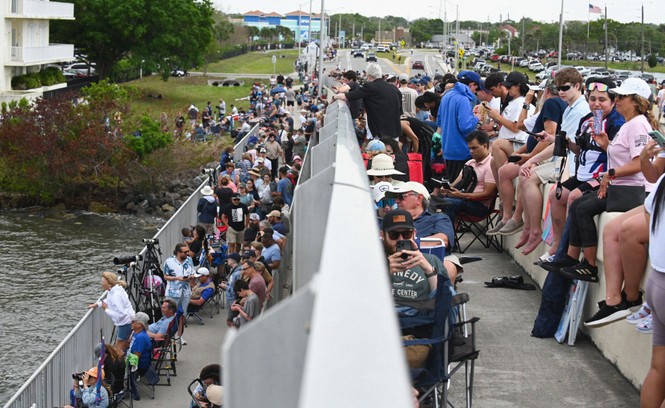
The recent launch of NASA's Artemis II mission has stirred excitement and nostalgia, yet it also exposes a broader cultural disconnect regarding human space exploration. As crowds gathered on the A. Max Brewer Bridge in Florida to witness this momentous event, many were left wondering: why does it feel like so few are aware that we are returning to the Moon? In a time when space exploration should feel like a shared adventure, the muted public reaction raises questions about our collective priorities. This sentiment echoes themes found in other recent discussions, such as the Court Rules Texas State Must Reinstate Prof Fired for Israel-Palestine Talk and the ongoing debates surrounding education and freedom of speech, which remind us of the complexities in fostering a collective consciousness.
The Artemis II mission, while a significant step back to the Moon, lacks the same fervor that surrounded the Apollo program in the 1960s. During that era, the Moon landing represented an extraordinary leap for humanity—a beacon of hope and a symbol of technological achievement. Today, however, the public seems ambivalent about this new lunar endeavor, partly because the mission's immediate goals do not feel as revolutionary. The astronauts of Artemis II will not even leave their spacecraft; their journey is more about preparation for future missions than about exploration in its purest sense. This lack of urgency mirrors a broader trend in our society, where technological advancements often feel more like incremental changes than groundbreaking milestones.
As we navigate a world driven by innovation—where the internet, smartphones, and artificial intelligence shape our lives—our focus on the Moon may seem misguided. The Artemis II launch, although visually stunning with its retrofuturistic appeal, feels more like a nostalgia act than a bold leap into the future. Many young people, who represent a significant portion of the population, have grown up without the thrill of a Moon landing and may struggle to connect with the event's significance. This disconnect highlights a need for better engagement and education about space exploration, particularly among younger generations who will inherit the mantle of these endeavors.
Moreover, the backdrop of political tensions and global crises contributes to the feeling that this mission is disconnected from the everyday lives of people. With looming issues like climate change and political strife, many might see space exploration as a luxury rather than a priority. The Artemis II mission, while it carries the potential for scientific and technological advancements, risks becoming just another spectacle in a world filled with urgent challenges. The presence of a divided political landscape, exemplified by figures like Donald Trump, further complicates public sentiment surrounding NASA’s missions, as the agency seems to oscillate between national pride and political maneuvering.
Looking ahead, the Artemis mission offers an opportunity for renewed engagement with space exploration. As we consider what the Artemis II astronauts might see as they approach the Moon, we should also reflect on what we, as a society, hope to achieve through these missions. Will they inspire a new generation to dream big and reach for the stars, or will they remain a footnote in our history? The anticipation of the Artemis II mission can serve as a catalyst for dialogue about our future in space. As we continue to explore the cosmos, perhaps we should also explore how to rekindle public interest and investment in what it means to be part of humanity’s journey beyond Earth.