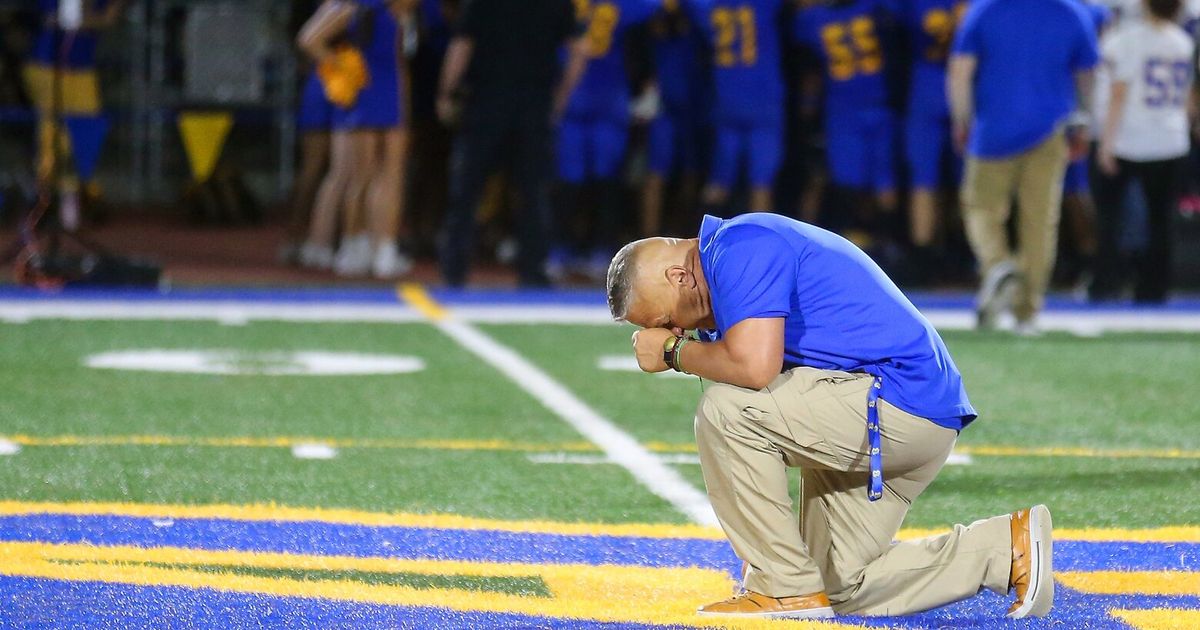
There's a version of this story where the Bremerton coach's Supreme Court case is just about one guy on a sideline. But the fallout we're watching now is bigger than that, and it's landing in places most of us actually live: classrooms, public offices, even the way we treat each other at work. The bright line between public life and religious life isn't just blurry anymore. It's moving under our feet.
For those of us who grew up assuming the separation of church and state was a fixed rule, this case is a reality check. The Court's decision didn't just open the door for public school employees to pray more openly. It gave lower courts a new lens, one that treats religious expression as protected speech unless it's coercive or disruptive. That sounds neat on paper. In practice, it means a teacher in Bremerton can kneel at the 50-yard line, and a principal in Yakima has to guess whether a prayer circle before a pep rally crosses a line. The old test was about whether the government was endorsing religion. The new test is more like, "Is anyone actually being forced into something?" That's a much harder question to answer in the middle of a school year.
Here's our honest take: this isn't a win or a loss for either "side" in the culture war. It's a transfer of uncertainty onto regular people. We're big on learning by doing, but this is one area where the doing is messy. A student wants to start a faith-based club, and a teacher wants to lead a voluntary Bible study off campus. Both of those are probably fine. But the lines get thin when it's a coach praying with players, or a teacher wearing a cross while grading papers and a student asks why. The Court said the coach's rights were violated, but it didn't give us a clean rule for the next hundred cases. So we're all left to be practical optimists in a system that rewards caution.
What does this mean for our readers? If you're a student, a club officer, or a student teacher, you're now the test case. You don't get to wait for a Supreme Court ruling to figure out your Tuesday. You have to decide, in real time, whether that moment of silence is yours or the room's. That's heavy. But here's the thing we'd tell a reader who asked: don't let the legal fog scare you out of showing up. The community-first move is to ask, not assume. If you're planning something with a faith angle, talk to your advisor or your principal first. That's not backing down. That's being smart with your energy, the same way you'd check your bank account before grabbing tacos.
The specific detail to watch is how schools update their policies. The Bremerton district already got hit with a bill for legal fees, and that's a concrete consequence. When districts have to pay for ambiguity, they'll either over-correct and chill all religious expression, or they'll write clear, neutral rules that protect everyone. We're betting on the latter, because that's the only move that keeps the peace. So here's our takeaway: the next time you're in a public space and someone tests that line, don't look for the nearest courtroom. Look for the policy. If there isn't one, that's the problem worth fixing. The law gave us a door, but it didn't give us a map. Someone has to draw it, and it might as well be the people who actually show up.