Iran Is Trying to Defeat America in the Living Room
Our take
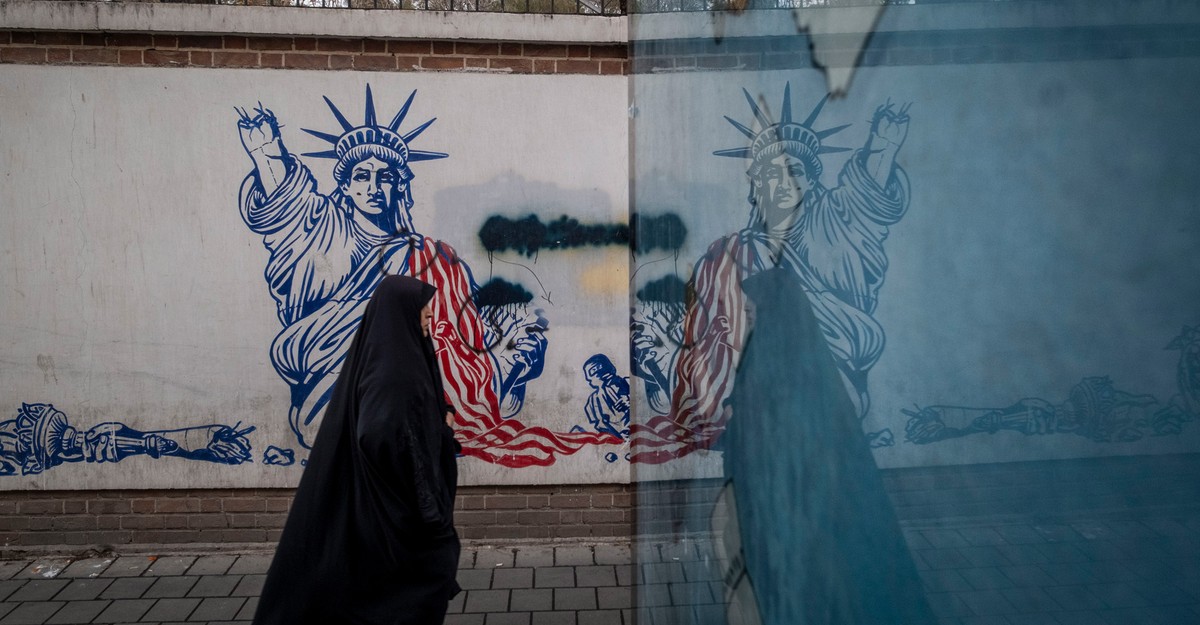
The recent article, "Iran Is Trying to Defeat America in the Living Room," sheds light on an enduring and complex strategy employed by Iran since the 1979 Islamic Revolution. This strategy leverages the vulnerabilities of American democracy, demonstrating that Iran doesn’t need to confront the U.S. militarily to achieve its goals; instead, it can sow discord and hesitation within the American public. This approach has roots in past conflicts, such as the U.S. embassy hostage crisis and the Beirut bombings, which ultimately shaped American foreign policy and public sentiment. Iran's ability to influence American opinion from afar highlights a critical aspect of modern conflict: the battleground has shifted from traditional warfare to the realm of perception and political will. For more context on these dynamics, consider reading related articles like The Strategic Follies of the Islamic Republic and Trump Is Flailing on Iran, which delve deeper into the implications of these strategies.
The article illustrates how Iran’s tactics have evolved over the decades, shifting from proxy warfare to economic and psychological maneuvers in the face of American military might. The current geopolitical climate, particularly in the context of the Strait of Hormuz, showcases Iran's ability to disrupt global commerce and raise oil prices, thereby exerting pressure on American consumers. As prices rise, so too does public discontent, particularly among Trump's base, who may begin to question the costs of prolonged military engagement. This creates a paradox: while Trump’s administration seeks to maintain a hardline stance against Iran, the economic repercussions of that stance could undermine his support at home. The divide within the Republican Party, with MAGA-aligned members supporting the war while others express hesitance, further complicates the political landscape.
Moreover, the article emphasizes a significant asymmetry in resolve between the U.S. and Iran. While U.S. presidents are bound by electoral cycles and public opinion, Iranian leadership operates without such constraints. This difference can result in a precarious situation where American leaders may falter under public pressure, while Iran can endure the hardships of economic sanctions and military threats. The ongoing struggle reveals an existential battle not just for territorial control but for the hearts and minds of the American populace. As we consider the implications of Iran’s strategy, it becomes clear that the nation is not merely fighting for survival; it is actively attempting to fracture American unity and resolve.
As we look ahead, the question remains: can President Trump maintain a cohesive strategy that addresses the dual pressures of Iranian aggression and domestic discontent? The upcoming months may prove pivotal as the interplay between public sentiment, economic realities, and foreign policy unfolds. Observers should pay close attention to how the administration navigates this complex terrain, as the consequences could redefine not only U.S.-Iran relations but also the broader geopolitical landscape. The stakes are high, and the outcome may very well hinge on whether American democracy can withstand the pressures exerted by external forces.
Among the first lessons that Iran’s Islamic revolutionaries learned after coming to power in 1979 was that their best ally against American power was American democracy. Their first test case was the seizing of the U.S. embassy in Tehran, in which 52 Americans were held hostage for 444 days, an act that devastated Iran’s economy and international reputation but succeeded in humiliating Jimmy Carter and ending his chances of reelection. Over the decades, Iran gained repeated proof that it didn’t need to defeat America on the battlefield; it just had to make the American people feel the war in their living room. And now, in a war for its survival, Tehran is attempting the same play.
In April 1983, Iran—via its newly created Lebanese proxy, Hezbollah—carried out a suicide bombing against the U.S. embassy in Beirut, killing 63 people, including 17 Americans. It was the deadliest attack on a U.S. diplomatic mission in history. “First word is that Iranian Shiites did it,” Ronald Reagan wrote in his diary, “d__n them.” Although Reagan remained outwardly steadfast, he was briefed that his approval ratings were beginning to sour because of Lebanon. “The people just don’t know why we’re there,” he wrote in his diary. “There is a deeply buried isolationist sentiment in our land.”
Months later, in October, Hezbollah struck again, this time with two simultaneous truck bombs that killed 241 American service members and 58 French soldiers as they slept. Four days after the attack, Reagan addressed the nation and asked: “If we were to leave Lebanon now, what message would that send to those who foment instability and terrorism?” He answered himself four months later, when, under pressure from Congress, he ordered the complete withdrawal of all U.S. forces from Lebanon.
[Eliot A. Cohen: The strategic follies of the Islamic Republic]
Tehran also tried the living-room strategy in Iraq. When George W. Bush invaded in 2003, Tehran feared that a stable, democratic Iraq could become an American platform to threaten or subvert the Islamic Republic. Rather than confront the United States directly, Iran did what it had learned to do in Lebanon: create enough chaos to make the war unwinnable. According to declassified interrogation records, the Iran-backed Shiite-militia leader Qais al-Khazali told his American captors that Iran supported virtually every faction capable of fueling the disorder and making Iraq ungovernable. Iran-supplied weapons, including improvised explosive devices, were responsible for as many as 1,000 American deaths. The United States was spending billions of dollars unsuccessfully trying to stabilize Iraq; Iran was spending millions successfully destabilizing it.
Iran’s path to victory was not on the Iraqi battlefield but at the American ballot box. Bush understood this, telling the American public in July 2007 that “the same regime in Iran that is pursuing nuclear weapons and threatening to wipe Israel off the map is also providing sophisticated IEDs to extremists in Iraq who are using them to kill American soldiers.” By then, however, nearly six in 10 Americans already said that the war had been a mistake. Bush, thanks greatly to Iran, had lost the support he needed at home.
Today, with its existence at stake, Tehran is once again trying to make war too unpopular with the American public for America’s president to continue. The weapons being employed are no longer truck bombs and IEDs; instead they are missiles, drones, and geography.
Unable to compete militarily with the United States and Israel, Tehran has fallen back on its most important strategic card: the Strait of Hormuz. Iranian threats have collapsed the number of ships transiting the world’s most crucial energy corridor each day from an average of 138 to single digits—on some days, just one. At least 20 commercial vessels have been attacked, sending insurance costs soaring to as much as $5 million a ship. Tehran’s $20,000 drones are disrupting hundreds of millions of dollars in cargo for each attack. Oil prices have surged more than 40 percent since February 28; Brent crude oil peaked near $120 a barrel. Americans are paying a dollar more a gallon than they were when the war began.
Donald Trump has threatened to destroy Iran if it refuses to reopen the strait, but the resulting chaos would undermine his own objective: His goal was to turn Iran into a pliant state, not a failed state.
Trump’s war on Iran has not unified Americans like previous Middle Eastern conflicts did; nearly eight in 10 Americans supported both the 1991 Gulf War and the 2003 invasion of Iraq immediately after each of those hostilities began. Today, nine in 10 Democrats oppose the Iran strikes, as do most independents, and an average of polls taken from February 27 to March 11 found that 50 percent of Americans are opposed and only 40 percent are in support. Even within the Republican Party, the divide is striking: About 90 percent of MAGA-aligned Republicans back the war, but non-MAGA Republicans are split; about 54 percent are supportive. Although Trump’s MAGA base has remained remarkably loyal to him, these Americans are acutely vulnerable to the war’s economic costs, paying more for gasoline, diesel, and groceries, whose prices have been swollen by a fertilizer shortage that the Strait of Hormuz’s closure has helped create.
Islamic Republic officials have actively sought to fracture Trump’s base by evoking anti-Zionist conspiracies. “Trump has turned ‘America First’ into ‘Israel First,’” the Iranian foreign minister, Abbas Araghchi, posted, adding, “which always means ‘America last.’” Mohammed Baqer Qalibaf, a former Revolutionary Guard commander who is close with Iran’s new supreme leader, Mojtaba Khamenei, referred to Trump’s relationship with Israeli Prime Minister Benjamin Netanyahu as an “Epstein Axis” and posted that “American families deserve to know why Trump is sacrificing their sons and daughters to advance Netanyahu’s expansionist delusions.”
Iranian state TV has also amplified the commentary of Tucker Carlson—an outspoken conservative critic of the war—including a recent interview with Joe Kent, Trump’s director of the National Counterterrorism Center who resigned after blaming “high-ranking Israeli officials and influential members of the American media” for the conflict. Tehran doesn’t want to turn Americans against just the war. It wants to turn Americans against one another.
[Rogé Karma: Iran might use its economic-doomsday option]
Although opinion polls, oil prices, and the number of projectiles remaining are measurable, the fate of the war will be determined in part by the resolve of both parties, something far more difficult to measure. A democratic president’s will to fight is constrained by elections, polls, gas prices, and the news cycle. An authoritarian regime fighting for its survival answers to none of those pressures. Reagan had resolve until Congress didn’t. Bush had resolve until six in 10 Americans called his war a mistake. This asymmetry of resolve is Iran’s greatest structural advantage. Tehran wins by not losing; Trump loses by not winning.
The Islamic Republic’s decision to build its political identity around “death to America” has been a 47-year war of choice. Trump’s decision to try to end Tehran’s malign capabilities, rather than merely contain or counter them like past administrations did, has also been a war of choice.
If Iran’s strategy depends on Peoria, Trump’s presidency depends on the Strait of Hormuz. Trump cannot withdraw so long as Iran controls it, but securing it risks the kind of mass American casualties that ended Reagan’s and Bush’s resolve. If Trump reopens it, his appetite for regime change may grow. If he doesn’t, the economic pressure on his base will mount. This is ultimately a war between a democracy’s impatience and a theocracy’s ruthless endurance. The question is whether, for the first time since 1979, Tehran has finally met a U.S. president more committed to destroying the regime than the regime is to destroying him.
Read on the original site
Open the publisher's page for the full experience
Related Articles
- The Countdown to a Ground WarDonald Trump announced this week that the United States and Iran had made significant progress in negotiations, and he was allowing five days to reach a deal. Tehran denied that it was talking with Washington at all. This is not, in any meaningful sense, a negotiation: It is a countdown. The timing is not coincidental. Thousands of Marines and much of the 1st Brigade of the 82nd Airborne are en route to the Middle East. Trump may intend the talks to act as cover for an escalation decision already made. Even if he doesn’t, the structural reality is the same: When the deadline expires, he will be close to having significant ground-combat capability in the region and a collapsing diplomatic process to justify using it. The gap between the two sides makes the collapse of talks likely. The American framework is, in essence, a demand for Iran’s surrender. The administration’s 15-point proposal, delivered to Iran via Pakistan, requires Tehran to dismantle its entire uranium-enrichment infrastructure, surrender its stockpiles of highly enriched uranium, sever all ties with proxy forces across the region, and accept strict limits on its conventional military. In exchange, Washington is offering sanctions relief and support for a civilian nuclear-energy program. The proposal is very similar to the deal that the United States put on the table before the bombing campaign began. Iran’s counter-framework reflects a regime that does not believe it is losing. Tehran is demanding binding guarantees that neither the United States nor Israel will strike again, reparations for the damage already inflicted, and formal recognition of its control over the Strait of Hormuz. On enrichment and proxies, Iranian negotiators have shown no willingness to move. The war has not moderated the Iranian regime. It has hardened it. The Islamic Revolutionary Guard Corps now dominates Iran’s internal deliberations to a degree unprecedented even under Ayatollah Ali Khamenei. Iran effectively controls the strait, and it knows that this control affords Tehran real leverage. Iran appears to have concluded that it is better positioned for a war of endurance than for a negotiated capitulation. Trump could still choose to declare victory, or even accept terms closer to Iran’s position, if he concludes that the alternative is a longer and more uncertain war. Last year’s trade confrontation with China ended with significant American concessions obscured by wins against U.S. allies and dressed in the language of reciprocal success. A similar reframing is conceivable here. He could point to Iran’s degraded navy, its shattered air force, the deaths of senior regime officials, and the setback to its nuclear program and argue that the threat has been sufficiently reduced to warrant a softer settlement. [Eliot A. Cohen: The war with Iran is exposing big problems for the military] But the Iran case will be harder to obscure than the China one was. Trade balances are abstract; the Strait of Hormuz is not. A deal that leaves the IRGC in effective control of the world’s most crucial shipping lane, imposes no enforceable limits on Iran’s missile or enrichment programs, and offers the regime international legitimacy cannot easily be framed as victory, especially when America’s closest regional partners will be lining up to say otherwise. Saudi Crown Prince Mohammed bin Salman reportedly told Trump that the United States should continue fighting to destroy the Iranian regime and remake the region. The United Arab Emirates’ ambassador to the United States rejected the idea of a “simple cease-fire,” calling instead for “a conclusive outcome that addresses Iran’s full range of threats.” The UAE and Saudi Arabia may not have fully welcomed the war in the first place, but now that it is under way, they will not want to see Iran emerge stronger from it. Meanwhile, Israel remains committed to regime change or, failing that, maximum degradation, and it worries about a deal that meets Tehran halfway or a cease-fire. These governments can be expected to push Trump to continue the war once the talks collapse, although they seem to have concerns about ground operations. But Trump wants to avoid a messy, long war, which could lead to sustained high oil prices and a possible recession. Ground troops would seem likely to bring this outcome about—but Trump appears to believe that their introduction will instead deliver a decisive knockout blow, which will either compel Tehran to accept his terms or make a U.S. declaration of victory credible. Trump announced yesterday that he had rescheduled a visit to China for May 14 and 15, which suggests that he expects the war to be over by then. According to media reports about internal Trump-administration deliberations, three ground operations are most likely: a raid on Iran’s nuclear facilities at Isfahan to seize its stockpile of highly enriched uranium; the seizure of Kharg Island, Iran’s principal oil-export hub; and the deployment of troops to Iran’s shoreline to suppress its attacks on shipping through the strait. Each carries risks that the administration appears to be underestimating. Austin Long, a senior nuclear fellow at MIT, told me that Iran’s highly enriched uranium is a white, crystalline solid, uranium hexafluoride, stored in thick, steel cylinders, and cannot be reliably and permanently destroyed with explosives. If the cylinders are pierced, they emit a severely hazardous gas. A successful seizure from Isfahan would require U.S. troops to secure a wide perimeter, locate and excavate up to 970 pounds of the uranium buried under an unknown depth of rubble, protect it from counterattack, load it onto aircraft, and depart under fire. The operation would be arguably the most complex raid ever carried out by U.S. forces. The 970 pounds of uranium could also be spread among Isfahan and two other sites, raising the possibility of multiple raids. [Nancy A. Youssef and Missy Ryan: The U.S. and Iran are fighting a massively asymmetrical war] Kharg Island and the coastal positions present different but equally serious problems. Forces on Kharg would immediately be within range of sustained Iranian fire; Iran could respond by attacking energy infrastructure and desalination plants across the Persian Gulf or destroying the island’s oil facilities to deny them to the Americans. Coastal positions are reportedly located near population centers, which would complicate both the military mission and the international response. In each scenario, the most plausible outcome is not a clean victory but a situation that demands more troops, more time, and more exposure to avert failure. The deeper problem is that military operations, however successful tactically, cannot substitute for what the war is trying to achieve strategically. Trump launched this conflict believing that Iran was weak, and that a short, sharp campaign would force a new leader to terms. The regime has proved more resilient and more capable of inflicting sustained damage on the region than the president expected. The question worth asking now is not whether the U.S.-Iran talks will fail, but what the United States will do on the other side of that failure. Trump has a long history of claiming victory in the face of overwhelming evidence to the contrary. This may be the rare moment when that instinct serves the country—because the alternative appears to be doubling down on a losing strategy by launching a ground war.
- The Strategic Follies of the Islamic RepublicWhen Western countries engage in conflict with other parts of the world, they often indulge in a kind of strategic orientalism. They attribute to the enemy extraordinary degrees of perseverance, fanaticism, cunning, and farsightedness. The war with Iran has proved no exception: As soon as the missiles began to fly, the familiar tropes returned. The regime possesses strategic patience, akin to the years of effort required to manufacture a Persian carpet; it is animated by indomitable religious zeal; it has mastered the art of winning by losing; and, of course, it thinks half a dozen moves ahead, as you might expect from the land that created the modern game of chess. This gives the leaders of the Islamic Republic of Iran way too much credit. The past half century reveals a record not of strategic brilliance, but of consistent folly, as the regime has waged wars badly—failing to achieve its objectives, creating new enemies, and inflicting more damage on itself than on others. Within a year of the revolution that brought Ayatollah Ruhollah Khomeini to power, Iran was attacked by Iraq: A bloody eight-year war ensued. The war itself was not Iran’s choice. But the regime still had its choice of tactics, and some of those were awful. It chose to launch human-wave attacks—some conducted by young teenagers—that withered under Iraqi artillery barrages and poison gas. The waste was shocking. If that war was unavoidable, picking repeated fights with the United States, first by holding hostages from its embassy and then by attacking shipping in the Persian Gulf, was not. In a series of sharp engagements in the 1980s, American naval and Special Operations forces sank Iranian ships and speedboats and destroyed Iranian bases being used to attack tankers. U.S. forces began large-scale escort-of-convoy operations—yes, it has been done before—to get oil through the Strait of Hormuz. They succeeded, and the Islamic Republic was humiliated. [Read: The trouble with seizing Kharg Island] The Islamic Republic had declared from the outset that Israel was the lesser Satan and the United States the greater. The latter was to be driven from the Persian Gulf, the former to be annihilated. These objectives had absolutely nothing to do with any reasonable definition of Iranian national interest, and their pursuit brought only military devastation and economic misery to the country. Before the revolution, some 50 years ago, Israel’s GDP was a quarter that of Iran. Today, with a tenth of Iran’s population, its GDP is greater than Iran’s. The policies pursued by the Islamic Republic in the 1990s—the death fatwa against Salman Rushdie and attempts to kill his associates, the terror bombing of a Jewish community center in Argentina—gained it nothing but opprobrium. More recently, it attempted to assassinate a former American president. It also began a serious effort to bring Israel to its knees by assembling a crushing array of proxies—Hezbollah in Lebanon, a Syrian client state with a large Iranian and Hezbollah presence, and two irregular groups with which it partnered, the Yemeni Houthis and Palestinian Hamas. At the same time, it built a covert nuclear-weapons program, and assembled an arsenal of ballistic missiles to be able to attack Israel. The aim here—which, judging by their declarations, the Islamic Republic’s leaders believed within reach—was the destruction of Israel. In response to an Israeli strike in Damascus in April 2024 that killed the head of the Islamic Revolutionary Guard Corps’ Quds Force in Syria and Lebanon, Iran fired hundreds of drones and missiles at Israel. In October of that year, following the assassination of the Hamas leader Ismail Haniyeh in Tehran and Hezbollah leader Hassan Nasrallah in Beirut, it did the same. What was the return on its investment? In a series of Israeli campaigns, some grueling (the war in Gaza’s tunnels), some tactically dazzling (the so-called beeper attacks on thousands of sabotaged Hezbollah pagers), the proxies and partners were defeated. Hamas was ground down, Hezbollah shattered, the Syrian regime collapsed in a renewed civil war, and the Houthis silenced, for the moment, by combined Israeli and American attacks. Israel’s punitive raids on Iran were limited. Iran’s strategy of encirclement of Israel had collapsed, and its ballistic-missile counterpunch was largely deflected by Israeli and Western defenses. There remained the Iranian nuclear program, long delayed and stymied by sabotage, assassinations, and sanctions. The Trump administration, like its predecessors, hoped to negotiate the Iranians out of approaching nuclear capacity but failed. And so came, with American approval, the June 2025 12-day war in which Israel demolished Iranian air defenses, killed dozens of senior commanders and scientists, and, together with a one-day American intervention, smashed Iranian nuclear sites. And after another American attempt at negotiation came the current war, the most extensive set of precision attacks on military targets the world has ever seen. The final outcome of the present conflict is unknowable, but some of the results are clear: the destruction of Iranian air defenses and its navy, the elimination of several ranks of senior leaders, the shattering of military infrastructure and industry. The Iranian counterpunch this time consisted chiefly of attacks against its Gulf neighbors, most of whom had declined to get involved in this war. Iran’s strategic logic was the same as in the mid-1980s: attack the world’s oil supply in order to bring the war to a conclusion on favorable terms by holding Western economies hostage. The result thus far has been the intensification of American military pressure and the permanent alienation of Iran’s neighbors, some of whom will support or even join the war against it. [Read: Trump’s eye is already on Cuba] And now, it appears, Iran’s leaders, most of whom dare not touch electronic means of communication or appear in public, have concluded that they have the upper hand. They talk of imposing peacetime tolls on commerce through the Strait of Hormuz, insisting on massive reparations and the expulsion of American bases by their neighbors. It reflects a self-assessment reminiscent of Monty Python’s Black Knight. Meanwhile, what of Iran itself? The capital city running so short on water that there has been serious discussion of having to move it; a drug-addiction problem that is among the worst in the world; hundreds of billions spent on a badly damaged nuclear program, or lost in foreign investment or to sanctions; and a population so seething with anger at its rulers that its risings against them every few years can be controlled only by massacring thousands of unarmed civilians. In the early 1980s, in the full flush of revolutionary ardor and against an age-old enemy who had attacked them without provocation, the Iranian people and armed forces fought and suffered for their country. That enthusiasm was gone less than a decade later, and although some portion of the population may still retain it, it has largely dissipated in the welter of corruption, maladministration, and tyranny that is the hallmark of the regime. Their supposedly clever leaders have fallen, one after another, to American and Israeli bullets and bombs. As for that noble Iranian game, chess. Ayatollah Khomeini initially banned the game, relenting shortly before his death, and today Iran has a few grandmasters playing the game their country brought to the world. But some of the best players, and particularly women, have defected to the West or been barred from playing at home—for the crime of wanting to compete with Israeli grandmasters, or simply for refusing to wear the hijab. It is a revealing record of folly on the part of leaders who are, from the strategic point of view, idiots.
- Trump Is Flailing on IranDonald Trump’s way of talking about war has always swung between extremes. He threatens “fire and fury” one day and extols his dictator buddies for their kind and thoughtful gestures the next. Since the conflict with Iran began, however, the cycle between aggression and conciliation has spun more rapidly. The president issues new and more terrible threats against Tehran, then backs off with soothing praise. He has now begun to do these things simultaneously. The reason may be that world markets, especially for oil, want the war to end, so that shipping can presumably resume through the Strait of Hormuz. Trump has learned that he can encourage the markets to expect a speedy end to the war by promising that talks are proceeding toward a settlement, or at least that he intends to quit the conflict and frame it as a victory. However, the Iranians can also read these messages. Every time Trump signals that he wants the war to end, they recognize his desperation. So, to counter this effect, Trump attempts to threaten Iran with new punishments should it fail to make a satisfactory deal. But of course, the markets can also read the threats. So Trump must counteract the impression caused by his saber-rattling with promises of peace. [Read: Six days of war, 10 rationales] A little more than a week ago, Trump warned, “If Iran doesn’t FULLY OPEN, WITHOUT THREAT, the Strait of Hormuz, within 48 HOURS from this exact point in time, the United States of America will hit and obliterate their various POWER PLANTS, STARTING WITH THE BIGGEST ONE FIRST!” Then he extended the deadline twice, explaining that he was holding promising talks with the Iranians. The Iranians have responded that no such discussions have occurred. It is difficult to assess which of these notably unreliable parties is accurately conveying the state, or non-state, of negotiations. Even so, a discouraging sign emerged yesterday in the form of a morning Trump post on Truth Social. It begins by reiterating his most dovish claims that the Iranian regime has changed, thereby fulfilling his prewar objective, and is now negotiating with him: “The United States of America is in serious discussions with A NEW, AND MORE REASONABLE, REGIME to end our Military Operations in Iran.” Regime change, in fact, refers specifically to ending a country’s system of government, not merely changing the individual people running it. The revolution that deposed the shah and replaced him with an Islamic theocracy was regime change. Replacing one leader with his son does not constitute “regime change” any more than electing a Republican president to succeed a Democratic one does. At least this fiction is consistent with Trump’s apparent attempt to find a way out by spinning his adventure in Iran as a success. Praising the “new” regime as reasonable likewise advances this goal. Yesterday’s Truth Social post reiterates that the U.S.-Iran negotiations—which, again, may or may not be happening—are making progress, and will probably succeed. But Trump also vows that failure will be met with terrible violence: “Great progress has been made but, if for any reason a deal is not shortly reached, which it probably will be, and if the Hormuz Strait is not immediately ‘Open for Business,’ we will conclude our lovely ‘stay’ in Iran by blowing up and completely obliterating all of their Electric Generating Plants, Oil Wells and Kharg Island (and possibly all desalinization plants!), which we have purposefully not yet ‘touched.’” Threatening to commit war crimes—and destroying civilian infrastructure such as desalination plants would certainly qualify—is generally an uncomfortable rhetorical pivot in any presidential text. It is even more awkward when the threat immediately follows praise of the prospective target’s leadership for its reasonableness. Trump does try to supply a moral justification, of sorts, for such a crime: “This will be in retribution for our many soldiers, and others, that Iran has butchered and killed over the old Regime’s 47 year ‘Reign of Terror.’” If the president is planting a defense for a future war-crimes trial at The Hague, he has not given his prospective legal team much to work with. As a motive for committing atrocities, “retribution” is more of a confession than an alibi. What’s more, whatever moral force Trump generates by citing the regime’s “Reign of Terror” as a rationale for harming its citizens is undercut by his casually noting that those offenses were committed by the old regime, the one that Trump claims has changed. The Allies bombing Dresden in 1945 was notorious, but bombing it in 1946 would have been altogether worse. [Watch: Trump’s mixed messages about Iran] A normal politician would attempt to convey that he is being reasonable and negotiating in good faith, whereas his adversaries are violent war criminals. Trump is arguing the reverse. Perhaps he is calculating that Iran has blundered by surrendering its well-honed “unstable aggressive fanatic” identity, and now he has a chance to own that brand. Or, more likely, he is desperately flailing for a message that will reassure the stock market and scare the Iranians—rather than the other way around. To be sure, there is another group that is alarmed both by Trump’s wild threats of escalation and by his intimations of peace: the rest of the world, which is coping with an economic crisis caused by Iran’s closure of the Strait of Hormuz. Trump proposes in a new post this morning that, having changed the regime, he will leave the wee problem of the strait for our former allies to deal with. Not our problem; they should have thought of it before we started the war.
- Is Trump Actually Having ‘Very Good’ Talks With Tehran?Sign up for our newsletter about national security here. Early this morning, with Asian markets sharply down and oil tankers idling in the Strait of Hormuz, President Trump offered Iranian leaders a familiar mix of threats but also a reprieve. What had been, only days earlier, a 48-hour ultimatum—reopen the strait or face the destruction of energy infrastructure —softened into something more elastic: a five-day extension for what he described as “very good and productive” talks with Tehran. The contours of the talks were not immediately clear, though Trump suggested while leaving Palm Beach this morning that both he and “the ayatollah, whoever the ayatollah is” should control the Strait of Hormuz, through which one-fifth of the world’s oil supply passes. He boasted of “major points of agreement” and assured reporters that Iran, like the United States, wants “very much to make a deal.” Otherwise, he added, “we’ll just keep bombing our little hearts out.” It was, by his telling, progress. By Tehran’s account, it was fiction. The gap between Trump’s claims and Iran’s categorical denials underscores how little control either side has over the conflict—or its narrative. The White House is attempting to manage a large-scale military confrontation with an undefined exit strategy—a confrontation that is unnerving markets. As military strikes fail to reopen the waterway and allies worry about the expanding conflict, the administration is facing the limits of unilateral action. Three foreign officials with knowledge of the U.S. efforts told us that Trump’s Middle East envoy, Steve Witkoff, has communicated with the Iranian government through Pakistan and other regional intermediaries in an effort to get the embattled regime to agree to demands regarding its nuclear program and uranium-enrichment efforts. They said that the U.S. presented a 15-point plan—based on the 15-point proposal presented to the Iranian government last year—to give the weakened regime a chance to concede and spare itself further bombardment. These officials, like others we spoke with, did so on the condition of anonymity to discuss sensitive negotiations. Vice President Vance spoke with Israeli Prime Minister Benjamin Netanyahu today about efforts to restart talks with Iran, a person with knowledge of the discussions told us. Vance, whose long-held isolationist views have put him at odds with some in the administration—including the president—may also take part in talks in the Pakistani capital, Islamabad, in the coming days, this person said. White House Press Secretary Karoline Leavitt told us in a statement that the situation is fluid and that any “speculation about meetings should not be deemed as final until they are formally announced by the White House.” She added that the administration would not negotiate the conflict “through the press.” Iranian officials insist that there are no negotiations. Mohammad Baqer Qalibaf, the Parliament speaker, dismissed Trump’s claims as market manipulation—they are an attempt, he said, to “escape the quagmire” and to reassure oil traders rattled by the strait’s closure. The result is a war suspended between escalation and exit, its terms of victory as undefined now as they were at its outset. Trump’s aides had previously urged him, advisers have told us, not to issue any ultimatums or deadlines that the U.S. would have difficulty enforcing—guidance that he followed for a time, even as his threats toward Tehran grew more belligerent. But the president grew frustrated late last week when Iran effectively closed the Strait of Hormuz and refused to reopen it, even under heavy American and Israeli bombardment. The strait’s closure sent oil prices soaring and stock markets tumbling, and it unnerved Republicans facing close elections this fall. (Trump has often taken the stock-market indexes to be the most important metric of presidential success.) By Saturday, Trump was seething that NATO allies had refused to help secure the strait—and that he had received criticism and negative news coverage for announcing that he was glad that Robert Mueller had died, two advisers who were aware of the president’s mindset over the weekend told us. That night, Trump issued his 48-hour ultimatum to Iran. [Read: How much pain is Trump really willing to endure?] But Iran showed no signs of budging, and some of Trump’s advisers and U.S. allies in the region warned that destroying Iran’s power infrastructure would be a mistake, one of those advisers and two other people familiar with the conversations told us. U.S. allies and experts warned that a strike of that nature might prompt Iran to attack its neighbors with much of its remaining arsenal. And still, there would be no guarantees that the strait could be swiftly reopened. Allies also cautioned that extensive damage to Iran’s infrastructure might produce a failed state at the war’s end, which could create a refugee crisis and a dangerous breeding ground for terrorism and violence. Since late last month, when U.S. and Israeli strikes killed much of Iran’s senior leadership, the military campaign has moved quickly (but not smoothly) toward some of the administration’s discernible objectives. American forces have hit missile sites, naval assets, and fortified positions along Iran’s southern coast near the Strait of Hormuz. Trump has said that the bombing of Kharg Island, a centerpiece of Iran’s energy infrastructure, completely destroyed the island’s military sites, though oil facilities were conspicuously untouched. The strait, effectively closed by threats of Iranian mines, drones, and attacks on ships, has proved more difficult to reopen than to threaten. Shipping traffic has dwindled. Insurance costs have spiked. Trump is known to pay close attention to financial markets, and he announced the five-day extension just as Wall Street opened this morning. The markets immediately rebounded, and the price of oil fell. The president acknowledged the link to reporters soon after. “The price of oil will drop like a rock as soon as a deal is done,” he said. “I guess it already is today.” One former administration official told us that even the prospect of resuming talks is enough to give Trump cover to extend his self-imposed deadline. It has also bought the president more time to consider whether he wants to deploy ground troops to the region, perhaps a strike force to seize Kharg Island. Such an operation—pushed vigorously in public and private by allies such as Senator Lindsey Graham—could force Iran to give up control of the strait but would also come at a cost: The fighting would likely be fierce, and Trump has expressed reluctance to risk numerous American casualties. [Read: The Iran war’s next threat is to food and water ] Allies, too, have hesitated to turn to force to reopen the strait. European and Indo-Pacific partners—Japan, Australia, and several NATO states—have resisted direct military involvement, instead urging diplomacy or limited escort missions through the strait. The coalition Trump once envisioned has not materialized. Against this backdrop, the president’s messaging has grown more improvisational. On Truth Social, Trump has alternated between declaring overwhelming victory and calling for other nations to assume responsibility for the strait’s security. His suggestion today that the passage could soon reopen under U.S.–Iranian management lacks confirmation from Tehran. The strikes threatened on Iran’s power grid—once imminent—have been paused, not canceled, and made contingent on diplomatic momentum that one side insists exists and the other denies outright. Meanwhile, the fighting continues, with no clear end in sight.