U.S. Deploys 3 Aircraft Carrier Strike Groups In Middle East For First Time Since 2003
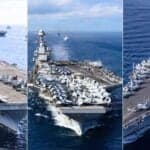


The United States has deployed three aircraft carrier strike groups in the Middle East for the first time in more than two decades.
The US Central Command (CENTCOM) confirmed that the aircraft carriers USS Abraham Lincoln (CVN 72), USS Gerald R. Ford (CVN 78), and USS George H.W. Bush (CVN 77) are operating in the region with 12 accompanying warships, more than 200 aircraft, and around 15,000 sailors and marines.
According to CENTCOM, this is the first time in decades that three US aircraft carriers have been deployed simultaneously in the Middle East. The last similar deployment was seen before the US-led invasion of Iraq in 2003.
The latest arrival, USS George H.W. Bush, entered CENTCOM’s area of responsibility this week and is sailing in the Indian Ocean.
The carrier left Norfolk, Virginia, on March 31 and took the route around the Cape of Good Hope, avoiding the Suez Canal and the Red Sea, where Iran-backed Houthis have threatened shipping near the Bab al-Mandab Strait.
The USS Abraham Lincoln has been operating in the Arabian Sea and has been involved in US strikes launched since fighting with Iran began on February 28.
The USS Gerald R. Ford, the world’s largest aircraft carrier, also remains in the region after returning to operations following a fire incident in March and a short repair and crew rest period in the Mediterranean.
The military build-up comes as a fragile ceasefire between the United States, Israel and Iran remains in place but negotiations are stalled. Iran has said the lifting of the US naval blockade on its ports is necessary before talks can resume.
US President Donald Trump extended the truce this week but indicated the blockade would remain. He later said he was in no hurry for a deal, adding that Iran was under economic pressure.
Iran has described the blockade, under which at least two Iranian oil tankers have been seized, as an act of war.
Iranian forces have also detained foreign commercial vessels in the Strait of Hormuz, accusing them of violating maritime regulations.
After earlier declaring the Strait of Hormuz fully open, Iran has again imposed restrictions there in response to the US blockade, raising concerns for shipping in one of the world’s busiest energy trade routes.
On Friday, CENTCOM said US forces had “redirected” 34 vessels in the region as the blockade on ships entering or leaving Iranian ports continued.
Analysts said the arrival of a third carrier increases pressure on Tehran and also gives the US more military options if the ceasefire breaks down.
Per reports, contingency plans have been discussed for possible strikes on Iranian fast attack boats, mine-laying vessels and other naval assets that could threaten traffic in the Strait of Hormuz.
Some analysts said the Bush may also partly be relieving the Ford, which has been deployed longer than normal. Others noted the Bush brings additional capability, including F-35 fighter jets.
Experts also said three carriers would be more than required for blockade enforcement alone, suggesting the deployment carries a strategic message.
According to data from the Center for Strategic and International Studies, this is the largest US carrier presence in the region since 2003, when five carriers took part in operations linked to Iraq.
A US official earlier said Washington had 19 warships in the Middle East and seven in the Indian Ocean, though that count did not include the Bush or its strike group.
References: Al Jazeera, Al Arabiya
Want to read more?
Check out the full article on the original site