Trump’s Mixed Messages About Iran
Our take
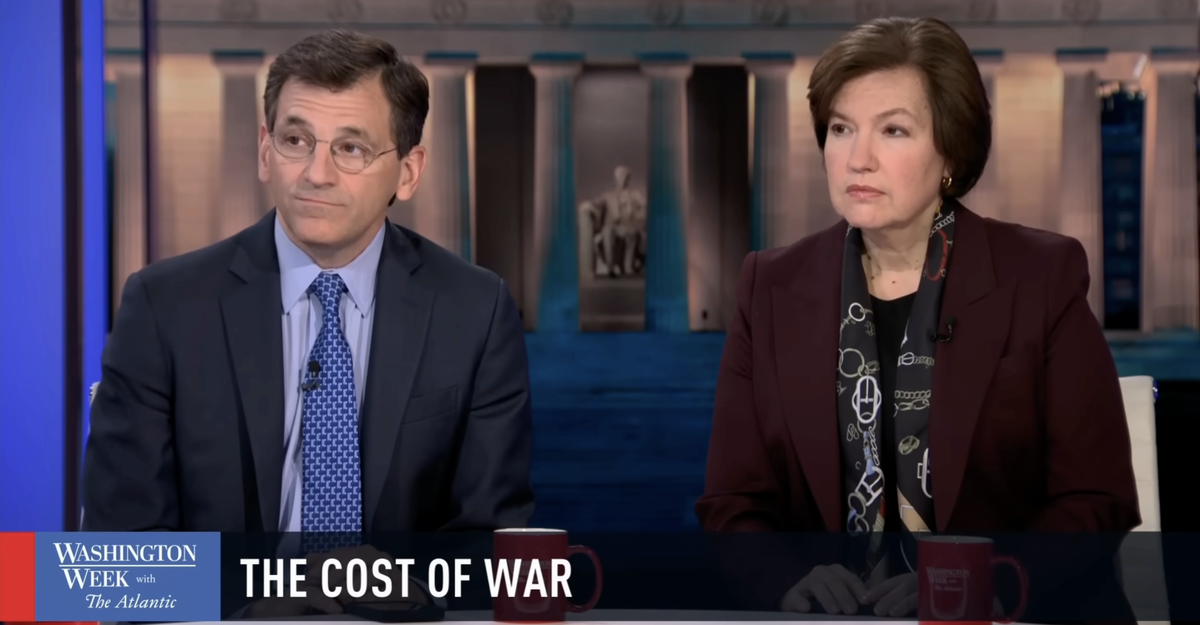
In recent discussions on Washington Week With The Atlantic, panelists explored President Trump’s mixed messages regarding military action in Iran, drawing parallels with past conflicts that highlight the complexities of modern warfare. As David Ignatius from The Washington Post noted, while the U.S. may exert overwhelming military power, the question of what victory truly looks like remains murky. This uncertainty is reminiscent of the ongoing struggles in Gaza, where despite significant military efforts, the situation remains unresolved. This raises critical questions about the efficacy of military force when objectives are unclear, a theme that resonates deeply in our current geopolitical climate.
Understanding the implications of Trump’s fluctuating rhetoric on Iran is essential. His approach has often swung between aggressive posturing and vague promises of peace, which can create confusion not only domestically but also among international allies and adversaries. For instance, articles like Trump Is Flailing on Iran provide insight into how his inconsistent statements undermine the U.S.'s credibility on the world stage. When the President threatens "fire and fury" one day and hints at diplomatic solutions the next, it can lead to a lack of trust in U.S. intentions. This unpredictability complicates relationships with allies who may hesitate to align themselves with a partner whose strategy appears erratic.
Moreover, the growing opposition to military engagement in Iran, as discussed in the panel, reflects a broader sentiment among the American public and policymakers who have witnessed the costs of prolonged conflict. With the U.S. still grappling with the legacies of wars in Iraq and Afghanistan, there is a palpable wariness about entering another protracted military engagement. This skepticism is not merely a reflection of past failures; it also speaks to a desire for more nuanced strategies that prioritize diplomacy and coalition-building over unilateral military action. As mentioned in What Trump’s Address to the Nation Revealed, the American public is increasingly advocating for foreign policy that seeks to address root causes of conflict rather than relying solely on military might.
As we consider these discussions, it’s vital to recognize that the consequences of Trump’s mixed messages on Iran extend beyond immediate military strategy. They touch on the larger narrative of American foreign policy and its role in global stability. The challenge for the administration will be to articulate a coherent strategy that resonates with both domestic audiences and international partners. As the geopolitical landscape continues to shift, the effectiveness of U.S. engagement in Iran may depend on the ability to balance military readiness with diplomatic efforts and clear communication.
Looking ahead, one must wonder: how will the administration reconcile its military ambitions with the growing demand for a more thoughtful, strategic approach to foreign policy? As we navigate this uncertain terrain, the answers will likely shape not only the future of U.S.-Iran relations but also the broader implications for global peace and security. This is a moment worth watching, as the decisions made today will reverberate long into the future.
Editor’s Note: Panelists on Washington Week With The Atlantic joined to discuss growing opposition to President Trump’s attacks on Iran and what winning a war with unclear objectives could like.
President Trump continues to offer different answers to what victory in Iran may look like. Panelists on Washington Week With The Atlantic joined last night to discuss this, and more.
“In a tactical sense, there’s no question that overwhelming military power is brought to bear and Iran is being degraded,” David Ignatius, a foreign-affairs columnist at The Washington Post, said last night. But “the more I watch this process of a weak enemy being pounded and pounded, I’m reminded of the Gaza war.” After two years of fighting, “Hamas still controls most of the Palestinians in Gaza,” Ignatius argued. “Even with all that power, Israel wasn’t able to win—and I think that’s what we’re all worrying about.”
Joining the editor in chief of The Atlantic, Jeffrey Goldberg, to discuss this and more: Peter Baker, the chief White House correspondent at The New York Times; Susan Glasser, a staff writer at The New Yorker; Ignatius; and Missy Ryan, a staff writer at The Atlantic.
Watch the full episode here.
Read on the original site
Open the publisher's page for the full experience
Related Articles
- What Trump’s Address to the Nation RevealedEditor’s Note: Panelists on Washington Week With The Atlantic joined to discuss growing opposition to President Trump’s attacks on Iran and what winning a war with unclear objectives could like. Earlier this week, Donald Trump delivered his first national address since the war with Iran began more than a month ago. On Washington Week With The Atlantic, panelists joined to discuss the president’s remarks, and more. “It’s always better for a president in a time of war to go to the public and explain what he’s trying to do, to explain the goals, to explain why it’s worth American treasure and lives,” Peter Baker, the chief White House correspondent at The New York Times said last night. But Trump’s address on Wednesday “did not feel like a speech a month into the war saying where we’re going to go from here, and I think it left a lot of people confused.” Joining guest moderator Vivan Salama, a staff writer at The Atlantic, to discuss this, and more: Idrees Ali, a national-security correspondent at Reuters; Baker; Susan Glasser, a staff writer at The New Yorker; Michelle Price, a White House reporter at the Associated Press. Watch the full episode here.
- Trump Is Flailing on IranDonald Trump’s way of talking about war has always swung between extremes. He threatens “fire and fury” one day and extols his dictator buddies for their kind and thoughtful gestures the next. Since the conflict with Iran began, however, the cycle between aggression and conciliation has spun more rapidly. The president issues new and more terrible threats against Tehran, then backs off with soothing praise. He has now begun to do these things simultaneously. The reason may be that world markets, especially for oil, want the war to end, so that shipping can presumably resume through the Strait of Hormuz. Trump has learned that he can encourage the markets to expect a speedy end to the war by promising that talks are proceeding toward a settlement, or at least that he intends to quit the conflict and frame it as a victory. However, the Iranians can also read these messages. Every time Trump signals that he wants the war to end, they recognize his desperation. So, to counter this effect, Trump attempts to threaten Iran with new punishments should it fail to make a satisfactory deal. But of course, the markets can also read the threats. So Trump must counteract the impression caused by his saber-rattling with promises of peace. [Read: Six days of war, 10 rationales] A little more than a week ago, Trump warned, “If Iran doesn’t FULLY OPEN, WITHOUT THREAT, the Strait of Hormuz, within 48 HOURS from this exact point in time, the United States of America will hit and obliterate their various POWER PLANTS, STARTING WITH THE BIGGEST ONE FIRST!” Then he extended the deadline twice, explaining that he was holding promising talks with the Iranians. The Iranians have responded that no such discussions have occurred. It is difficult to assess which of these notably unreliable parties is accurately conveying the state, or non-state, of negotiations. Even so, a discouraging sign emerged yesterday in the form of a morning Trump post on Truth Social. It begins by reiterating his most dovish claims that the Iranian regime has changed, thereby fulfilling his prewar objective, and is now negotiating with him: “The United States of America is in serious discussions with A NEW, AND MORE REASONABLE, REGIME to end our Military Operations in Iran.” Regime change, in fact, refers specifically to ending a country’s system of government, not merely changing the individual people running it. The revolution that deposed the shah and replaced him with an Islamic theocracy was regime change. Replacing one leader with his son does not constitute “regime change” any more than electing a Republican president to succeed a Democratic one does. At least this fiction is consistent with Trump’s apparent attempt to find a way out by spinning his adventure in Iran as a success. Praising the “new” regime as reasonable likewise advances this goal. Yesterday’s Truth Social post reiterates that the U.S.-Iran negotiations—which, again, may or may not be happening—are making progress, and will probably succeed. But Trump also vows that failure will be met with terrible violence: “Great progress has been made but, if for any reason a deal is not shortly reached, which it probably will be, and if the Hormuz Strait is not immediately ‘Open for Business,’ we will conclude our lovely ‘stay’ in Iran by blowing up and completely obliterating all of their Electric Generating Plants, Oil Wells and Kharg Island (and possibly all desalinization plants!), which we have purposefully not yet ‘touched.’” Threatening to commit war crimes—and destroying civilian infrastructure such as desalination plants would certainly qualify—is generally an uncomfortable rhetorical pivot in any presidential text. It is even more awkward when the threat immediately follows praise of the prospective target’s leadership for its reasonableness. Trump does try to supply a moral justification, of sorts, for such a crime: “This will be in retribution for our many soldiers, and others, that Iran has butchered and killed over the old Regime’s 47 year ‘Reign of Terror.’” If the president is planting a defense for a future war-crimes trial at The Hague, he has not given his prospective legal team much to work with. As a motive for committing atrocities, “retribution” is more of a confession than an alibi. What’s more, whatever moral force Trump generates by citing the regime’s “Reign of Terror” as a rationale for harming its citizens is undercut by his casually noting that those offenses were committed by the old regime, the one that Trump claims has changed. The Allies bombing Dresden in 1945 was notorious, but bombing it in 1946 would have been altogether worse. [Watch: Trump’s mixed messages about Iran] A normal politician would attempt to convey that he is being reasonable and negotiating in good faith, whereas his adversaries are violent war criminals. Trump is arguing the reverse. Perhaps he is calculating that Iran has blundered by surrendering its well-honed “unstable aggressive fanatic” identity, and now he has a chance to own that brand. Or, more likely, he is desperately flailing for a message that will reassure the stock market and scare the Iranians—rather than the other way around. To be sure, there is another group that is alarmed both by Trump’s wild threats of escalation and by his intimations of peace: the rest of the world, which is coping with an economic crisis caused by Iran’s closure of the Strait of Hormuz. Trump proposes in a new post this morning that, having changed the regime, he will leave the wee problem of the strait for our former allies to deal with. Not our problem; they should have thought of it before we started the war.