Trump’s Absurd Citizenship Arguments Went Nowhere
Our take
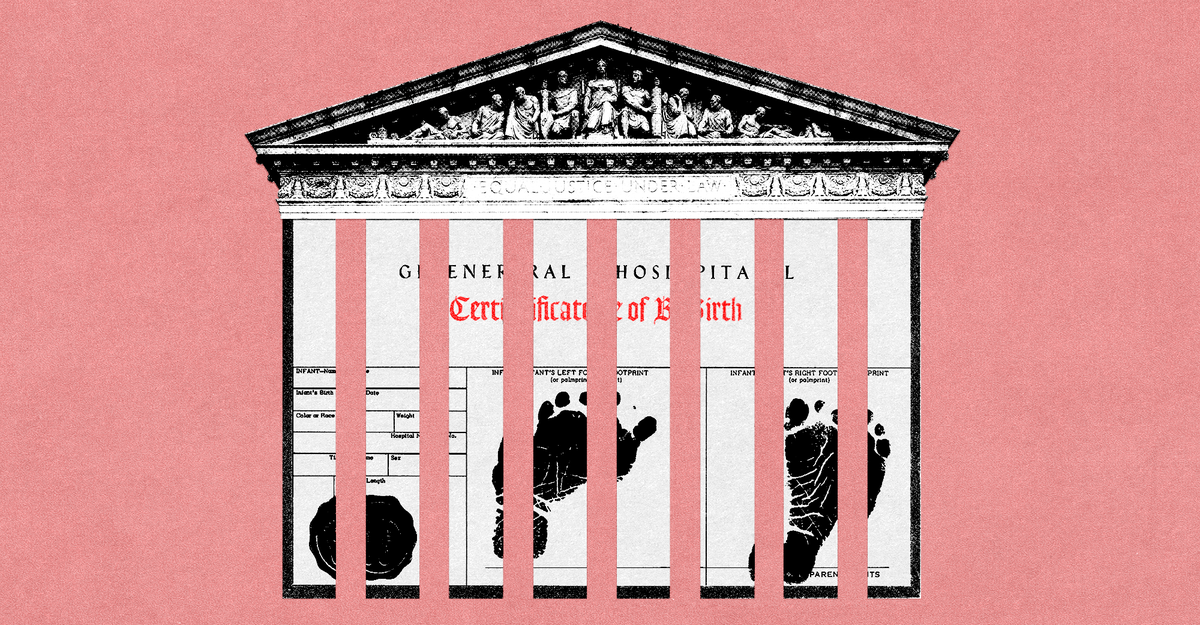
The recent Supreme Court oral arguments surrounding birthright citizenship have thrown a spotlight on the contentious and deeply rooted issues of immigration, identity, and constitutional interpretation in the United States. As Donald Trump observed the proceedings, it became apparent that the administration's approach has often hinged on a declaration of correctness rather than engaging with substantive legal arguments. The case, Trump v. Barbara, involves an executive order that seeks to deny citizenship to U.S.-born children of certain immigrants, a move many view as a direct contradiction to the Fourteenth Amendment. The implications of this case are profound, especially considering the historical context of the amendment’s ratification, which was meant to rectify injustices like those seen in the Dred Scott ruling. The stakes are high, not only for the parties involved but also for the foundational principles of citizenship that define American democracy.
During the oral arguments, the skepticism displayed by the justices—who seemed largely dismissive of the administration's rationale—raises critical questions about the integrity of judicial processes in light of political pressures. Chief Justice John Roberts and Justice Neil Gorsuch's pointed questions suggested a reluctance to entertain arguments that lacked historical and constitutional grounding. This moment was not merely about the legalities of citizenship but resonated with a larger narrative about who gets to belong in this nation. The justices' apparent inclination to uphold the principles articulated in United States v. Wong Kim Ark, which affirmed that citizenship extends to anyone born on U.S. soil, reflects a commitment to protecting constitutional rights against arbitrary political maneuvers. Such a commitment is vital for ensuring that the judiciary remains a bulwark against the erosion of civil liberties.
Moreover, the case underscores a troubling trend in which legal scholars and political figures attempt to reinterpret constitutional texts to serve specific agendas. This echoes broader societal debates about immigration and identity, themes explored in related discussions such as the Court Rules Texas State Must Reinstate Prof Fired for Israel-Palestine Talk and the Kentucky State University Students, Alumni Sue to Block New State Law. In each of these instances, we see a struggle between established legal precedents and contemporary political narratives that threaten to redefine the fabric of American society.
As we look ahead, the outcome of Trump v. Barbara will undoubtedly shape the future landscape of citizenship in the United States. Will the Supreme Court reinforce the foundational principles of the Fourteenth Amendment, or will it open the door to a new interpretation that could undermine the rights of countless individuals? The upcoming decision may serve as a litmus test for the resilience of constitutional democracy in an era marked by divisive rhetoric and legal reinterpretation. As citizens, we must remain vigilant and engaged, recognizing that the outcomes of such cases have far-reaching implications for our collective identity and values. The question remains: how will we, as a society, navigate the complexities of belonging and citizenship in the face of shifting political tides?
As the Supreme Court heard oral arguments today about birthright citizenship, Donald Trump was watching from the courtroom—an apparent first for a sitting president. He listened silently as the justices pelted skeptical questions at Solicitor General John Sauer, who tried to defend a Trump executive order purporting to deny citizenship to the U.S.-born children of certain immigrants. Not long into arguments by Cecillia Wang, the ACLU lawyer representing Trump’s challengers, the president got up and left.
The odd scene reflected the administration’s approach to the matter of birthright citizenship: Simply declare you are right, and then ignore arguments to the contrary. Yet if Trump intended his presence to pressure the justices into siding with him, he failed. Most of the justices, even among the conservative supermajority, seemed inclined to strike down his policy. Still, the fact that this case got as far as it did—and that the justices had to consider it seriously enough to spend their time rebuking it—is itself a scandal.
The case, Trump v. Barbara, turns on the Trump administration’s argument that the Fourteenth Amendment does not actually mean what its text states and what nearly everyone has agreed it says for more than 150 years. Ratified after the Civil War, the amendment establishes that “all persons born or naturalized in the United States, and subject to the jurisdiction thereof, are citizens of the United States.” It repudiated the Supreme Court’s notorious 1857 ruling in Dred Scott, which barred Black people from citizenship and created a permanent underclass of people without access to the same rights offered to other Americans. In 1898, the Supreme Court established clearly in United States v. Wong Kim Ark that the Fourteenth Amendment’s protections extended to babies born in the United States to parents of noncitizens.
This egalitarian guarantee was, however, unsatisfactory to Trump. On the first day of his second term in office, he released an executive order attempting to restrict citizenship to children of parents who are either U.S. citizens or lawful permanent residents (that is, green-card holders). The fact that this flatly contradicted the Fourteenth Amendment seemed not to bother the new administration. The policy would have created an enormous administrative headache—maternity wards, after all, are not set up to establish the immigration status of expectant parents—but it was immediately halted by a wave of legal challenges.
[Amanda L. Tyler: The Supreme Court has heard this one before]
At first, some Supreme Court watchers were nervous when the justices agreed to take up the case. The Court had the option of simply refusing the government’s request to hear the matter. Meanwhile, contrarian legal academics had been busy cobbling together scholarship to support Trump’s claims about the meaning of the Fourteenth Amendment. These arguments were so absurd, some scholars worried, that even the justices’ willingness to dignify them with a hearing might have indicated an inclination to be convinced.
Today’s proceedings will come as a relief. The justices overwhelmingly appeared dismissive of Sauer’s legal arguments. Chief Justice John Roberts deemed Sauer’s reasoning “quirky” and “idiosyncratic.” Justice Neil Gorsuch accused the solicitor general of relying on obscure “Roman-law sources,” in a tone that sounded as if he were rebuking Sauer for leaving a moldy Tupperware in the fridge. Justice Amy Coney Barrett cut Sauer off mid-sentence, demanding, “Yeah, yeah, yeah—what about the Constitution?” The three liberals were similarly skeptical. Only Justice Samuel Alito and possibly Justice Clarence Thomas seemed open to potentially ruling for Trump.
Sauer’s opening remarks did not mention Wong Kim Ark at all or ask the Court to overturn it. His arguments—made with Trump sitting behind him—depended on quibbling with the intended scope of the Fourteenth Amendment, which, he maintained, was narrowly meant to correct the injustice of Dred Scott by granting citizenship to Black Americans. But as the Court recognized in Wong Kim Ark, the amendment’s framers intended to extend the grant of citizenship to everyone except a small number of people who were born on American soil and yet remained outside U.S. “jurisdiction”: the children of diplomats and invading forces, and—because of the unique circumstances of Native Americans—members of Native tribes. (Native Americans born in the U.S. are nevertheless citizens under a 1924 statute.)
Sauer insisted that the loopholes in the amendment were wide enough to withhold citizenship from the children of immigrants. Meanwhile, Gorsuch, a strong supporter of Native sovereignty, seemed to grow more and more annoyed over the course of oral arguments with Sauer’s selective use of Indian law. (“Do you think Native Americans are birthright citizens under your test?” Gorsuch asked bluntly at one point, to which Sauer responded, uncertainly, “I—think so?”)
[Greg Grandin: The revolutionary idea that remade the new world]
The justices’ prickliness toward Sauer contrasted with their collegial reception of the ACLU’s Cecillia Wang. Herself a citizen born to immigrant parents, Wang had the easier argument by far: “I know you’ve got a lot of good stuff on your side,” Gorsuch told her at one point. She called Sauer’s decision not to ask the Court to simply overrule Wong Kim Ark a “fatal concession.” Near the end of arguments, Justice Brett Kavanaugh suggested that the Court could simply issue a “short opinion” in the ACLU’s favor reaffirming Wong Kim Ark. “Yes,” Wang said, simply. Laughter rippled through the courtroom.
The Court’s apparent lack of interest in rolling back the Fourteenth Amendment bodes well for the durability of the Constitution, the integrity of the judiciary, and, not least of all, the lives of the many people who have depended and will depend on its offer of citizenship. Whatever the Court rules, though, Trump v. Barbara will be a black mark on administration lawyers and legal scholars who proved eager to reverse engineer flimsy arguments in support of an anti-constitutional aim, and on a political system that nearly enabled the gutting of one of America’s most foundational promises.
Read on the original site
Open the publisher's page for the full experience