The Black Women Changing the DAR
Our take
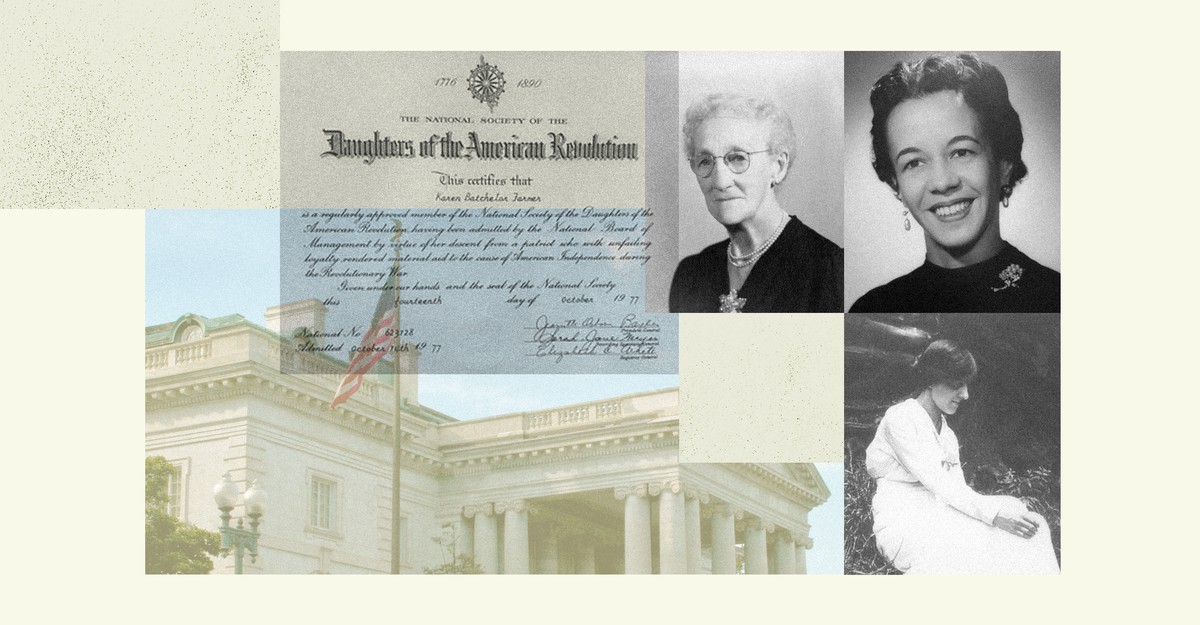
The rise of Black women within the Daughters of the American Revolution (DAR) marks a significant cultural shift for an organization once synonymous with elitism and racial exclusion. Karen Batchelor's journey from a hesitant seeker of her heritage to becoming the first openly Black member in 1977 is not just a personal triumph; it signals a broader movement toward inclusivity in spaces traditionally dominated by whiteness. This transformation resonates deeply in today's societal landscape, where conversations about race, history, and representation are more critical than ever. As seen in other recent events, like the court ruling that reinstated a Texas professor fired for discussing sensitive topics or the ongoing legal battles faced by Kentucky State University students against new state laws, the fight for representation and equity is a pressing concern across various sectors.
The narrative of Batchelor and her fellow Black members is emblematic of a larger reclamation of history that includes diverse voices. For decades, DAR's legacy was marred by its exclusionary practices, particularly its infamous rejection of Black opera singer Marian Anderson in 1939. Such an event highlighted the organization's systemic racism and pushed civil rights activists, including Batchelor's parents, to view DAR with skepticism. Yet, as Batchelor and others like Shelley Murphy began to infiltrate DAR, they not only sought to change the organization from within but also to redefine the narrative around American history itself. The fact that DAR is now welcoming a more diverse membership is a testament to the changing tides of historical scholarship and public awareness about the contributions of Black and Indigenous peoples to the American Revolution.
This integration is not merely a matter of membership numbers; it symbolizes a shift toward a more inclusive understanding of American history. The acknowledgment that thousands of Black men and women fought for freedom during the Revolution, despite being largely omitted from traditional narratives, is vital for fostering a sense of belonging among all Americans. As more women of color take on leadership roles within DAR, as noted in the growing number of chapters founded in cities like Cincinnati and Queens, we see a tangible shift in who gets to tell the story of America. This evolution is crucial, especially as we approach the 250th anniversary of the nation’s independence—an event that should reflect the diverse makeup of the country’s history.
However, challenges remain. While the DAR has made strides in addressing its past, the journey toward true inclusivity is ongoing. The recent emphasis on using DNA evidence alongside traditional genealogical research to validate claims of lineage demonstrates an understanding of the complexities surrounding African American ancestry. Yet, as Shelley Murphy aptly points out, there is still a need for the organization to deepen its understanding of the historical context surrounding these records. The question looms: will DAR continue to adapt and embrace this complexity in a way that honors the multifaceted stories of all its members?
The story of Karen Batchelor and the evolving DAR serves as a powerful reminder of the importance of inclusivity in historical narratives. As we witness the rise of diverse voices in traditional spaces, it beckons us to consider how we can collectively reshape our understanding of history to truly reflect the contributions of all Americans. The transformation within DAR is just one example of the broader societal shifts taking place. What other legacy organizations might follow suit, and how will their changes impact the way we understand our collective past? As these discussions unfold, it’s vital to stay engaged and advocate for a history that acknowledges and celebrates all its participants.
In 1976, Karen Batchelor was a young mother desperate for mental stimulation. One day, she went to a library in Detroit to explore her family’s history and unexpectedly found an Irish ancestor who had served as a Revolutionary War soldier on the Pennsylvania frontier. Batchelor, who is Black, was even more surprised when a librarian told her that this discovery qualified her for membership in Daughters of the American Revolution.
“All I knew about them”—the Daughters—“was what I learned at the dinner table,” Batchelor told me recently. DAR had long been known as a bastion of racism and elitism, and Batchelor’s parents, who were civil-rights activists, had shared a mostly negative view of it.
In 1939, the organization had sparked national outrage when it barred the Black opera singer Marian Anderson from performing at its auditorium Constitution Hall. Eleanor Roosevelt, then the first lady, publicly resigned from DAR in response, and a Protestant bishop labeled the society “the Mothers of Fascism.” Anderson subsequently performed on the steps of the Lincoln Memorial in front of an audience of 75,000; millions more listened on the radio. She was allowed to sing at a 1943 war-relief concert in Constitution Hall, but DAR’s overall ban on Black performers remained in place for another decade.
At the time when Batchelor learned that she was eligible to join the society, virtually all of DAR’s roughly 150,000 members were white. The group’s influence was in decline, and membership was flat. A writer for The New York Times dismissed the resolves made at its annual Continental Congress, which “no one really pays much attention to”—such as opposing arms control with the Soviet Union and warning that the Equal Rights Amendment would degrade women’s rights—as “laughably reactionary,” and damned with faint praise fundraising efforts to buy birdseed, plant trees, and save old buildings. Another writer noted that DAR’s aging members were known primarily for “outlandish hats, ill-fitting dresses,” and “stony faces.”
Batchelor’s mother had attended Anderson’s concert at the Lincoln Memorial, and her father had been seriously injured in Detroit’s bloody Belle Isle race riot. In the 1960s, at age 14, their daughter had been one of four Black students to integrate a white high school. She recalled sobbing from the loneliness as she came home from school one afternoon. “Why do I have to do it?” she’d asked her father. “Because somebody has to,” he replied.
[Clint Smith: What it means to tell the truth about America]
Batchelor took his maxim seriously. In 1976, this meant contacting a local DAR chapter to explain that she was an African American woman with an ancestor who had fought in the war, and that she was interested in joining. She never heard back. A second chapter also failed to respond.
The librarian then contacted a friend at the National Archives who was part of a network of Black genealogists who felt that it was time for DAR to integrate. He helped Batchelor find a Detroit chapter willing to sponsor her application, and in 1977, she became the first openly Black DAR member since the turn of the 20th century. “I still have the framed certificate here on my kitchen wall,” Batchelor, now 75, said from her Detroit home. “Seeing it gives me resilience and strength.”
Although DAR does not officially collect data on its racial and ethnic makeup, a small but growing number of its members today are women of color. Shelley Murphy, a Black professional genealogist who joined DAR in 2013, considers herself part of a group that inadvertently launched a quiet revolution by applying to the organization in significant numbers during the Barack Obama years. They were able to do so thanks in part to advances in DNA testing and document digitization, and an active DAR-led effort to scour the historical record for Black and Indigenous Patriots (all members must prove direct descent from a Revolutionary War soldier or a supporter of the cause). These new members have in turn told sisters, friends, and cousins that the society now welcomes their presence, bringing more—and younger—women into the fold in the years leading up to the 250th anniversary of the nation’s independence. “I call it our infiltration,” Murphy told me with a laugh.
DAR, which was established in 1890 by four white women, never explicitly forbade Black women from joining. In its early years, the society aligned itself with progressive causes such as women’s suffrage—Susan B. Anthony was a longtime member—and even bestowed an award on a mixed-race member whose father had served in the Revolution. It also spawned local chapters that primarily sought to promote history education, preserve historic homes, and mark the graves of the Patriot dead. Members soon began to assemble an archive on Revolutionary War soldiers and early American families, which today is housed in a cavernous library at the group’s block-long headquarters across the street from the Ellipse, in Washington, D.C.
By World War I, however, DAR had embraced white Christian nationalism. The organization’s 1920s call for “pure Americanism” sounded eerily like the Ku Klux Klan’s slogan of “100 percent American.” Annual resolutions decried Communists, called for strict limits on immigration, and urged increased defense spending. Anyone deemed unacceptable by a local chapter, no matter how solid their genealogical claim, could be denied membership. For much of the 20th century, this had the effect of excluding the poor, the uneducated, Indigenous people, Black people, and many Jews.
In reality, the American Revolution was a multiethnic and multinational struggle that engaged every class. During the eight-year conflict with Britain, some 5,000 to 8,000 Black men fought in the Continental Army, and thousands of Indigenous, Jewish, Spanish, and French soldiers joined the Patriot cause. Many thousands more supported the war effort with labor, materials, and money. Yet their role was neglected by most historians, as well as by DAR’s rank and file, for much of the 20th century.
“It was not an easy journey to integrate an organization like DAR,” Batchelor said. “At the annual congress, I would walk through the halls alone, and people would stare at me and whisper amongst themselves.” She recalled that one member asked her what her grandmother had looked like. “Since my grandmother was half white and had dark hair, I said, ‘She looked something like you,’ which was the truth—and the lady looked mortified.”
[Adam Harris: Black History Month is radical now]
At the same time, the study of history itself was becoming more democratic. The year Batchelor began her efforts to join DAR, the country’s 1976 bicentennial celebration and the publication of Alex Haley’s Roots created a new wave of interest in genealogy that reached far beyond white Americans eager to pinpoint colonial-era ancestors. With its extensive archive, DAR was a key resource; Haley did much of his research for Roots in its library.
DAR was at first slow to embrace change. Lena Ferguson, a mixed-race school secretary in Washington, D.C., had a white Patriot ancestor from Maine and tried to join DAR in the 1980s. When Ferguson was denied membership, local politicians threatened to rescind the organization’s tax-exempt status for discriminatory practices. The society initially denied the charges, but in a 1984 agreement with Ferguson, it amended its bylaws to bar discrimination based on race or creed. Ferguson also insisted that DAR take a more active role in encouraging Black women to join, by taking into account that many Black supporters of the Patriot cause, both free and enslaved, had left behind little documentary evidence. The society soon established scholarships for minority students and employed genealogists to gather data on neglected Black and Indigenous Patriots.
The agreement with Ferguson was part of a broader organizational shift away from attempting to influence public policy and toward serving as a hub for those seeking information on their ancestors. Even as a handful of nonwhite members were admitted to the society, however, they continued to encounter resistance. In 1984, Faith Tiberio and Joyce Finley publicly criticized a proposed amendment to DAR bylaws that would require members to prove that their ancestors had been born “legitimately”—a condition that many African Americans, with enslaved forebears who had been denied legal marriage, could not meet. After Tiberio and Finley were officially reprimanded by DAR leadership for “conduct calculated to disturb the harmony” of the organization, Tiberio filed a lawsuit seeking $3 million in damages and attorneys’ fees; the case was settled out of court. That lawsuit coincided with the start of a long decline in membership.
At the start of the 1990s, Batchelor was still one of the society’s few women of color. Exhausted from so often being the only Black woman in the room, she took a decade-long break from DAR. “I wasn’t sure I was relevant to DAR or DAR relevant to me,” she said. But after some time away, she decided to rejoin at the start of the 21st century.
By then, DAR was offering frequent workshops on genealogical research and a growing network of useful contacts for those seeking support in constructing their family tree. In 2008, the society published Forgotten Patriots, a book compiled by DAR genealogists that provided details on more than 6,000 Black and Indigenous supporters of the Revolution. That wealth of data made it far simpler for their descendants to prove their eligibility for the society.
A new wave of women of color joined the group in this era, and overall membership began to grow for the first time in more than two decades. Many were surprised by the warm reception they received. Yvonne Liser became a member in 2012; three of her ancestors were free Black men who’d fought in the Revolution. “My people participated in making this nation,” she told me. “Showing this to other members helps change people’s perceptions.” Liser said that she could think of only a few instances in which she’d experienced overt racism in DAR.
In recent years, Black women have taken on leadership roles within the organization, founding chapters in Cincinnati and in Queens, New York. The group’s first Black state regent, or leader, was elected in 2019. Today, Liser, an experienced genealogist, is the regent for the state chapter of the District of Columbia; Dymond Bush, who has an ancestor who served in the mostly Black First Rhode Island Regiment, holds that title for Rhode Island. There is even talk of DAR electing a Black president-general in the not-too-distant future.
On a Friday afternoon last June, nearly 100 members from around the country crowded into a restaurant down the street from DAR’s D.C. headquarters for the Forgotten Patriots luncheon. Waiters loaded with plates of salmon and filet mignon navigated a sea of broad-brimmed hats. The luncheon, which has been an annual event for a decade and a half, is a chance for women of color to gauge their growing strength within DAR. “When I first began attending the luncheon, in 2012, there were maybe a dozen ladies,” Liser said.
[From the November 2025 issue: The many lives of Eliza Schuyler]
Shifting the society’s focus from trumpeting right-wing causes to helping a wide variety of Americans trace their ancestral roots seems to be paying off. Membership is on the rise, and the organization hopes to top 250,000 members by 2033—in part by encouraging state and local chapters to assist women of color seeking their Patriot ancestors. Today’s applicants still need written proof of lineal descent from a Patriot, although DNA evidence may be used in conjunction with traditional records. Shelley Murphy would like to see genetics given more weight. “They need to understand the slave era a little better,” she said. “Not everything is going to be in a document.”
Fifty years after Batchelor first tried to breach DAR’s color line, she is a staunch supporter of the organization that once tried to keep her out. “I’ve learned the hard lesson that change takes time, and that change must come from the inside,” she said. When Batchelor and I spoke, she was still feeling excited about a Zoom call the previous day with 50 DAR women of color. She told me that she now views her membership as an important bulwark against those seeking to erase Black history from American public life. “More than ever,” she said, “we must speak the names of the ancestors.”
Read on the original site
Open the publisher's page for the full experience